
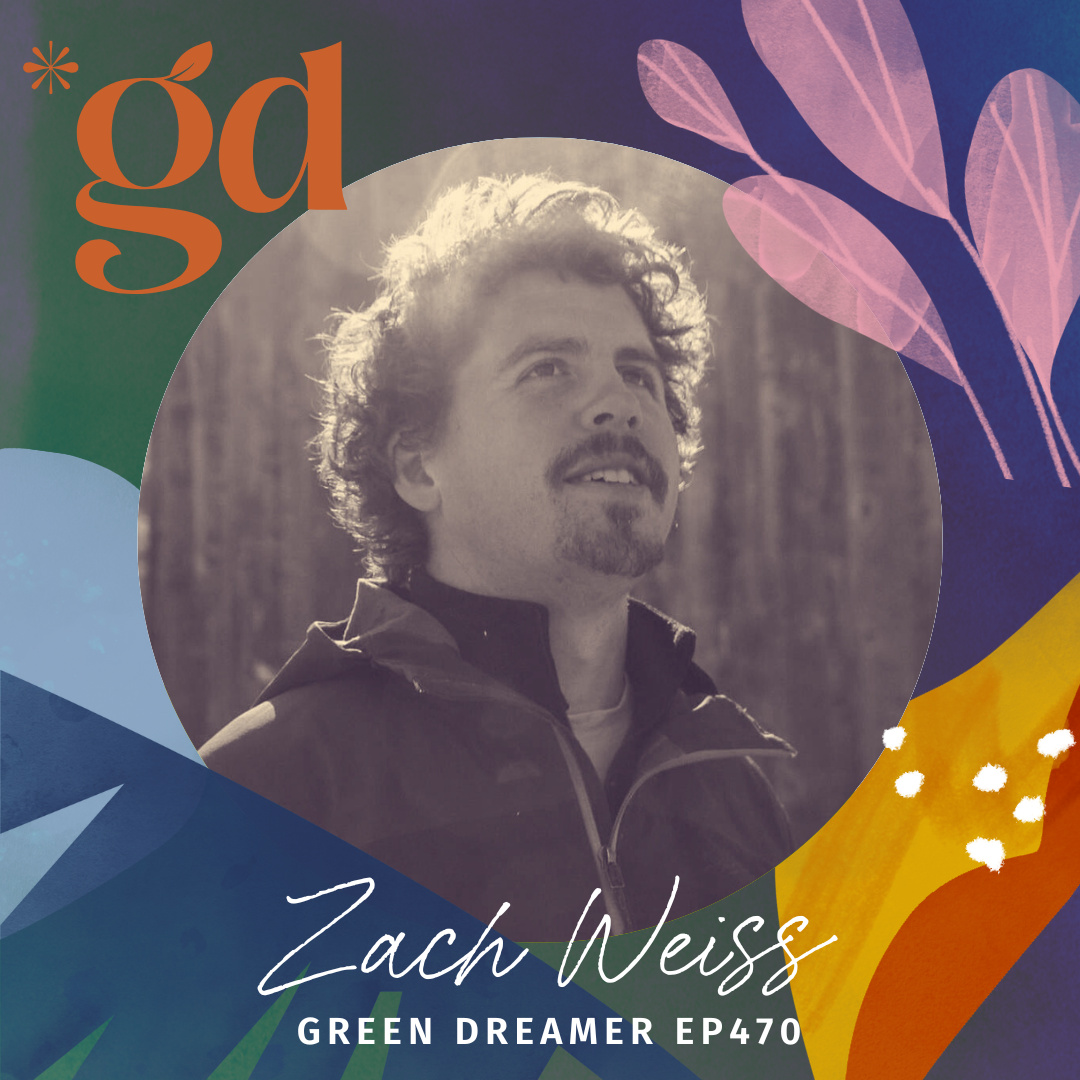
Zach Weiss: Restoring watersheds, revitalizing community (Ep470)

“Nothing works as one isolated issue. It’s all interconnected. In the water cycle, once you have more water on land, you have more life, you have more carbon sequestration, all of these things happen more naturally.”
What is the “watershed death spiral” that has led to the vicious cycle of more droughts and floods at the same time? How might learning about the water cycle expand our perspectives on climate change? And how can restoring watersheds support the sovereignty of land-based communities?
In this episode, Green Dreamer’s Kaméa Chayne speaks with Zach Weiss, who founded Water Stories to help empower as many people as possible to revive their local waters and lands.
Join us in this conversation as we explore the humility of working with ecosystems that resist formulas and master plans, how people can support the revitalization of their own local water cycles, and more.
We invite you to…
tune in and subscribe to Green Dreamer via any podcast app;
tap into our bonus extended and video version of this conversation on Patreon here;
and read highlights from these conversations via Kaméa’s newsletter here.
About our guest:
Protégé of revolutionary Austrian farmer Sepp Holzer, Zach Weiss is the first person to earn Holzer Practitioner certification directly from Sepp — through a rigorous two-year apprenticeship working on projects in North America and Europe.
Blending a unique combination of systems thinking, empathy and awareness, Zach created Elemental Ecosystems to provide an action-oriented process to improve clients' relationship with their landscape.
Artistic credits:
Episode artwork: Ekaterina Selezneva
Song feature: “Honor the Water” by Ayla Schafer
Dive deeper:
Check out the Water Stories project, trainings, and upcoming courses
Learn more about Zach’s Elemental Ecosystems and check out their featured projects from around the world
Learn more about Sepp Holzer and Holzer Permaculture
Read more about decentralized water retention
Read the Dao De Jing
Expand your lenses:
Independent media is more important than ever! Please consider joining our Patreon or making a one-time donation today.

interview transcript
Disclaimer: Please note that Green Dreamer’s interviews are minimally edited (both audio and non-verbatim transcript) for clarity and brevity only. All statements should be understood as commentary based on publicly available information, and the views expressed in this interview are those of the guest and host only and do not necessarily reflect the views of Green Dreamer.
While we have made reasonable effort in our interview research and production process to ensure accuracy, we do not present our commentary as factual assertion and we are unable to guarantee the completeness or correctness of every piece of information shared. As such, we invite you to view our publications as references and starting points to dive more deeply into each topic and thread explored. Thank you for adventuring with us.
Zach Weiss: You know water I think is the easiest thing in the world to take for granted it's ever present everywhere so it was never my first intention i just always loved nature wanted to do something beneficial for nature and for people on landscapes. And it was really only seeing the impact of when you work with water and I started to really focus on it.
And so that came from working with Sepp Holzer and he always says, when the water household is in accordance, 70% of the work is done. 70% of life is water. If the water household, so to speak, on a landscape is out of balance, everything else is going to be difficult. And if you get that water balance achieved or closer to it into a healthy balance, everything becomes really easy. 70% of the work is already done. You're going to have lush vegetation and now you can just craft the vegetation that you have. And so just loving nature led me to water, you could say.
Kaméa Chayne: Yeah. I'm not a permaculture expert by any means, but I have interviewed people who are and personally worked with people with a lot of like land-based knowledge and Indigenous agricultural or land knowledge. And I know that water is a big part of what people say to start with, is to start with observing and looking at water. So we're going to dive into a lot of this in our conversation.
Part of the reason that I was really interested in speaking with you is having this aha moment that totally made sense, but learning about how a big part of sea level rise actually doesn't come from glacial melt, but from the degradation of watersheds on land. And so I want to just preface this conversation by reading this part of a Grist article, which I'll link to in the show notes, but it reads, quote, "Total water storage losses on land, of which groundwater is the largest component, account for 44% of global mean sea level rise, compared to about 37% from Greenland, and roughly 19% from melting in Antarctica," end quote. So this means almost half of sea level rise can be attributed towards the loss of water that is being held or at least slowed down in the pores of the land.
So I want to just start here and invite you to share about this watershed death spiral. And I know the specifics look different in every context, but broadly speaking, how would you introduce people to this picture of how water has been lost from land, or more water is being lost than replenished on land?
Zach Weiss: Yeah, the most basic way to look at it is an analogy I always draw is it's like a bank account. You're always taking out from the bank account and never putting back in. We all know how that goes. And it gets, you get into debt, you get into all these really big challenges really quickly. Whereas if you're always putting a little bit more in, you always have a little extra for a time of scarcity, a time of need, there's always a healthy buffer. And we have these big issues, but we also have a lot of human quality of life issues that are happening. And the disturbance of the cycling of water through continents is the fundamental stress that's the root of all of these other issues happening all throughout.
And the way this manifests itself is what we call the watershed death spiral. Starts by humans clearing big swaths of land, draining and dredging wetlands. We've lost 87% of the world's wetlands have been deliberately drained and dredged. So we've removed the storage capacity of the landscape. We've hardened the landscape. We've heated the landscape through its exposure to the sun. All of these things make the land reject the rain when it does arrive. So that rain comes in, it falls, it runs quickly downstream, leading to a flood somewhere downstream, and then also leading to drought in that area because the water that used to soak into that landscape and slowly flow is just quickly running downstream.
In some places, the landscape then gets so dry that you start to have big, massive wildfires. And these are wild in the way that they're destructive, not in that they're a natural occurrence, because we've desertified the landscape, sent all the rainwater away, caused the drought, dried all the organic material into tinder for fire, then the landscape burns and you get these cycles of flood drought and fire that we're seeing increasingly everywhere around the world.
Now what's really disastrous is then as all that open exposed earth absorbs more temperature, absorbs more heat its ability to hold heat increases exponentially. And so it starts heating up more and more faster and faster making these high pressure heat domes that resist the incoming precipitation. So now you get longer periods of drought, the pressure in the system building, and bigger flooding events and hurricanes than ever before.
And this is what, it's really amazing, I'm fortunate to work all around the world. And no matter where you are on the planet, almost, if you have a disturbed ecosystem in your backyard, you are experiencing bigger rain events than normal with longer dry times in between with all the issues that result from both of those things.
Kaméa Chayne: Yeah. Wow. Well, something that I've felt really critical about is how mainstream climate discourses disproportionately fixate on carbon and looking at the Earth as if it were this machine through this equation of inputs and outputs, sequestration versus emissions. And that is definitely part of the picture, but I think a lot gets lost there. And water, of course, is a huge part of that, along with all the life and biology that is in conversation with that water.
So I'm curious how you'd invite people to think about climate change more expansively through this lens of understanding the water cycle and watersheds.
Zach Weiss: A question I like to start here is, do you know how much of the global heat dynamics are regulated by carbon, the whole carbon cycle? Do you have an idea, Kaméa?
Kaméa Chayne: Probably not as much as water.
Zach Weiss: Somewhere between four and 25 percent. How much is regulated by water is 75 to 95 percent so when we look at how the Earth manages temperature it regulates that through water through water-driven processes in all of these different ways. And as we disturb that cycling of water, heat variation is the natural consequence.
Actually, when they started looking at climate change, there were very much two legs of climate change, the carbon cycle and the water cycle. The water cycle is very complicated, very hard to model. And that one never really went anywhere because we don't understand enough about water to actually be able to model that situation. So the carbon narrative really took off, but I feel that we've hitched our cart to the wrong horse in the modern environmental movement, in that if we do everything for carbon as much as possible, we won't even know if it's working for 25 to 50 years because of the buffering capacity of the ocean.
Whereas on the alternate leg, if you do something for water, you see the results the first time it rains. And then the next year you see the results and the neighborhood sees the results. And it enables this feedback loop that makes sense on a human life cycle where your actions are benefiting you and your community and your children and your neighbors. And it starts this big flywheel that results in these big restoration projects we see in some areas of the world because the results are so clear and on a timeline that humans really understand and benefit from.
Kaméa Chayne: And this isn't an either/or also, right? Because the carbon cycle and water cycle also are deeply entangled. So maybe it's more so that if we can really work with water first, everything in the carbon cycle then follows as well in terms of bringing life back to particular degraded ecosystems and so on. So yeah, I'd be curious for you to speak more to that.
Zach Weiss: Absolutely. And this, I think, speaks to the fundamental misstep of, call it living system sciences, in this trend towards reductionism, where we want to say, okay, CO2 is the one issue. We're screwing the planet over in a million ways, but CO2 is the one issue that matters, because then we can just develop some miracle cure for that one issue. But nothing works as one isolated issue. It's all interconnected. As you say, in the water cycle, once you have more water on land, you have more life, you have more carbon sequestration, all of these things happen more naturally.
And so I think in many ways, modern science is learning more and more about less and less until we know absolutely everything about nothing at all. And we're just so narrowed and siloed on each thing. Whether there's marsupials in Australia in healthy populations, affects the fires in those areas. You never think these little tiny marsupials that digest the eucalyptus leaves are having such a big impact on fires, but everyone having house cats have decimated these little marsupials and made the fire situation way worse.
Anytime you see anyone pull out one single element and say, this is the thing we need to work on, that's wrong. That's the wrong approach. You could argue that we do that with water, but that's really just as an opening door, if you look at the stories we share, the trainings we do, it's all around connecting and understanding with the whole web of life and seeing it in this whole system. And when you start with water, it creates these ripple effects all the way through the system, which is why we call it Water Stories, but it could be nurturing nature or nature stories or any of these other things. Water is just a really good entry door into this world of whole systems.
Kaméa Chayne: Yeah, it's just kind of that lens to start with. A lot of our past conversations recently have focused on the history of how things became the ways that they are, the roots of certain injustices and colonial impacts that are also tied to the destruction of place-based native ecosystems because they all kind of are entangled and go hand in hand. And I think a lot of these conversations have been with people who come from more scholarly and academic research backgrounds.
But I've personally felt called to speak more to people like you who are practitioners whose knowledge and research are more so field informed. So like yes I think it super important to connect the dots to see the systemic critiques, and also with my sort of all of the above mentality, I think we do need to keep cross pollinating between fields and perspectives.
We're not going to go too much into the social histories in this particular conversation. But I still would like to leave some space here for you to share like your learnings in terms of the relationship between the watershed death spiral and colonial industrial histories and like mindsets that treat the land in ways that are more so about like imposition rather than being in conversation with. So what do you feel is important to highlight here in regards to like these different worldviews and ways of relating to the Earth?
Zach Weiss: I think the big highlight I would have is that over the last 10,000 years, we've desertified one third of the earth's surface and we've degraded two thirds of the Earth's land surface. And you can track colonialism around the world through that desertification process happening in the Middle East, spreading to Africa, spreading to Asia, spreading to the Americas. I mean, you can follow it through the history books of this attitude of extracting wealth and resource for land for the betterment of someone else, which is the craziest part to me that the people on the ground extracting these lands, they barely benefit from their extraction. Someone else in bank accounting firms somewhere really benefits from that transaction.
And it's seeing everything as having energy to exploit, whereas the Indigenous worldview that stewarded 85% of the world's remaining biodiversity sees everything as having place and spirit and a role within the whole. And I think big picture when we look at our mentality and our relationship with the landscape, that's the kind of shift that we really need to create.
Kaméa Chayne: Yeah. And I think that's a big problem or barrier as well as like oftentimes the people who hold the most quote unquote power in this system are the people who are the most out of touch from what is actually happening. So people who own Big Ag corporations aren't the people doing the farming. They're not the often undocumented farm workers that can't speak up when they're working with these toxic chemicals and seeing the impacts of that. They can't organize and say like, hey, we don't want to be working with these toxic chemicals. They're hurting me. They're hurting the land. So there's just a lot of these layers of disconnect going on in terms of who's making the decisions on what's happening versus what is actually the feedback coming back from the land that is trying to express themselves to us, but are we listening?
Zach Weiss: And when you look at water with that in mind, there's this real devilish thing that in a water abundant world, water is worthless. In a water scarce world, nothing is as valuable as water. So the people that have no connection to the landscapes that are managing the water resources in a big sense that own those water resources are economically incentivized to make them scarce because that's the environment where they'll make money.
And unless if they're really in tune with the people in that landscape and thinking about the greater whole, they're going to every time decide to impoverish the landscape, the water household, the people in the communities living there because they will make much more money with that outcome. And if they're making the decision based on a spreadsheet rather than the people in the land, that's how things have tended to gone at least over the last couple hundred, couple thousand years.
Kaméa Chayne: Yeah, I'm sure once you learn enough about what's been happening in different pockets of the world, like there are certain patterns that you're able to find in terms of, you know, why so many communities are dealing with these similar issues of manufactured scarcity today.
And this word keeps coming up that I'm hearing you say water household. I'm curious to hear you expand a bit more on that term. And also, I know that something you emphasize is our need to revitalize land through creating more water catchments. And I don't think you mean this in the specific way, installing more water catchment tanks, per se, but more so as in like increasing the holding capacity or the slowing down of water while it's traversing on land. So yeah, I would invite you to elaborate on these concepts as well.
Zach Weiss: The easiest way to describe it is community-driven decentralized water retention. And what this means is, how do we restructure the water household, the environment for that water, our watersheds into water catchments? Some countries call them water catchments. Some countries call them water sheds. The idea is in these basins, these areas that lead water to certain points, are we draining those basins or are we actually recharging and rehydrating those basins?
We've done so much drainage over the past hundreds to thousands of years, depending on where you are, that it's time for us to do a lot of retention. And an easy way to think about this is where water's running, help it walk, where it's walking, help it crawl, and where it's crawling, help it go into the ground. The idea is how do we increase recharge and decrease discharge to build up that water bank so that we all have a healthy supply?
Kaméa Chayne: I know that ponds are a big part of this work, depending on the context as well. But I was watching this video about the creation of ponds and different uses and etc. And I think in some particular uses, like when people really have to have it hold water for fighting wildfires and things like that, or like recreational ponds, maybe people need to turn to things like pond liners to put up this impermeable barrier to guarantee that it will hold water.
So I think there are maybe particular use cases for that. But I think a lot of what you're speaking to in terms of holding water or creating ponds is also to allow it to more slowly recharge the water table. So I'm curious to hear you speak more to these nuances as well in terms of creating ponds and getting a land base to, instead of having water just run off when there's a heavy rain, for it to be held in some sort of basins that are meant to slow down the flow with the intention of it actually being able to sink and seep into the soil just much more slowly.
Zach Weiss: Exactly, exactly. When you build a pond with a pond liner, it's basically just a tank. It's creating no recharge for that landscape. It's really hard to keep the water quality decent. It's a very artificial construct. And we're not trying to hold water separate from the Earth. We're trying to return water to the Earth.
What we're doing, we're working with all of the natural resources that we have, with the Earth, with the rock. We're not using any plastic. We're not using any concrete. We're oftentimes using big diesel equipment, the tools that we have available to us today. But these can also be done by hand by people in community just as easily. If you have 50 people working in a shared direction, you can get a lot of earth moving done as well.
And so we're restructuring or shifting around. It's also kind of earth sculpture, creating landscapes that receive, hold, and recharge. And many times these can be perennial bodies of water that are nice swimming areas that accomplish all of these things. The liner really comes in if you are trying to force a pond onto a place that's not suitable for a pond, that's when people need liners. And most people don't have the skills to understand the different types of material and how to work with them and how to assess those points in a landscape. So for the fear of failure, they'll put in a liner. But really, when we talk about these decentralized retention landscapes, in some sense, the more water that goes into the ground, the better.
When you look at these projects like in India, they're trying to find the permeable areas where the water goes quickly into the ground so that they have that water stored up in the aquifer for the dry season, the very long, hot, dry season. And this is how they've revived the flow of nine rivers and a quarter of a million wells and raised the water table five meters because they're putting so much water into the ground.
So depending on the goals, depending on the landscape, depending on the situation, we are creating different types of water retention. Some might hold water throughout the year, some might be more ephemeral, and that's all part of the process of recharging the landscape. The tricky thing here is in landscapes that are so starved for water, you can't create a natural water body that holds the water year round. It's even more important to do that in that area because that land is so starved of water. It needs every drop it can get. Now it doesn't make a pretty year round pond, so a lot of times people aren't as inclined to do it, but it's actually even more important in those areas because that landscape's are dry.
Kaméa Chayne: Yeah, it sounds like there's a lot of considerations and things to learn that are very place-based and dependent on the context as well. We talked earlier about this fixation on carbon being reductive. And I think something else that has felt kind of reductive to me is dominant conversations around water use. Because I think while that is an important consideration, and a lot of us can be a lot more mindful in like our water consumption, I think it also misses out on a lot.
And there are all these like ecological impact assessments about how different crops use different amounts of water, and therefore we should grow more crops that need less water. But it again, treats the Earth like this equation of input and output rather than this complex system of life.
So yeah, I just think the mainstream concept of water use also misses out on a lot because I think it's like the water household that you're talking about. Like, if our water infrastructures and systems are set up in ways that don't allow our used water to be reintegrated into the ecosystem and instead it goes straight into pipes and these water treatment plants that are essentially highways of runoff or water to go right back into the ocean, then first of all that's super energy intensive as a system to maintain, and second of all instead of allowing the water to work its life magic across the terrain, this type of configuration just accelerates that water loss and runoff. And obviously pollution is another big conversation to be had. But I wonder if you can speak more to this idea that it's not necessarily water use itself that is the problem to focus on, but maybe more so like the how that needs more of our care and listening towards.
Zach Weiss: Exactly, exactly it is the how. And you worded that perfectly that water as it's moving through the landscape it makes all this magical life stuff happen, and if it can slowly move through the landscape and keep making that stuff happen that's the system that regulates the climate, that is the system that makes areas cool and livable and nice and comfortable. And so when we think of water use as loss, to me, this is just totally insane because this is actually the water that's going through that tree that's transpiring, is absorbing heat energy at the surface of the Earth, it's bringing up into the atmosphere, and if it condenses, it's releasing that heat back out into space. And it's moving a huge amount. This is actually one of the main thermodynamic regulators of our planet.
And so when we look at water use through a living ecosystem, that's a positive thing for the regulation of our climate. If we take water and superhighway it downstream, and then superhighway it downstream further, none of that magical life process can happen in those areas in between. You end up with them heating up, desertifying, aridifying, all of these different problems. And so really, we need to look at it as a full picture.
If you imagine of the rainfall we receive in any given place changes a bit from place to place, but about half of that water is transpired or evaporated locally. So if you imagine a big orchard in the West Coast using water, they're helping create rain further inland in the West Coast in that process. So it really bothers me when, like you're saying, people reduce it down to water use and they say, oh, these big agriculture endeavors are using all this water. And that's true, but their water is going back into the system and being cycled. Whereas the city's water use is usually being mainline downstream, mainline downstream further, polluted in the process, and that naturally desertifies the whole area in between there.
Kaméa Chayne: And there a lot more nuance here too as in there a difference between maybe like more agroforestry based systems where they really paying attention to like making the entire agroforestry system spongier so that whatever water they use to irrigate the trees, they stay there more. And so they have to irrigate less compared to farms like monocrop farms from big agricultural systems that will still treat the land like a machine. And yeah so whatever water they used to irrigate does just disappear more quickly and they have to irrigate more often because their system wasn't set up in a way to honor and yeah respect the water.
Zach Weiss: Exactly, exactly. And so it's really all of these things the details matter so much more than just the one sentence about what's going on. This is where humans can make some really catastrophic missteps, focusing in on these minute details that aren't that relevant in the picture of the whole.
Kaméa Chayne: I've been in a rural agricultural and ranching community the last few years that has been experiencing probably the worst drought that it's had in decades or even ever, according to elders who were born and raised here. And I think what has been kind of frustrating to me is when people just passively blame the bigger climate change for the lack of water and rain without also holding up a mirror and asking like, what are we doing for the water?
Because there are many people who aren't actively producing food as farmers or ranchers, but are just maintaining these giant acres of lawn because that's the sort of aesthetic that a lot of people have been told is desirable. And this also is taking place in a region that historically was blanketed in cloud forests and went to mesic forests.
So I think it's kind of a both/and and not seeing this as a sort of blame for people who have inherited these micro climactic changes that probably were set into motion decades ago from, again, colonial extraction, clear cutting native forests into plantations and grasslands that contributed to this watershed death spiral. But I think it's more so like a call to action that like there are things that we can do that from the micro to the macro there are ways that we can take the matters into our own hands, to an extent at least, to support the restoration of our local watersheds.
So I'm reminded by lakota Elder Tiokasin Ghosthorse who said recently in our conversation it's not about how life's treating us it's also about how we're treating life and therefore also the Earth and water as well so i thought that was a beautiful invitation. So yeah, I guess I don't really have a question here, but I'm wondering what else this all stirs up for you.
Zach Weiss: You know, you think we're in an abusive relationship with Mother Nature right now. And what happens as a result of an abusive relationship, oftentimes you get abused back in different ways. And nothing in nature is intended to hurt humans.
And I think this is one of the big things where when you accept the narrative that, okay, this is all carbon and climate change, you're giving away all of your agency to do anything about it. And irregardless of what happens with global temperature, these things, I don't know that we can solve those things, I know the local droughts that we're experiencing, we can 100% solve those things. We have huge agency to be able to solve those things. And we have this ecological amnesia where we think the past five years, the average of that is just the way it's always been.
And this is where it's really important to connect with your Elders. Talk to them about the landscape, what it used to be like, how things used to be throughout the dry season, what the flow and the waterways used to be like, and you will learn so much about the potential of that landscape. And that's not lost to climate change, that's lost to land abuse. And when we give a helping hand back to the Earth, we can really quickly help heal that previous abuse. And when we take that first step, nature takes the next hundred. So if we just start the process going in the right direction, it just gets easier and easier for us.
And that's where I think we have tremendous agency. I don't know about solving all of the world's problems, but if you're suffering from drought, flood, fire, water scarcity, extreme temperatures, I know we can totally regionally affect those things through this kind of land healing.
Kaméa Chayne: Yeah. So again, it's kind of the all of the above, as in the microclimactic changes that we are able to influence at our regional levels that will also ripple upwards towards affecting the larger climate change as well. And all of the above also as in like this doesn't absolve us from addressing over extraction and over consumption and all those sorts of things and just energy systems across the board becoming super like more energy intensive, like the shipping back and forth of the same foods across the globe. There's a lot of systemic factors still to critique. And of course, injustices of food access and land access wrapped into this bigger picture as well. But yeah, there are many ways in which we can take matters into our own hands and start to take action.
So we do have a global audience of people who live in all sorts of places from metropolitan cities to suburbs, small towns to more rural and subsistence living land-based communities. So I want to do our best to provide some inspiration and possible courses of action for people across different contexts. And I know we can't cover everything, but we'll do our best.
But to start here, I think it'd be helpful to go through all these different elements also of a watershed, because it's not just the macro things like lakes or rivers or large forests. It's also plants and microbes as well and small gardens or community gardens. So I think we often hear the saying that water is life. And I'm like, therefore, life is also water in many ways. And so that does implicate us no matter where we are. So yeah, I would just be curious to have you take us through the different elements and scales of things from the microbial to the more geologic like shapes of the Earth that influence and yeah, participate in the water cycle.
Zach Weiss: Nice. Well, so for one, water is this mythical substance that we still don't really understand. There's 72 anomalies of water, things that we can clearly observe about how water behaves that we have no physiological understanding for. So water is in many ways still this kind of black box. And when we look at water as life, life is 70% water by volume. But molecularly, life is 99 out of 100 molecules water. And so we, all life, is water living in many ways. And because of this, some people call it the exclusion zone, some people call it the fourth phase of water, because of these physical properties of water, as it relates to hydrophilic surfaces, something as simple as bacteria and fungi in the soil do an incredible job of holding on to water long term in that landscape.
So when we look at the very top of the watershed or the water household, how does the raindrop meet the soil? Is it meeting a hot, hardened soil that rejects the rain or a cool, moist, open soil that accepts it? And then what is it meeting in that soil? Is it meeting this rich soil full of life with all of these organisms and tunnels and it can easily move throughout with roots moving water down and up? Three to five meters deep in the earth is what a healthy water household looks like. And then that rain's falling, it's moving into the Earth, it's slowly moving through, and it's creating the headwaters for springs and rivers and aquifers downstream. And so it's moving through that system.
When we look at the dry season flow of a river, for example, about 50% of that flow is groundwater, is rain that had previously entered into the Earth and was coming back out. And when you look at, they've done studies in mountainous areas, a snowflake will spend five to 10 years moving through the Earth in a mountain before it actually comes out in that river. So when you have a drought, it might be five or 10 years later that the river expresses that loss of snowfall in the winter. And so as we're moving through, we can address the raindrop where it falls, where raindrops collect and gather, we can try and hold those into the landscape and recharge that. And then we just, as we move down the watershed, we're going to do different things based on where we are.
In some ways, you imagine basically all of our rivers, the water's just been pushed into the river. There's all these levees, there's all these retaining walls, there's no connection for water to meet its floodplains anymore. So in those kind of areas, the more we can return water to its floodplains, the more we can help balance out these different things.
So on a very small scale, just increasing the level of life in your soil, that does a huge amount of water retention. And then as you move down, you can start to, in key points, aquapuncture points, You can intervene to have a really outsized impact for your intervention in that one key area. And then you can really start to address a whole water household in this kind of way.
Kaméa Chayne: Yeah, I think the impact that life and the microbiology of the soil and plants, I think that's a portion that a lot of people gloss over is thinking of water as this sort of like passive thing that we just collect and use and it goes away and stuff. But I think to remember that life and microbes play a big role in like how that gets cycled is really important.
And I think it was my conversation with Ferris Jabr who talked about how the Amazon rainforest, a big part of what continues to bring that water and the rain cycle back is actually the microbes that are within the rainforest that are actively participating in like drawing back that moisture.
So yeah, I think with all of these different levels and scales in mind, what are the different things that people can experiment with and participate in in the restoration of their local watersheds and supporting greater water storage where they are? Whether they might live in big cities, so the action maybe looks more like advocacy or participating in community gardens, to people with front or backyard, so like very small pockets of space to work with, to people who steward like farms or are doing agroforestry at larger scales and can maneuver like the Earth shaping that you talked about earlier.
Zach Weiss: Yeah. And just to not gloss over a really good point that you just had that, you know, when we look at even something like rainfall in the Amazon, 50 to 80% of the rainfall is driven by hygroscopic microorganisms that are in the atmosphere, condensing that water vapor into droplets. And the really interesting thing is they work at much warmer temperatures. So there are inorganic cloud seeding nuclei like salts and things like that. And then there are these microorganisms. The inorganic work only at the extremes. So once the water cools all the way off, it can finally start to condense. These microorganisms work at much warmer temperatures. So they're actually super important in any warmer biome anywhere closer down to the coast.
And so you just start to see all these different ways that everything's connected. But as far as what we do about it, the easiest, simplest thing for everyone that I always recommend, go outside in the rainstorm, get a good jacket, get warm, whatever you need and see is your landscape receiving or rejecting rain and where it's being rejected. Is there anything you could do to address that? And where it's being rejected to, is there any way you could offset that?
So let's say you're in a suburban lot. This might look like a simple rain garden where all the water coming off of the roof of your home and your driveway can, instead of just being sent downstream and away, can meet that landscape and be received in a small basin that collects and then infiltrates that water. As we start to move up in scale, we can really start to find key points where we can move a very small amount of earth for a big amount of water storage and recharge within that landscape.
So if you imagine trying to fix our dams and reservoirs that are failing right now, what they've done is created big centralized dams and dehydrated the catchment to try and fill it. And so in many places it fills and it overflows and then it goes dry because the whole water household has been destroyed So if instead we created these decentralized water bodies all throughout that landscape now water still moving through and refilling that reservoir in the dry time for a number of months. And you start coming down much later into the dry season.
So for a farmer, this might look like different water bodies, check dams, terracing, things to move the water back and forth and help it meet and be received by the land. In a more suburban context, these might be really small features. In a more urban context, this might be, like you said, advocacy is a big one. And then also even just rooftop gardens, composting your waste, create more life and more living soil with your actions in any way possible, that's a real good, easy thing.
And then the other piece is cities are where all of our governance are. And so if you live in a city, you have an unfair advantage in your access to governance. And we need to start being the voice for the voiceless all around us, the people, the organisms, the landscape. And so show up to your town hall and ask what this is going to do to the water holding capacity of the landscape. What's going to happen when it floods in this area that you're trying to develop that used to be a floodplain? Really going and being present and speaking up for the things to help improve them in that more urban context.
Kaméa Chayne: Thank you for offering these wide range of steps that people can participate in. I know you've personally supported and taken part in a lot of watershed restoration projects. And I'd love to invite you to also share some of the most inspiring water stories that you've been a part of that offer a glimpse into what's possible for us. So what have you already seen in terms of this revitalization that can happen in a timescale of seasons or years that you've been able to witness already?
Zach Weiss: Yeah, I mean, there's so many, but one that just always brings home how quick the results can be achieved. One project we did in Oregon, we had two springs, one in the area where we're working, one in an area where we didn't really do much work. They had the same flow rate when we tapped them. Now the one is 10 to 13 times the flow in the dry season. So the one in the dry season where we didn't work is barely a little trickle. The other is like a big pipe full of water all year round. And that's in two years that that was accomplished, just by holding water in the land, charging up those water sources. So it's a 10 times increase in water flow in two years.
And then just seeing these bigger projects where communities that were out of water now have water abundance that at the end of a long five-year drought still have shallow aquifer water when they used to be on deep borehole water. And you see some of these other projects, I mean, places where wildfires have burned around for two months and didn't come into the property at all because of their decentralized water retention and agroforestry.
And then the stuff that students are doing where our students are already creating new springs on landscapes and creating all of these really beautiful projects that end up providing hope and inspiration to the whole region. Because the wonderful thing about this is the seeing is the believing. It's one thing to talk about all these things, but when you can go to a land that used to be dry, that now is full of life, and there's all these birds everywhere and wildlife everywhere, it's just so apparent. And so it's something that really spreads. The neighbors see it and they want to do it. Their friends see it and they want to do it. And it starts to make these regional movements of restoration.
Kaméa Chayne: Yeah. And I really want to honor that these conversations and this type of work is really important for also addressing systemic injustice because it is often the most impoverished communities who are having to face the brunt of the manufactured scarcity of water. And so being able to have a more rural community who is experiencing manufactured drought and that is dealing with histories of colonization and impoverishment and so forth, it's even more important to think about ways that we can honor water to support these communities that are facing the brunt of feeling the impacts of these things as well.
Zach Weiss: And this is where I think the water is so powerful because it's something that every earthling with a bit of earth can do something about. And so yeah, we can come in and do big transformations really quickly with big equipment. But if we're in an area that all they have is the humans there, you can also accomplish really incredible things. And you see the results so quickly that again, it spreads.
And so like we're involved in one project in Mozambique. These people are in one of, I think it's the poorest country in the world. They're in this region that no one ever goes to. That's this semi-lawless region. They have a tough, tough existence. And we did a five-day training with them. We built one water body all by hand. And the next day, people were using the water body to water their garden, to do their laundry. I mean, it immediately gave water to it. And so then when we left, they built 26 more water bodies all throughout the village. And so these are people with, you know, you can't imagine how little they have, and yet they have all of the agency to change their own landscape, their own community, their own quality of life. And they can see the results so quickly when they do that, starting with water.
Kaméa Chayne: Yeah. And that sounds really pivotal for supporting the sovereignty of communities as well for land-based communities. We are starting to wind down our main conversation here. And I want to note that I think sometimes our senses of urgency to try to like fix or tend to different crises can replicate or worsen the issue if we jump to solutions without taking the time to really listen and observe first. Or maybe if we charge forward with some elaborate plan without being then able to adapt or to be flexible to change so that we can respond to the nuances of how every pocket of the earth is different.
So as you've already gained so much field experience, how much of it to you feels formulaic at this point across different terrains and climates versus how humbling does this journey continue to be for you in terms of requiring you and other people to still be fluid in being responsive to change?
Zach Weiss: The only recipe I've found is a recipe for disaster. And I think as soon as you start trying to have any formula, you have just totally lost any connection with that landscape and actually trying to serve that landscape. And so it's one of the things that to me, it's the single most critical piece of what kind of outcomes land restoration projects achieve. Did they spend the time to let the landscape lead the process, to read and understand that landscape for what it is and to help it reach its potential, keeping in mind the goals of the humans and how to meet those as well. And anytime I see a project that hasn't gone at it with that approach, at best, it's marginally worthwhile, and at worst, it's wildly a waste of time and money and effort.
And so I think there really is no formula, no recipe. You have to come into connection and relationship with your landscape to understand what it can be and how to help it get there. And it's this intuitive manifestation of observation action reaction and observation and interacting with the land learning from it letting it be your guide. People always ask like is there some technology to understand what you can do where on a landscape? And I say, yeah, there's a brilliant technology perfectly adapted to this, it's called the human body. And we are finally tuned with all of our senses to understand this stuff in a deep and meaningful way. It used to be for survival, but we can tap into it. We all have that ability. And to me, that is the number one most important piece. As soon as you start trying to apply a recipe or a formula, it's probably going to be a disaster. It might just be a waste of time and money.
And I also tell people, if what we implement looks exactly like the plan, even after spending a week on someone's place, walking every square meter of it, I tell them if what we implement looks exactly like the plan, we have screwed up because we should be adapting as we're going through this. I hate the idea of a master site plan because just how audacious to think you're going to know what nature is going to do over 10 years. The humbling is the perfect word for it because nature and the land, it'll all keep you honest to this greater whole. And you got to just observe that as peacefully and as truthfully as you can and work with that. As soon as you start letting the monkey mind and the ego lead the process, you're bound for disaster.
Kaméa Chayne: Yeah. So there's both humility and permission for us to make small mistakes as well, right? Because we have to kind of experiment to know what is working or not working. So I think maybe also having compassion for ourselves for not knowing what to do from the start, but honoring that the process requires us to experiment and approach it with an open mind.
Zach Weiss: Exactly. We have this fear of failure and fear is the worst companion in life. And so we let it cripple us into becoming these theory cripples stuck in analysis paralysis where we never do anything because we feel like we don't know enough about it to do it. And you're never going to know enough about it until you do it. And do it and you make the mistakes and have the failures and learn from those.
And so absolutely, we're so scared of failure that we don't progress. And the failures and the mistakes are what we learn from. So we actually want to create as many of those as often as possible, as early on as possible, on small scales where they're navigable. Then you get all those mistakes out of the way, you start thinking, oh, I know how to do these kinds of things. And so we'll always tell people, build a model first. You can model things on the land, create a model of what you want to create, simulate a flood, and watch the failure unravel, and water will teach you exactly what you need to do and how you need to do it.
//musical intermission//
Kaméa Chayne: What has been one of the most impactful books you've read lately or publications you follow?
Zach Weiss: The Dao De Jing. When you look at mastery of a subject in the Daoist master i see Sepp Holzer and Reginger reflected so well in that book that was written thousands of years ago it's really remarkable.
Kaméa Chayne: What is a motto mantra or practice you engage with to stay grounded?
Zach Weiss: Practice reading the landscape sit spots in nature. Motto, knowing is not enough we must apply. Willing is not enough we must do.
Kaméa Chayne: And what is one of your greatest sources of inspiration at the moment?
Zach Weiss: At the moment, the Water Stories students in our core course are so inspiring, so amazing. They're like the best people in the world and it makes it all so worthwhile and fulfilling.
Kaméa Chayne: Well, Zach, thank you so much. It's been an honor to share this time and conversation with you. Definitely a lot more that I'll be thinking on and learning after this discussion. As we close off here, where can people go to support your work? Any upcoming projects that you want to share about? And what closing words of wisdom do you have for us as Green Dreamers?
Zach Weiss: waterstories.com is the place to find all sorts of films, webinars, a whole community of people from all around the world. That's waterstories.com. You can learn a lot there. We have a live core course training every year, a self-paced one you can do whenever you like, and a live training between April and September each year. So that's a great way if you're at home and you want to learn how to do these things professionally for your own land or as an advocate, this course is designed exactly for you.
And words of wisdom is just that the book of nature is always open to all of us and you can learn so much by just letting your mind go quiet like a still body of water you can see the reflection clearly and you will be amazed what you learn through this process of a sit spot.