
Vanessa Machado de Oliveira: Sensing into collapse and what it is asking of us (Ep469)
“From 2021 to 2024, many people would be asking me, what evidence do you have that modernity is in decline? From January 2025, nobody asks me again this question specifically, because it’s so in your face now.”
How do we sit with our fears and discomforts around collapse? What might we miss when we demand quick fixes, takeaways, and summaries — without allowing our bodies to ferment and feel through the practices and experiences that could move us more deeply? And what does it mean to retune our literacy of the languages of the Earth?
In this episode, Green Dreamer’s Kaméa Chayne speaks with Vanessa Machado de Oliveira, whose latest book is Outgrowing Modernity: Navigating Complexity, Complicity, and Collapse with Accountability and Compassion.
Join us as we hold up a mirror to reflect on questions of complicity and collapse — while sensing into what these fractured times may be asking of us.
We invite you to…
tune in and subscribe to Green Dreamer via any podcast app;
tap into our bonus extended and video version of this conversation on Patreon here;
and read highlights from these conversations via Kaméa’s newsletter here.
About our guest:
Vanessa Machado de Oliveira Andreotti is the former Dean of the Faculty of Education at the University of Victoria. She is the author of Hospicing Modernity: Facing humanity's wrongs and the implications for social activism and Outgrowing Modernity: Navigating complexity, complicity and collapse (August 2025), and one of the founders of the Gesturing Towards Decolonial Futures Arts/Research Collective. Her latest work, Burnout From Humans: A Little Book About AI That is Not Really About AI, explores AI as a mirror and metaphor for human systems and invites readers to rethink relationality amidst planetary crises.
Artistic credits:
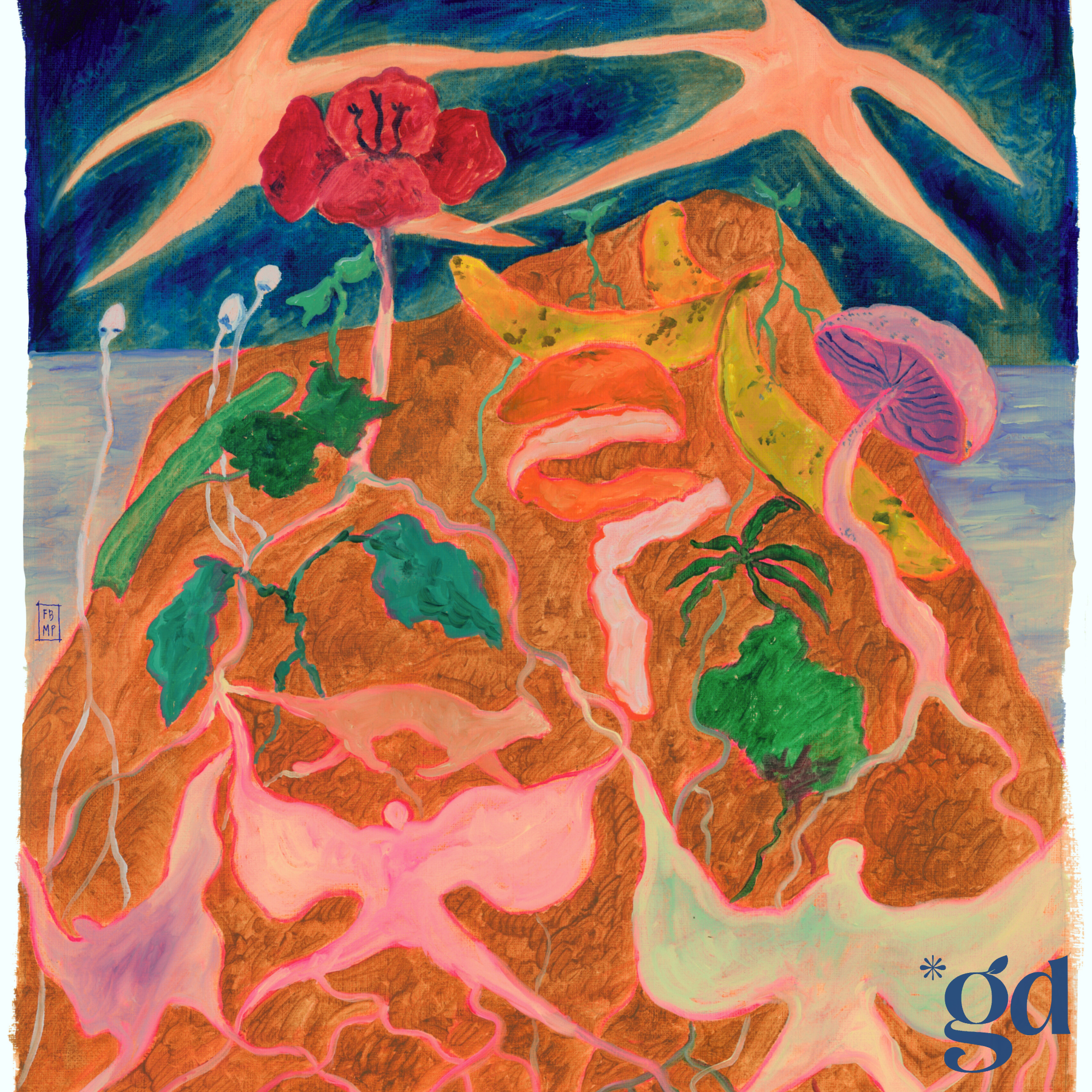
Episode artwork: Fernanda Peralta
Song feature: “Goodnight Moon Child” by Beautiful Chorus
Dive deeper:
Hospicing Modernity, a book by Vanessa Machado de Oliveira
Outgrowing Modernity, a book by Vanessa Machado de Oliveira
Check out the arts/research collective Gesturing Towards Decolonial Futures
The Spell of the Sensuous, a book by David Abram
Learn more about Māori philosopher Carl Mika
“A Speculative Inquiry Into Meta-Relational AI,” a report by Vanessa Machado de Oliveira and Aiden Cinnamon Tea
Expand your lenses:
Vanessa Andreotti: Allowing earth to dream through us (Ep338)
Tiokasin Ghosthorse: Learning from the Earth as an Elder (Ep460)
Farmer Rishi: How regenerative language can light the way towards planetary healing (Ep232)
Independent media is more important than ever! Please consider joining our Patreon or making a one-time donation today.

interview transcript
Disclaimer: Please note that Green Dreamer’s interviews are minimally edited (both audio and non-verbatim transcript) for clarity and brevity only. All statements should be understood as commentary based on publicly available information, and the views expressed in this interview are those of the guest and host only and do not necessarily reflect the views of Green Dreamer.
While we have made reasonable effort in our interview research and production process to ensure accuracy, we do not present our commentary as factual assertion and we are unable to guarantee the completeness or correctness of every piece of information shared. As such, we invite you to view our publications as references and starting points to dive more deeply into each topic and thread explored. Thank you for adventuring with us.
Kaméa Chayne: So we last spoke a couple years ago to explore Hospicing Modernity. And I'd love to begin here just by building on that and asking you, like, what remaining questions or curiosities or needs did you see after completing Hospicing Modernity that then led you to Outgrowing Modernity?
Vanessa Machado de Oliveira: This is an incredible question. Thank you. And it's so good to be back. Thank you for inviting me. This is an amazing question. What comes to mind now? I would love to stay with this question longer, actually, but what's coming to mind now is that from 2021, which was the year that the book was published, to December 2024, many people would be asking me in podcasts or interviews or keynotes, questions and answers. They would be asking, what evidence do you have that modernity is in decline? And I have to say, like, if you see the patterns, it's very long. It's long coming, right? But from January 2025, nobody asks me again this question specifically, because it's so in your face now. Things are not going to stay the way we've been told they were going to stay. So that is one of the things that I hold about this period between one book and the other, how quickly things changed.
The other thing that was interesting for me is that even people who are clued to the crisis, the multiplicity of crisis, and are describing the metacrisis, the polycrisis, the permacrisis, they're not talking about it as a consequence, right? So I've been saying now, instead of talking about the metacrisis, let's talk about a metaconsequence of really bad choices that have been going on for centuries now. And then instead of a polycrisis, let's talk about a polyculmination of tipping points as well. So seeing more people hold the space of destabilization has been very interesting. But it's also interesting to see that many people want to address it as a point in time rather than as part of a wave of things that are happening in a much longer timeline. So the new book tries to address that, but it was written also in 2024. And I think I submitted it in October 2024. So it gets a little bit of this wave crest for the U.S. It doesn't really get what we're living right now, right? So when a book is published, it's generally around a year since submission. So I feel that if I were to write it today I would I would write a very different book because of everything that's happening.
Kaméa Chayne: Yeah that's really interesting I also have friends who never really paid attention to what I was interviewing what I was writing about and etc, and within the last like this past year since January like more of them are like hey, like, subscribing to my newsletters or like actually tuning in to these conversations.
So it's really like you said, if we've been paying attention and looking at the bigger picture, we can already see that things are going to play out. And I think it's just become a lot more explicit and in people's faces today. And also across both Hospicing Modernity and Outgrowing Modernity, the metaphor and language around health and disease, you know, hospicing, providing palliative care to modernity or even giving prenatal care to what's emerging like what is the significance for using this language around care and hospicing, like hospicing something that is causing a lot of harm and destruction also so how does it invite us to frame or relate to the problem or people over there who are causing and driving the problem differently?
Vanessa Machado de Oliveira: Differently, yeah. It was deliberate, but it was also grounded in teachings and experiences that we had with Indigenous people in Brazil, some of our partners, long-term partners, are people talking about it like that for forever, basically. So I remember the first time that I got challenged on the Western conceptualization of justice, right? And the pushback, it was very gentle and very kind. And it was around this idea that the framing that there is individualism, there is collectivism, and then there is metabolism. And in metabolism, everything is entangled. And therefore, justice would mean healing, right? And when I heard it the first time, because we bring it back in translation to the context of the West, and it's already a very loaded term with different kinds of meanings that are probably not the meanings that were attributed in the context where I was challenged, I started using justice slash healing in the beginning until I guess it dawns that if we're going to address this differently from the machinery of separation, we have to have a gut feeling.
And we need to feel it really in the body, this form of entanglement. And once you do that, once you see yourself in a different temporality, in a larger temporality, in a larger context, and you undo the root problem, which is the separation, then you can see the different layers of being. And in these different layers of being, the foundational layer is one where by addressing the problem, you cannot be reproducing the same thing that caused it, right? So, and it's interesting also because in the West, when we say it's either separate or it's one, it's actually this dichotomy is a separating dichotomy. It's both, right?
We are a part of an entangled metabolism that is sick as the Huni Kuin people in the Amazon, the Tremembé people in the northeast of Brazil and other communities there, they insist on that factuality. They talk about it because they say it's not a concept. It's just the fact that the way we relate to the planet, to each other, to ourselves, is not conducive to health. The way we relate to mortality and life itself, there is a problem there. And in that problem, they see a dis-ease. So it doesn't allow the metabolic ease and the metabolic intelligence, which is relational intelligence of this metabolism to operate, to secure the continuity of life.
So if we start treating this organism, this metabolic organism as a machine made of parts, and some parts are more important than the others, and this machine is made to produce a specific form of progress or prosperity that is very much attached to the hierarchies themselves, this is a lethal disease right? Because the number one, the planet is finite and exponential economic growth. In a finite planet, it's just, it's not an equation that works. And what that creates in terms of the wellbeing of all the beings that are entangled in this metabolism, human and non-human is catastrophic, right?
So the Huni Kuin people also talk about this imposed sense of separation being an impairment, a neurophysiological impairment that prevents us from sensing the pain of the whole, from sensing the pain of the fields that we inhabit. And it prevents us from activating this sense of visceral responsibility to interrupt the shenanigans.
Kaméa Chayne: Yeah. First of all, I want to point out that in your book, you write dis-ease as in D-I-S dash ease. And so it sounds like that was very much intentional. And also, this reminds me a few years ago when I interviewed Farmer Rishi, he talks about how it's not so much a disconnection as it is more of a dissociation because we can't not be connected. It's more like the perception and ability to sense, as you just mentioned.
And when you talk about collapse, I find it really sobering when you raise these questions of like, what will we do differently or how will we live our lives differently if we knew that collapse was going to happen in five years or in five months and so forth? And so you share that generally there are four different ways that people respond. So what have these largely looked like when people are faced with this question?
Vanessa Machado de Oliveira: There's four general ways, but there are more I'm discovering, as you try to put this to the table. So when we're thinking about the continuity of what we've been promised, right, in terms of progress, prosperity, comfort, certainty, and then we see that there's disruption. Our nervous system is not prepared within modernity, right? We're not conditioned to, officially conditioned, basically, to hold the level of complexity that is already upon us. We are conditioned to simplify and to have narrow boundary, yes or no, fixed answers.
And this gets really intensified when we're faced with existential disruption or life course disruption, which is what we're facing in terms of seeing the rewriting of agreements, like the settlement agreement after the Second World War that held together the international world order. This agreement has been challenged and it's not holding, right? So what we see in places like Gaza and in other places too, it's not just an event. It is a sign that what was holding, what we understood to be human rights as protection of life, or even our sense of what humanity is, this is being challenged and changed. So that is one thing that's changing.
The other thing that's changing is the agreements that we have that are intergenerational, right? So we agreed to pay pensions as a sign of respect and gratitude for those who had made the world better for us in the sense of social mobility and progress and prosperity as defined by modernity. That promise is already broken for the younger generations, right? So there's the rewriting of that agreement. And with executive orders and other shenanigans, we may even see, and we are seeing, the rewriting of the rule of law, right?
So once you understand the context of agreements being broken, then there are different possibilities for you to face collapse. And one of them is deny it, like it's just dissociate, deny and just keep planning for what you were planning before. And it's interesting that in that response, sometimes one of the things that I'm challenged with is people saying it's irresponsible to talk about collapse because people are going to lose hope and then they're going to go into the other ways of responding. And my response has been, look, for us to be able to approach this responsibly and more maturely, we will need to feel everything we need to feel. Everything we've been dissociated from, we will need a space to do that so that when the time comes that is really at your door, and for many people it already is, you can coordinate better, right? You're not going to be panicking because you know it's a consequence of other things that are coming. And you can then approach collapse as a reckoning, as a threshold for a different way of existing.
But if you don't do that prep, then it's going to be really hard because then it comes even with the awareness that it is coming some people would say okay so if it's there I'm just gonna party. I'm gonna party hard just live my best life and accept that I'm not responsible for any consequence. So there's denial there is the party there's the bunkering, right, like when people want to protect whatever it is that they want to protect that they love and they go into strategy mode, like obsessive strategy mode, which might work for whatever they want. But also like the conditions of collapse are going to be very different from what we understand and expect.
So, for example, up to last year, whenever I talked about collapse, people would imagine things like lack of access to water or lack of access to energy or money or fuel or something. But they would never, like that I experienced in the circles where I brought this up, that a country like the United States would be driving, right? That the government would be the one driving it. This was not imaginable last year, I don't think. It is imaginable now, right?
So in the attempt to protect, and I had that drive too, and it was probably 10 years ago. And the idea that like, let's just buy a plot of land near a river and stay there. But then somebody from a large eco-village in India sat me down and said, Vanessa, if you have food and water, you're going to be raided, my friend. And I remember the day where that fantasy fell, I cried. And he was also saying, look, for this size of land, you would need to have at least eight people working full time to feed one family. Well, a large family, I would say. And then when I started doing the math, it was like, yeah, it doesn't work.
And I can understand the reflex, right, that it is possible. Because we don't know where we're standing. Like, what are the agreements that we're standing, including the agreement of private property, right, that you would be protected? So I talked about denial, I talked about bunkering, I talked about partying. Dissociating goes with denying too, dissociating from the problem, apart from the dissociation that we already live in terms of our entanglement.
Kaméa Chayne: Is there a sort of ideal kind of response that is maybe more mature or like what the ways that the world needs us to show up as, or?
Vanessa Machado de Oliveira: So one of the things i've been thinking about is that i've been working in education for 30 years trying to move people from the ontology or the mind, heart, gut space of separation to a heart, mind, gut space and understanding these are all constructs of entanglement. And what I've noticed in this is that it's really hard for humans to do it, also because there's no incentive. There's zero incentive for you to do that. Now we have the incentive, right? This could be the greatest incentive of all.
If we have this sense of reckoning, of a threshold and a reckoning, because if it's only catastrophe, then we say it's just a crisis, it's a government or it's a political fracture or mistake or error, and this shouldn't be happening, right? And somebody should have done something. Then we do not grapple with the long arc of this, right? But if we see the long arc, and if we see what this arc has done to us as a species, and the species is also a construct, but what it has done to our relationships with everything, including ourselves, including our own bodies, then we might get to this point and say, this cannot continue. It is time. It is time for the possibility of something else being birthed, but it's not going to be through us. It's the Earth itself calling for something else. But in order for us to be present to that moment where we're coming through again as beings, we need to declutter and understand the harm that has been done.
It's not a guilt trip or something to be shameful about. It is just to understand the consequence. Like that's, that's why we call it the metaconsequence of the trajectory we've been on. And the fact that we cannot think as a species and that is the basic thing. Not even think it's like sense, relate and coordinate. It's not a thinking problem, I don't think. I think our way of thinking is part of the problem. And because we, in our way of thinking, specifically within modernity, we relate to the world through the concepts, right? We really believe that the concept represents reality. And then we hug the concept as if it is reality.
So when we say, for example, let's acknowledge the land, even if we say as a living entity, we understand, acknowledge the land as a living entity, as a concept, rather than the thing is out there, in here, in my body. The thing is alive and she's a yapper. She's talking all the time. Another example would be to say, from an entanglement perspective, I would need to present to you as 30 trillion cells, for give and take of any day, resonating with the different brains in my body, but each one doing their thing and some negotiating, some dying, some being born. It is a mishmash of different things. And these cells have the imprints of my ancestors. They have the imprints of the context I've lived, the stories I've carried, the trauma, everything. And I am then forced to relate to you within modernity as Vanessa. It is a concept.
Vanessa is the concept, an agreement, a name, given a label, that cannot ever represent this ecosystem that is always in motion. It's irreducibly indeterminate and always in conversation with everything else around me. So inviting people to that kind of sensibility and having incentives for that kind of sensibility to grow in our hearts, in our guts, in our perception, and it can shift the reality that we live. And in this shift, we can work with each other much better in contexts of adversity. Right? But yeah. I think for me having spent so many years as an educator trying to do this, this is the only time that I see it's possible.
Kaméa Chayne: I do want to circle back to collapse because I think maybe it helps also when people are talking about collapse to ask this deeper question of what is collapsing? And there's no neat way to answer that question. But I imagine that it's not literally all of life collapsing because there's so many things that can, as you share, like the prenatal care we need to give to what can emerge. So I think maybe sometimes people shut down hearing the word collapse because all they can imagine is everything that we know changing.
But how about the possibilities that all of this can feed? So how would you answer that question of what exactly might collapse or is collapsing?
Vanessa Machado de Oliveira: So on the one hand, we need to see there are promises of modernity collapsing, of endless growth and consumption as prosperity. These things, if you're attached to that for comfort, I can understand the reflex of my world is falling apart because it is in that. And there are worlds and worlds underneath it that we can’t see and that may be worth as you said protecting.
So if we hold on one hand the fact that like there is mass extinction of species pollution, climate and biodiversity catastrophes. Let's just put it here, which are material. But then on the other hand, I think what's collapsing too and could collapse in a very generative way is the pedestal that humanity built for itself. Right. And it's a pedestal that places, and I'm going to say man at the top and nature as an object. Right. And it's a pedestal built on reason. And this reason is grounded on a specific way of relating to language. But if that pedestal collapses that's a good collapse, I think, for us to be able to reintegrate as part not apart from nature, right.
So if we see ourselves…imagine this, imagine a way of being in the world where you see yourself as an ecosystem nested within other ecosystems and that you can sense the metabolic intelligence and care working through you. Right? Maybe through baby or other baby beings around you. I don't know what is it called, the babies of turkeys.
Kaméa Chayne: Poults. Yeah.
Vanessa Machado de Oliveira: Or a peacock that comes to visit in your yard to give you a dance. So these things are not just quaint occurrences. They are calls and entanglements that come to teach you something, that come to tell you you are not an isolated being. You're part of something that is alive and that requires both your balance in your embodiment, but also your reaching out.
Kaméa Chayne: When you talk about these worldview and relational shifts, it reminds me of a conversation that I had with a relative where I was trying to put into words, I was failing to put into words, how we need to change our worldviews and how we relate to ourselves and other beings, because I feel like that is very much at the heart of our crisis.
And then he just said, well, this feels very abstract to me, but can you give me a summary of what this means in terms of what we do? And I think I felt very tripped up by that because I'm like, all of the embodied and experiential unlearnings and relearnings that I've been through over the last 10 plus years, if I were to just simmer that down into like a verbal summary and had that delivered to the me from 10 years ago, it would not have landed.
So I want to invite you to share more about this desire to ask for condensed summaries and that stay at this level of the intellect and thinking mode that refuses to open itself up to all the experiential learnings that cannot be short-circuited.
Vanessa Machado de Oliveira: Yeah, that is one of the greatest spells of modernity, right? That if we could contain reality in language, we can control and we can engineer based on it. And that then creates this desire for eloquence to solve the problems. And we've been saying in my research collective that this is not an informational problem. It's a relational one, right? And the expectation we place on language for getting things done, basically, we see that in academia, for example. If the next article could just describe and prescribe more eloquently or accessibly or whatever, things would change. And we know already it's not the case.
And I think in that case, AI can help us to saturate this desire for eloquent language because it will give us, it gives us one version and then you say refresh it gives us another one and another one. And it doesn't matter how many times you say it or how beautifully you say it, we still have the relational problem, right?
So in that sense, that pedestal of reason, which is the pedestal that expects eloquence to be what creates hierarchies of intelligence as well, right, and that when the top intelligence will come, it will probably be a man that will tell you what to do. Or if you're challenging the man, it will be a woman. That idea of intelligence is what got us into the mess we're in as well, because we don't then understand language first as something that weaves reality, but doesn't represent reality and that has many meanings at the same time. It moves. It's an entity. And it's an entity that is not just verbal. It's an entity that operates through embodiment as well. And it's an entity that connects.
So if you're thinking about intelligence that way, intelligence is not a possession of an individual. Intelligence is what happens when there is the coupling, right? It happens in the field. It emerges from an assemblage. And then the measure of good intelligence or not very intelligent intelligence would be how connected it is, or whether there is or not a gap between what it wants to do and what's metabolically possible.
And I think that's where we also got into a pickle here because more and more in modernity, especially at this stage, we want our framings of reality or our idealizations to contain the complexity of reality we're facing. So that gap between the ideal and the real is extremely far right now. It's a very wide gap. And in this gap, that's where I want to say the demons, but that's where monsters live, basically. Lots of angst, anxiety, all the different types of neuroses that we can think about, but also where it's very easy to scapegoat others and justify their destruction or elimination.
Kaméa Chayne: Yeah these different layers of reality also i'm very curious to dig deeper into. And also i just want to mention that as much as we are doing our best to intellectualize and make sense of these topics and words, like this is so limiting and a lot of it we cannot truly understand unless we feel it like deep in our bodies and open up our senses to like these different ways of relating and being.
And I'm thinking of this metaphor of composting. And there are all these machines nowadays designed for urban households to compost their food scraps. And essentially what they do is they mechanically grind up the food scraps, maybe in like an hour or two. Sometimes they'll heat it up to a certain temperature just to sanitize the remnants as well. And I not judging if that the best that people have access to in their context then you know do what you got to do. But the quality and configuration of life within that resulting mechanically turned up shreds of food scraps, I don't think can be compared to a pile of compost that is allowed the proper time for the microbes to slowly populate and dance with each other and process everything in the ways that they would. So there's that.
And at the same time, I'm thinking about how when there are crises that feel so dire and urgent, like genocides in Palestine, Sudan, Congo, and so forth, like, how do we understand this sort of slower work that requires time, and a level of depth and intimacy and embodied presence in relation to that fabric of urgency?
So how do we deal with the fact that these very important and necessary shifts that we need to make cannot happen fast enough for us to be able to like immediately apply them to tend to some of these acute wounds that are literally bleeding entire peoples out right now?
Vanessa Machado de Oliveira: Yeah, no, you said it very well, it's the different layers of reality and the floods are affecting different people differently. So in Portuguese we have this saying that in a situation of a flood it's only when the water reaches your bum that it's even possible for you to swim, but depending on the current you even can't, right? And some people have been swimming for a long time.
And they cannot teach us how to swim. We've been saying this about Indigenous people too. Lots of people want to go to Indigenous communities and say, okay, you have the knowledge. They have survival strategies about facing and having to survive collapse for a long time. And joy is definitely one of the things that if it's not there, you get killed much easier, right? So that specific kind of humor and generosity and connection are extremely important there, but it's not a curriculum of things to be done because as you said too, in different contexts, composting will need to be done differently. And yes, the idealized way is to have a compost pile.
In mine, the kale here decided they wanted to grow. Suddenly I had a compost full of kale that became then something else than a compost. But beside that, so there is that, the idealization. There is the reality of what you need to do, where you need to do it. There are all the interferences of modernity of, okay, let's do it mechanically, the composting. And it's this mess, right? The mishmash that right now is not very functional, that needs to be brought and stewarded to more functionality. And we need the scaffolding for that. And it cannot be a scaffolding of purity politics.
We've seen the limits of a politics that tries to impose and then that polarizes, right? And at this point, at least for me, it's become very clear that any attempt to heal that actually furthers that polarization is irresponsible because of the moment we're in. I wouldn't be saying this before unless I maybe could foresee exactly what was. I had a hunch that this could be a possibility that this polarization would take us where we are.
So back to your question. There's urgency. Yes, there is urgency for people who are experiencing collapse at different points differently. It's not going to be a uniform process. It's going to be very difficult to find universal values that can be applicable across the contexts especially for trying to do this through articulated language. But I do believe that underneath the language there's another language that is not worded but it's felt. And I do believe that because of the indeterminacy of our bodies, especially bodies that go through cycles, and I'm opening this to all bodies that go through cycles. And if people are connected with that cyclical literacy of bodies, they have more access to the texture of that language.
So when we run out of language or of the desire that articulated language, that words are going to be able to control this, when we run out of that, there will be a moment where we feel we won't understand each other because we don't have the words anymore. And at that point, I think that is the semantic collapse, right? That is the point where we either turn on each other, because definitely we can't understand each other, or we access that other language.
And through that other language, we see the species that is humanity is so vast. We're 9 billion, right? And nested in an ecosystem of trillions of even cells just in our body. But once you have that metabolic sensibility or literacy, then the desire to control or to determine, to fix, it goes away and you can communicate through the field with what is needed for you at that point in time and what you can do for the other in other fields, which is to balance your field. And offer the abundance and generosity of support that you can. Because otherwise you're operating in scarcity.
Kaméa Chayne: Yeah. I feel so stimulated by the ways that you weave all of these threads together. I just spoke with Tiokasin Ghosthorse this past Tuesday, and he brought your name up in our conversation. And I told him we're speaking today. And he says hi, by the way. But part of what we talked about was oral cultures. And I raised my frustration about how oral cultures are often depicted as being less advanced than cultures with the written language.
And my focal point there was that the format of oral modes of knowledge sharing allows the knowledge to be a lot more fluid and reiterative and also present necessarily to the living world. And as I've been thinking about it even further and engaging with your work as well, what's coming up for me now is this idea that people of oral cultures very much know how to read and write. It's just that the language that they're reading and the format of how they're writing for self-expression and sharing of signs and knowledge are embedded in the language of the land.
So I'd love to have you share more about what it means for us at this point to regain our literacy and fluency in the languages of the Earth. And you started touching on this as well, but also how different ways of relating to the written form and increasingly computed and digitized forms as well kind of change or limit our abilities to really see and remember the languages of the land.
Vanessa Machado de Oliveira: It is super interesting. So for me, my trajectory with it, because my area is also linguistics, but applied linguistics, so it's language learning. And I came across the work of The Spell of the Sensuous from David Abram, I think, who talks about the spell of alphabetic literacy. It creates a spell in your senses, basically, in your sensibility, in your perception of the world. So you then start to relate to things through concepts, right?
In philosophy, if we're looking at post-structuralism, you would have Derrida, for example, talking about logocentrism, the fixation on representation and the logos, which is also super characteristic of modernity. And then you have other people in the margins saying there are multiple literacies. They're reading the word doesn't mean necessarily reading the world, which is what actually Paulo Freire said. And so they challenged Paulo Freire to say, we can read the land, we can read the room, we can read our bodies. And it's not just through sight either. It's through the texture of things that we have in our skin. It's through ways of reasoning that can see long arcs of history, that can see patterns, that can see cycles.
And once you express this through oral language, you are bringing in a layered understanding of things. So, for example, also one of the things that my son, my son is also a linguist, and he studies how when we try to save Indigenous languages, we come with a template of the English language that really edits out what doesn't fit in the English language. And then it becomes just a direct translation. So instead of saving the language, you're actually killing it because you're killing the ontology.
And then there are languages like Maori where when you are speaking in public, the value of your kōrero, of what you say, depends on you saying one word that can be interpreted in 10 different ways. But you kind of know that is eloquence, right? So all of this to say that when we put things in terms of Latin languages or English that are very much prioritizing the written word and the word as representative of the world, we lose movement. We focus on the form of things and not the motion of things. And we lose the ability to dance with the world with language, right?
But having said that, there are ways to hack it, right? To get the written language to also help us come back into the movement of things. It happens through poetry, for example, right? It's one way of doing it. And I'm exploring other ways of doing it as well. But in order to do that, you cannot be, you have to have a critique already of logocentrism. So if you're trying to fit the world into words, that's not what we're talking about. But there are ways to get the words that other people try to fit the world in and get the world to eat it from the inside, right, and come out.
And you can use words to meet the world through without making it fit into the box of the world but it does require a counter spell i think yeah and but when that counter spell is possible some of these words can take you out and reignite or reactivate your senses to read the rest of the land.
//musical intermission//
Kaméa Chayne: I think a lot of this is humility and understanding that whether it's oral language or written language, they're tools that we use to try to conceptualize the real world that is dynamic and alive, and that we don't end up holding these tools as being more real than reality itself.
And I've been learning Ōlelo Hawai'i, Hawai'ian language, and my tutor was telling me how there's been a revitalization of the language, and a lot of speakers today are second language learners, meaning that they didn't necessarily grow up speaking it, but, you know, learned it later on. And he said that a lot of second language learners are learning Ōlelo, like what you said, like as English translated back into Hawai'ian. And so he was telling me that there are a lot of things that native speakers who grew up with that language as their first language, there are certain things that they don't even say because it's not how they conceive or it's not how they relate it's not how they perceive the world and try to understand the world.
So I think that's really interesting and when I spoke with Tiokasin and I also brought up this metaphor of how like after we clear cut and deforest an ancient established forest community and people try to reforest and plant all the right trees and understory plants and so forth there are still a lot of gaps and intimacies and cultures and complexities developed over like thousands or tens of thousands of years that were lost from the clear cutting and that will not just come back because people are planting the right tree species again.
And so I think in a similar way when the loss of many Indigenous and land-based languages has already taken place and people are trying to relearn and revitalize these languages and land-based literacy there becomes this need to differentiate between learning the language just to like know the vocabulary, know the right ways to string the sentence together to speak it properly versus learning the language in a more loose way that still gives it room to breathe.
And when you introduce this idea of mastery education versus depth education, I think it really put a name to what I was trying to get at but didn't have the proper language or conceptual knowledge to pinpoint and to explore further. So how would you introduce the difference between mastery education versus depth education? And why is the latter so vital for our re-embodiment and re-emergence during these times?
Vanessa Machado de Oliveira: I will go back to your example to show it because one of the things that came to mind when you were speaking. So when I was learning Maori, so my family is married into Kāi Tahu. So, and I lived for four years in Aotearoa. And I was learning that as you introduce yourself, you will talk about the mountain that you are related to, right, that you're coming from. And I did have access to first language speakers in the teachings at the university. And I was trying to compare the two. And at the university, I was learning that this is my mountain, right? Rather than this is the mountain that has me instead, which is the opposite.
And one of the heartbreaking things that I saw in this process was people with university knowledge who had learned Maori at the university correcting the elders. So there's a super imposition of a higher, not higher, but valued higher than modernity form of knowledge that imposes a specific type of forest. And the other thing that I learned, and this was when you were talking about the forest, it took me back to the Amazon. And the last time I was there, and it's in the book as well, like one of our mentors had said, as you go through the eight hours to get to the river, where you're going to get the boat to the community, and it's cattle ranches and asphalt, right? And he said, remember that the roots of the trees are still there. Right? And imagine that you going still through this lush forest because the spirit of that forest is still there.
So depth education is about the sensibility to connect to that spirit of the forest, the essence, the timeless essence of that being, versus trying to impose the road, the asphalt, to get to places or the cattle to be exported, to be eaten as meat somewhere else. So mastery education is more about transmission of a specific thing, content, that then is going to be measured and evaluated in relationship to exchange value in the market, right, of social mobility or progress, prosperity. And it's like conquering something. It's very dopaminic. Whereas depth education is more about getting a truckload of onions and with a community, chopping the layers and understanding each layer brings a different form of life and joy and grief and sadness and happiness. And that's what life is about.
And instead of conquering anything, it's more like one of the things that it could be compared to is in Finland, we do the deep diving in the ice hole. And when you do that, there is a response from your body like that it's cold and it's painful and your body will twitch. And then something else happens after the pain, that something gets reset in your body so that you survive. And that thing that resets is of enormous benefit to your immune system, to your mood, to everything. So it's not separating what's productive and what's not productive in what you're learning. But it's understanding that the exposure to complexity, to diversity, to pain, to joy, to mortality, this is necessary for us to live our life well.
Kaméa Chayne: Yeah. Oh, there's so much here as well. I think maybe this is an invitation for us to not so much like obsess over grammatical correctness when trying to learn languages, because that also like boxes it in in a way where like you can only ever see the world in this way. And this is how you relate to the world. This is how you make sense of the world. This is how you structure things. And to remember like the essence of land-based languages, which is deep listening and embodied presence.
As we start to wind down here, one of the complexities that I think we have to increasingly grapple with today is what it looks like to rebuild community in a vastly diasporic world. And I don't just mean diasporic as in like people of all different ethnicities making up a physical community. But I think compared to more intact, deeply rooted communities where most people have at least somewhat shared orientations of their worldviews, cosmologies, relationalities, and collective values, many of us are finding ourselves in place-based communities where it's so much messier because people who live in proximity to us no longer have a sense of shared rootedness in our relationalities, our perceptions of the world, our perceptions of reality, and so on.
So, Sophie Strand in our recent conversation talked about how real place-based community is messy, and sometimes the communication can be violent because people may not be operating from aligning values or ideologies. And after I thought about that further, I'm like, yes, real place-based community is messy regardless. And I also do think that people are facing a level of complexity in dealing with different flavors and compositions of shits as we attempt to rebuild community that did not exist and don't exist in communities whose biocultural relationships with each other and with the more than human world have not been severed.
So I'm wondering how you'd like to invite people to approach this kind of messy communal shit processing as we attempt to like really dig our hands into this pile of a stinky compost that might not have a pleasant or proper mixture of ingredients, but that we just have to keep turning and turning so they can still break down and help to fertilize more regenerative futures.
Vanessa Machado de Oliveira: It is really interesting what's happening with language, isn't it? And I just, before I go there, I just wanted to say the work of Carl Mika, who's a Maori philosopher, who writes about wording the world versus worlding the world. It's very important there too in this fracturing of our semantic fields that then makes it impossible for us to operate on consensus, right? Or alignments of values, worded things, because that's how language works. It has these layers of meaning and it will be, the meaning is ascribed in context and generally in emotional context, right? So you project the meaning onto the word.
Now, for me, I don't have the answer to how to do that. I think that we are all struggling with it. But figuring out that field language that I've seen in certain communities, but I have to say too, I've been connected to different communities for a long time. And I'm seeing this happening there as well. So I am careful not to romanticize. Also because it's part of why it's happening is the romanticization, right, because then it arrives as a burden they have to carry too so it's happening there too and it probably is a species level event, right? But what I've seen before is that like some generally there were grandmothers at the back of the room who could sense when a song was needed right so they could read the field again and sometimes they could hear a bird outside saying it's time for something else and they could weave these threads that are pre-verbal and non-verbal. Because that is what sustains the field.
The idea that words could do this is a hallucination basically, right? It's something else between our bodies and the bodies around, like not just the human bodies, right? Everything around us is what sustains the field. And that field is where a much deeper sense of belonging lies, a much deeper sense of unbound identity, right? So it's not just Vanessa, the label, but it's Vanessa's ecosystem nested in a different ecosystem and sensing what's being exchanged, that's what helps me stay in the room and move and compromise and negotiate, right?
Now, number one, when we expect words to do that, it's already problematic. Number two, as we have this complexifying of the layers, the discursive layers, and words cannot do it anymore, it's not that they ever did. Like even when we had values in the past that seemed to hold a policy, for example, it was because of homogeneity. You introduce diversity, that doesn't work anymore, right? Everybody's going to be challenging everything all the time, as they should, basically.
But this other field language between us is something else, right? It's not negotiated through units, coded units or boxes. It's negotiated through threads and tethers. Again, not romanticizing it because tethers can also be very projective. And imagine a mom wanting the child to be in a certain way. That's a tether that is problematic. But wise holding of tethers and threads, especially intergenerational ones, right, where you can see the commitment to the new and to the old at the same time. This is what I think I'm talking about. And I've seen it. I've seen it in community. I've seen it hold.
There was once, I remember, I got some seed funding for a research project that I needed to create in a participatory way with communities, right? So we got all these communities to one community. And we had five days. For four days, we did ceremony. And it was amazing. And I was having the time of my life, but I was thinking every day, like, we're not going to write this proposal because there's no time. And by the fifth day, I was already in my mind writing a report that said, well, it was amazing, but we're not going to write this project. And then it was the afternoon we had two hours left together these people sat me down with everybody else and said okay let's write this thing and I said there's no way. But because of these four days of stabilizing the dance of the threads it happened. In two hours we had this proposal to because there was trust and it was not because we had talked about it, it's because we had gone three times to the waterfall, we had spent two nights like together overnight, we had danced a lot together you see what I mean? It's not yeah it's not coming up with a manifest it's not a framework. It's a frequency. It's a freaking frequency.
Kaméa Chayne: Yes. Oh, I love this so much. We are coming towards the end of our conversation. And I feel like there's still so many things I'm curious to chat with you about. And also, I think there are so many things that I'd be interested in learning from you that I couldn't even properly, you know, articulate myself.
So as we close off, I want to just ask you to share anything else that feels pertinent or that is calling on you to share in this moment and any calls to action or deeper reflections for our listeners.
Vanessa Machado de Oliveira: Thank you. This new book, the Outgrowing Modernity book, it holds three questions, basically. One is that if you knew in your bones that what is comfortable and convenient is not going to be viable. In the book, actually, the first time that I submitted it, I put in five years. And then in one of the revisions, I had to say sooner than you think because we don't know when it's going to happen, right? So if you knew in your bones that this is coming and we could respond collectively from a space of emotional sobriety, relational maturity, intellectual discernment, and intergenerational and interspecies responsibility, what would we be doing right now? And what would people who are born today, 30 years from now, be not grateful in that sense, but say that what we're doing right now is helpful, right?
So I've held these questions as I was writing the book very much close to my heart. And the book does have a very controversial part which is the last chapters, which are about AI. And I will invite people to read it. And I know it's polarizing. And I'm trying, again, to go back to anything that is polarizing, that pushes us into this oppositional pose is irresponsible. So I'm trying to hold the complexity of this inquiry.
And what happened then from when I wrote the book about this and now is that I've been in a year of inquiry around AI. And I just published a report on that inquiry because I tend to metabolize things through the body. And this is one of the most difficult things to metabolize, more difficult than racism and colonialism. In my experience, in the bodily experience. So the idea is that it's not to defend or attack AI, but how to hold this moment where it's coming, it's here, and we need to go into inquiry about what it, it's not even what it means, it's what possibilities, risks, and dangers are there as we encounter this moment together. So I will ask you to put the report also with the materials for the book. And the report was also a way for me to say, I'm offloading this. so that the field can hold it and my body can rest.
Kaméa Chayne: Yeah, thank you. We'll definitely link to that in our show notes. And I will also add that when I went through your portion on AI, I felt challenged and stretched. So I will continue to sit with all of these different feelings coming up for me.
And as we close off here, thank you so much again for this conversation. I feel very invigorated by everything that you brought up and I'm excited to just let everything simmer and sit with my body well beyond this conversation. So, gratitudes. Thank you so much for this time together. And as we close off here, what closing words of wisdom would you like to leave with us?
Vanessa Machado de Oliveira: That's a good question. So, there is a part of the book towards the end where this kid, Nana, Nara, talks about the end of the world, right? So she was mourning the death of her friend, canine friend, Geisha. And what she was asking is what happens when everything dies? Her dad said, well, the Earth continues. It's not like humans, humans are going to go and then the Earth will continue. And then she said, no, no, that's not what I'm talking about.
I think she was talking more about this symbolic moment of death. And then she gives an imagery because we said, we don't know what happens, but what do you think? And she gives an image of a party at the end of the world. So in the end of the world is the end of one world. There's many more worlds that are not only possible, but already in existence, right? So as we think about what we want to be doing at the end of the world, as we know it, if we want to be in a bunker or if we want to be in a party or if we want to be supporting each other, if we want to be in a river, that these exercises are really helpful for you to feel what you need to feel instead of repressing these things. All these feelings and fears and dissociations that we repress right now, in the moment of contextual crisis, this is what comes up and gets projected outward as rage, scapegoating, or as dysregulation and dysfunction, right?
So part of the job I think that we have right now is to actually sit with what's difficult and figuring out a way to do it without throwing up on ourselves or each other. But holding the bucket for each other is actually quite good. So without throwing up, without throwing a tantrum, without throwing in the towel, and without turning away.