
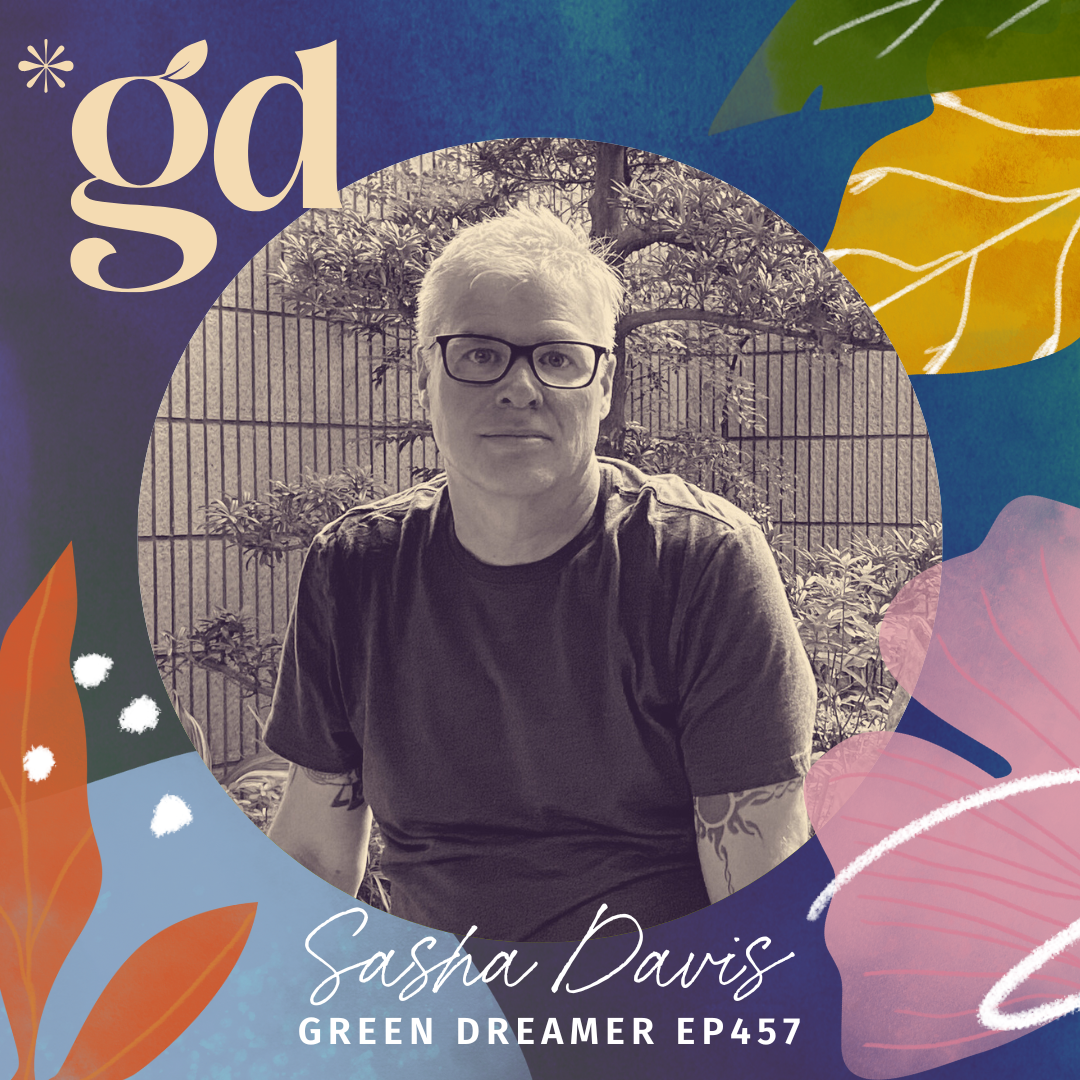
Sasha Davis: What do we do when protests and elections fail? (Ep457)

“I think all of us can get a little bit focused on the reaction, and to structure our thoughts as resistance against something. And there are times when that certainly has to happen, but I think to be effective at stopping what’s going on, we have to focus on the productive. What is it that we do want to create? How do we get from where we are today to that place? ”
How do we navigate the overwhelm that comes from staying informed about the world’s many interconnected crises — many of which may feel extremely dire and with grave urgency? Why do we need to look beyond conventional approaches to social change, such as electoral politics and even protests asking for things to be changed? And what does it mean to shift beyond acting from a place of reactivity and resistance — and to strategize for the longer term intention of supplanting oppressive governance?
In this pertinent conversation, Green Dreamer’s host, Kaméa Chayne, is joined by Sasha Davis, who takes us through some of the themes explored in his latest book, Replace the State: How to Change the World When Elections and Protests Fail.
Join us as we gently but critically hold up a mirror in front of ourselves to examine our methods and mentalities of change — ultimately landing on practical lessons from many Indigenous and people-led movements that have reclaimed power through effectively “replacing the state” in some shape or capacity.
We invite you to…
tune in and subscribe to Green Dreamer via any podcast app;
subscribe to kaméa’s newsletters here;
and support our show through a one-time donation or through joining our paid subscriptions on Patreon or Substack.
About our guest:
Sasha Davis is an activist and professor at Keene State College in New Hampshire. His previous books examine activism and environmental politics in colonial contexts, while his latest book, Replace the State, takes the lessons of those social movements and applies them to current grassroots organizing in the United States.
Artistic credits:
Song feature: “Sisters of Winter” by MILCK
Episode artwork by Haruka Aoki
Dive deeper:
Replace the State, a book by Sasha Davis
Follow Sasha’s Substack, Make the New World
Cooling the Tropics, a book by Hi'ilei Hobart
Read the article “Hawaii Telescope Protest Shuts Down 13 Observatories on Mauna Kea”
Watch the video “Why Native Hawaiians Protesting Giant Telescope on Mauna Kea Aren't Going Anywhere | NBC Left Field”
Read the article by Sasha Davis: “Security for Who? Resistance to Militarization Intensifies in Okinawa, Japan”
Learn more about Kanaka Maoli scholar Noelani Goodyear-Kaʻōpua
If We Burn: The Mass Protest Decade and the Missing Revolution, a book by Vincent Bevins
Check out Kali Akuno and the Cooperation Jackson
Expand your lenses:
Independent media is more important than ever! Please consider joining our Patreon or making a one-time donation today.

interview transcript
Disclaimer: Please note that Green Dreamer’s interviews are minimally edited (both audio and non-verbatim transcript) for clarity and brevity only. All statements should be understood as commentary based on publicly available information, and the views expressed in this interview are those of the guest and host only and do not necessarily reflect the views of Green Dreamer.
While we have made reasonable effort in our interview research and production process to ensure accuracy, we do not present our commentary as factual assertion and we are unable to guarantee the completeness or correctness of every piece of information shared. As such, we invite you to view our publications as references and starting points to dive more deeply into each topic and thread explored.
Kaméa Chayne: So, as we're speaking right now on June 11th of 2025, I personally feel kind of distracted and overwhelmed, honestly, because my feed is full of constant updates from these militarized ICE raids going on across the US, seeing people's family members being taken without warrants or due process. And also seeing protests across the globe against forced starvation and genocide in G@za, and against the detainment of activists who recently just tried to deliver humanitarian aid from the Freedom Flotilla.
So there's a lot going on, and forgive me if I feel a bit unfocused, but also, we couldn't be sharing this conversation at a more pertinent time. So, thank you in advance for this discussion. And I also know that you've talked about, feeling this way, feeling scattered and disoriented by all of these very urgent crises dotted across the map is by design of the system, and that we shouldn't feel bad about it.
So, what more can you tell us about this overwhelm and urgency that we might experience in these moments, and how they're designed to make it more difficult for us to maybe slow down and strategize for effective long-term transformations?
Sasha Davis: Right. Yeah, such a great question and such an important one right now. And I think one that's going to remain important. I think that we have to give ourselves a little grace, that it's hard not to do that, right? To give in to some of that urgency because there are some urgent things to do.
I think that part of it is about finding a balance and recognizing that you can't be effective if you stay in that state. Like, there are times when that's absolutely called for. However, it can't be done at the expense of the longer, deeper thoughts about, what is it that we really want?
If we were able to replace what’s going on now, with the militarization, the crackdown on activists and migrants, and the violence in G@za, what is it we imagine we’d like to replace this with?
I think that takes a little bit of time for some reflection. And it also takes a little bit of time for strategizing, because oftentimes, I think that all of us can get a little bit focused on the reaction, and to structure our thoughts as resistance against something. And there are times when that certainly has to happen, but I think to be effective at stopping what's going on, we have to focus on the productive. What is it that we do want to create? How do we get from where we are today to that place?
It's going to take more than just resistance and resistance and resistance. It's going to take something else. And so we need to make sure we're leaving time for that. Because even though the process can be long, if we don't do it, we're going to stay in this state of urgency and resistance and reactivity.
Kaméa Chayne: Yeah, and we're going to explore this question throughout the rest of our conversation today. We did recently publish two interviews, one with Abbey Reyes on tapping into the slow work and tapping into a deeper currency of change, and also with Kazu Haga on the need to not respond to panic with panic because of, literally, the brain chemistry of the state of mind that that puts us in, and how it shuts down our creativity and our abilities to have longer term visioning. So, I appreciate that this is a continuation of these threads and also taking on a different flavor, because I think we're going to focus a lot more on, like, examples of what this has looked like for different movements.
The first part of your book talks about how we're often taught to enact social change in a supposedly democratic society, but also how gravely limited they actually are. Can you walk us through some examples of these more traditional approaches to social change, and how do you begin to tell people who've been taught these things their whole lives that, hey, this is maybe not the best way and is extremely limited in its potential for systemic change?
Sasha Davis: Yeah, thank you. What I talk about in my most recent book is, I really kind of foreground it with this idea of, okay, we're used to thinking that if there's a problem, that’s social, economic, whatever it might be, that the government is the proper arbitrating authority. That's who you go to to kind of fix this.
And I try to make the case that that's not necessarily the best idea because oftentimes, I think its pretty clear, especially today, but even under previous administrations, a lot of that activism towards trying to make the government do something different hasn't been super effective. And it certainly has limits.
So then what often a lot of people turn to is, like, they first say, well, okay, we'll try and change the system from within, or do reform, or try to elect better candidates. And then when that doesn't work, they turn to protest, right? And we'll try to petition the government and pressure them and say, hey, we want you people in office to do something different. Protest is a little different in that it is outside of the state, in a way.
However, it also has this very circular relationship, which is you’re still going to the state, you’re still saying you are the proper authority, we accept your authority, and could you please just make this a little different? However, when they say no, which they very often do, it throws you right back to, well, okay, I guess maybe we need to elect better people. And then when that doesn't work or when people get in and they don't really make the changes that people need, we go back to protest, and we can chase our tails.
So what I try to bring up in the book and I try to talk people through, is that it's pretty natural to want to engage in those ways. And we're very used to those ways. And there are a lot of kinds of social discussions and chatter, and this is what you're supposed to do.
However, what I try and say is, like, you have to have a little bit of an off-ramp into trying something different. And where I try to get people to think about that is by thinking through, well, how effective have some of the things been that you've been involved with? Have you worked on an election campaign to then get disappointed about what happens when that person gets into office? Have you engaged in a large-scale protest, with signs and making demands, when those things didn’t get listened to?
I think it's very important to realize that it doesn't mean not to engage in those things. I think some very important things come out of trying to engage with the government in elections and through lobbying and all of that. I think you can also do some very important things in protest.
But it may not necessarily be what you kind of think it is. Like, what I think people get out of protest, more than being listened to or being able to change policy, is that you make the solidarities with other people. You learn new tactics. You understand that kind of way you see the world, there are a lot of other people who see it very similarly. They see the same problems. It encourages you to kind of keep working. So, engaging in protest is important.
What I try to kind of emphasize with the book is that it's not enough. There has to be something else that we do on top of these things to make a fundamental change. We just have to recognize that the current state, under this administration, but previous ones too, is not designed necessarily to make everyone’s life better. [The current state] is designed to enhance capital accumulation to guard the property of the people who already have property.
And it's not necessarily in the business of equality.
Kaméa Chayne: Yeah, I do wonder about a lot of these questions because I'm very curious about different theories of change. And I do think most people are doing their best, given what they've been taught. So, yeah, I think I want to also be very sensitive in critiquing, like, this is the right way or wrong way to go about things, because I think most people's hearts are there. And I think that's really beautiful. At the same time, I would say it is important to constructively critique our recipes for collective transformation.
And it reminds me of my past conversation with Rasul Mowatt and Too Black, where Too Black mentioned that they're a poet, and political art and poetry are really important expressions of movements. But if everybody only wrote poems, that wouldn't bring about any sort of structural, material changes to lived realities and how things operate. So I want to hold the both/and of, like, honoring all the ways that people are already showing up today and even putting their bodies on the line for the greater good.
And I think I want to go a little bit more into protest. You shared that “Petitions and protests, which asked the current administration to do things differently, aren't going to get many results. Protests do serve some important functions in showing dissatisfaction, reminding sane folks that they're not alone, and building solidarity. Just don't expect the government to change course in response to them.” End quote.
I can only think of my example. I've joined some protests before, and I appreciate them for the relationships that I make and the feeling I get, like feeling invigorated by, like, wow, so many people care about these similar things that I do.
I think what I've personally observed is that a lot of it is more for, like, in-movement affirmations and building solidarity. But when I reflect on the protests I've participated in, next to none of them has led to whatever changes the protests were intended to ask for. So I wonder if you can elaborate a bit more on the role of protests within the broader movement of change as being necessary, but also limited in certain ways.
Sasha Davis: Yes, and I think you bring up great points about how there are these very important functions of protest. And also, I would add, oftentimes protests that seem not to necessarily have succeeded in their primary missions at the time that they were done may be quite successful in terms of what they have kind of put into motion that then happens years down the road.
But I think that also, when we think about the function of protest, I think, also, we have to think about what if nobody protested? I mean, it can be easy to critique, well, hey, maybe these protests didn't do everything they wanted. But can you imagine with everything going on, say, right now in June here in 2025, with the ICE raids and the militarization of the cities, if nobody protested? That's how bad things would be.
I think sometimes we might critique protests for, how much are they getting done? But if you kind of imagined if they didn't happen, how horrible that would be. If we didn't send the message, hey, this is completely unacceptable, just how bad things could keep sliding? So I think protests do have a little bit of a breaking function, in that respect.
Kaméa Chayne: Right. So this isn't saying that protests don't lead directly to some sort of change, and therefore, this isn't where any of us should be spending our time. This isn't kind of like an either/or. It's just saying it's a part of the picture, and there's a lot more to it.
Sasha Davis: Yes, and I think where I come at this is, I started in activism quite young, about 16. I grew up in Arizona, and my start in activism was around nuclear issues, particularly nuclear weapons testing, which was still going on in Nevada when I was at that age. And I started working for an anti-nuclear testing organization.
So, back in the late 80s, early 90s, they used to set off nuclear weapons in Nevada all the time. They were underground, but they would leak a fair amount of radiation. And I got involved with an organization that went up there. We did road blockades. We trespassed into the nuclear test site. We were trying to stop the test, put our bodies on the line, and do it.
I remember how empowering it felt to be involved in that, to be able to call out the horrible process of nuclear weapons testing on stolen Indigenous land from the Western Shoshone that was then being contaminated.
And the government was lying about how much radiation. It just seemed like a very obvious thing to get involved with because it seemed so wrong to me at that age. But what I came away from those experiences with, really, also was a big appreciation for the life that was created in the peace camp, the camp of people that were putting on the protests, the envisioning of what a sane foreign policy might be that's not based on a kind of violent nationalism.
I learned a lot about the logistics of just what it takes to put on protests like that, and the planning, and the idea that if you want to make effective change even in that protest setting, there’s no such thing as a spontaneous protest. There's always somebody behind the scenes who’s helping put things together and the logistics for it.
And so, through that process, I realized what some of the limitations of protests were, but also where it could be kind of taken in a positive sense. And I think that was reaffirmed later in my kind of studies as I became more of a researcher and went into college and graduate school and beyond, looking at organizations, social movements that protested a little differently.
This is kind of one of the keys of the book, Replace the State, is that…
Some of the more effective movements were ones that weren’t asking the government to change this or that. They were like, we’re taking over this place, because the government or corporations are going to treat it very badly.
And we are going to try and govern it ourselves for as long as we can and for as big a spatial extent as we can. Essentially, we’re going to try to replace the state and reinsert or reinstall previous, Indigenous styles of governance into these spaces that respect the ecologies, respect the people. And I started seeing just how effective those techniques were.
And that's what kind of led me to write this book. I think there are techniques that really could be brought into more activism in North America.
Kaméa Chayne: Yeah, I really want to stay on this for a bit. So I will ask you specifically about Mauna Kea as an example in a little bit. But first, I'd love to invite you to elaborate on why you make this distinction between replacing the state and replacing the government. So what's the significance of differentiating between what state is referring to and what government refers to?
Sasha Davis: Yeah, I think, you know, traditionally in political theory, folks will use the term state to talk about the larger apparatus of governance, right? So the state will include what we kind of think of as the government, right? Like the current administration. But the state is also the police. It is also the courts, the military, the bureaucracy, and the different agencies.
Going back to Greek philosophy, there's this idea that the state is like the ship that's running the country, and the government is like the crew. Governments come and go, but the state is a more solid entity that tends to last. I think that if you look at it in the American context, we just usually call it the government.
We don't talk about the state, and it gets confusing because sometimes people think state then means like, the state of New Hampshire, the state of New Mexico, or whatever. But in this context, when we're talking about the state, we're talking about the US federal government as this enduring entity that actually has been fairly consistent in its governance practices, whether there's a Republican or a Democrat in office. The governments come and go, but the state stays somewhat stable.
I think that's an important distinction, even if it seems a little abstract. One of the things I try to emphasize in the book, I wrote this entire book during the Biden administration, and granted, I had seen what had happened during Trump's first term. But I'm arguing that going back to 2024 is not paradise, right?
A lot of things that have been wrong economically, socially, the number of people being deported, the support for the Israeli bombardment of G@za, those things have been consistent from administration to administration.
And I think that we don't want to lose sight, even as bad as things are right now, because of the extra cruelty and the rhetorical garbage that's coming out of the current administration. Don't lose sight of how continual some of these processes have been.
Kaméa Chayne: Yeah. I'm thinking about the boat analogy that you just gave, and maybe it's like this giant cruise that is currently speeding towards a glacier or something. So like, simply replacing the crew who is navigating the ship that is already out of control isn't really gonna help us to change course, and maybe it's about taking the lifeboats and steering in our ways that we need to in a way to kind of decentralize power and take matters into our own hands.
I know that a central part of your book draws on lessons from the Kānaka Maoli-led movement against the 30-meter telescope development on Mauna Kea. I had the honor of interviewing one of the movement's leaders, Auntie Pua Case, a few years ago, and also Hi'ilei Hobart, author of Cooling the Tropics, who was also supporting with the food distribution there. And so, in the context of our discussion here on replacing the state, what are some ways that this movement took hold to not just resist and fight against the TMT project, but actually to build Indigenous sovereignty, and as you say, to supplant state governance?
Sasha Davis: One of the reasons why a lot of these ideas come from Indigenous scholars, Indigenous communities, and Indigenous social movements is, I think, there are a couple of reasons why. These are organizations that have been under formal colonization. And so it's like some of the research and things that I do are in Okinawa, in Guam, in Yap, and in the Marshall Islands, right? And also in Hawai’i.
These are places where there's no illusion that the government that's running things is interested in the well-being of the people, really, because it's a formal colonization or occupation situation. I think that the more people realize in other contexts that their government also isn't really representative of their needs and their desires, that a lot of what's been going on in these colonized communities should resonate far beyond them, too.
The other thing that I think makes these movements in these places so important is that they really talk about the fact that they have a way of governing their places because they were doing it. It wasn't very long ago, historically, right? And I think some of the things that you were saying, like, that these states all over the world have been treating Indigenous groups very, very poorly in all sorts of places.
A lot of the states that are currently in control of countries, and certainly in the developed world, are more interested in facilitating capital accumulation, guarding property, etc., but those logics are historically somewhat new.
If you actually look over the long history of humanity, what's more the norm is having governance structures where you are thinking about long-term sustainability, where you are having inclusion of people within your community, where you are having different voices taking turns and understanding the needs of larger groups. That's not utopian or something we have to dream up as being brand new.
Indigenous communities know that it's much more about taking those governance practices that they've already been doing for generations and generations and re-empowering them. And that you can, in a place like Mauna Kea, say, okay, if we're running this place, we already know what works in this area and what doesn't. And we have cultural protocols and religious protocols and ways of interacting within communities, and the respect that we give to elders. All of this is there.
So it can show you how you can replace state power with a different structure because those structures are there, they've been, you know, suppressed and pushed underground in some respects. And I think I was listening, I believe it was the podcast that you did with Nick Estes, where you were talking about this idea of mushrooms, and you have these rhizomes underneath the soil of these groups of fungi that are everywhere underneath. And then they pop up in these different places.
A lot of the protest movements you see in these Indigenous spaces, all of those ways of governing are there, they just have to push through, be given some light, and allowed to flourish.
I think one of the arguments I try to make in the book and that's something that can be done outside of Indigenous organizations and social movements as well, there are ways to re-empower other ways of governance. It's historically more the norm than what seems like the norm.
Kaméa Chayne: Yeah, I remember learning about kinship networks of governance from Indigenous scholars and community leaders. As in, a lot of these kinship forms of governance see government as embedded within the community itself, and isn't this thing that separates the private from the public, and where government is an institution that is outside and on top of community life.
I think it just reminds me of how a lot of Indigenous forms of kinship governance were completely invalidated and seen as not formalized, and therefore they weren't recognized because they weren't something in the form that the colonial governments recognize, which is something that is outside and on top of.
It's interesting because I think a lot of this talk about decentralization and more community-situated forms of governance is kind of like remembering and returning to, like you said, what was more of the norm throughout the deeper human history. So I think it's helpful to contextualize this, like you said, it’s not some utopia that is really far off, but like we remember, it just depends on how far back we have to go, depending on the culture.
Sasha Davis: And it's something that is, I believe, and I think a key point that I try to make in parts of the book, is that this is not exclusively something that is a project for Indigenous folks.
This is a project that everybody can be a part of, this idea of reinvigorating and re-empowering these different ways of knowing.
I think that in any struggle in any place, particularly in North America, there has to be a lot of heed paid to the Indigenous knowledge of the areas that people are in, and understanding the leadership of Indigenous groups. That doesn't mean other people are not invited into that process, right, of kind of making change.
I think that was one of the other things that I've learned from looking at the movements in places like Mauna Kea, Okinawa, and Vieques in Puerto Rico, as well, you know, like in terms of how broad those movements are.
Kaméa Chayne: Yeah. And I also think there's not necessarily a neat either/or as in, movements that are intended to supplant state governance, is like that's their only purpose. Because I don't think they can entirely be decontextualized from broader state structures, as in, there is going to be probably police and militarized violence.
So I think in the process of people nurturing efforts that supplant state power, it will still inevitably be met by the barriers imposed by the state.
Sasha Davis: I think it's also important to recognize that the state, of course, is not a monolithic entity, right? That there are these different aspects of the state. And we're seeing that right now, how some aspects of the state that we might think of as actually somewhat helpful that are about understanding science or our social safety nets, those parts of the state that have been helpful for communities, which are now, of course, being kind of more shredded, are also part of the state, right?
Then, different scales of the state. And we're seeing that now, again, here in June of 2025, with the way in which the California government is sort of facing off against the federal government and all of that. But that also happens in other contexts as well, where you have some parts of, say, the Hawai’ian state government that were more supportive of what people are doing on Mauna Kea in terms of the protest movement, whereas other state agencies were not.
In Okinawa, you had a local government that fought really, really hard, and still fights hard against the imposition of new US military bases, while the Japanese central government in Tokyo kind of pushes it.
The state is also a complex terrain of struggle in and of itself. But I’ve been really impressed by the groups that usually replace the state. This idea of supplanting governance in a place is usually one tool in the toolbox.
They are still having protests where they're waving signs and doing petitions. They are still engaged in elections, both in running candidates and supporting candidates. They are also sometimes occupations of space just to kind of get more media attention, and then to kind of win that discursive battle over what should be in a place.
But then, they're also adding this other layer of like, we know how to govern this space in a way that's much more sustainable, just, and that supports equality than the current governance.
// musical intermission //
Kaméa Chayne: Yeah. I want to continue bringing this discussion to our current context. So you say that you've been grappling with how to explain the current resurgence of naked US colonial ambition towards Greenland, Panama, G@za, and Canada, as well as the rise of patently undemocratic and dictatorial policies at home. And you point to this acute crisis we're facing between two very old and different views of reality, which are the relational and the imperial.
So what exactly does this mean for people who've never thought through these lenses?
Sasha Davis: Yeah, some of the discussion that I've had around this idea, it's in the book, but I've also been doing a Substack where I'm writing about concepts from the book that I try to bring more into the contemporary, you know, what's happening right now. And I think that I try to have this discussion about that there are these two general kinds of ways in which governance can function, or there's a way of kind of dividing governance into these two structures.
One being the imperial, which is that whatever's out there doesn't matter. We can remake it, right? We can literally either remake it with bulldozers and tanks, or we can remake it by just trying to say it's a certain way and get everyone to believe us. One of the things I bring up is that Trump is a master of trying to do that. Trying to say, this is what's happening out there in reality, even though there's lots of evidence that that’s not happening, to try and make it real, get enough people to believe it, right?
There’s another way of governing, which is relational, which has much more to do with taking stock of what exists out in reality.
What is the ecological situation? What activities are humans doing or having? What kind of effects? Can we tweak those so that we can have better outcomes socially, environmentally?
And it's this more back-and-forth style of governance that takes what's out there as the template for what you do. And you try to harmonize with that. I think there's a caveat that, of course, we all perceive what is out there in reality slightly differently, of course, but there are limits to the kind of fantasies that folks in the Trump administration try to push and pretend that things like climate change don't exist, etc.
And so the relational approach is much more in line with the types of governance that I've been kind of talking about, too, and particularly Indigenous communities and other communities that have been in a place for a long period of time. You don't stay in a place for a long period of time unless you're able to have that approach, right? Because otherwise you tend to ruin it. Because you're not paying attention to the signs that the landscape and that place are kind of sending back to you.
And that's why I kind of counter it with the imperial. The imperial, this idea that we can just do it, stems from colonial history, where, like in the context of the United States, if we just ruin this valley, we can go take over the valley over the hill, then the next valley, and the next valley, and you never have to necessarily be sustainable. You don't necessarily have to try and come up with any kind of relationship with that landscape. You just keep expanding.
My argument would be that it happened across the continent and then into the Pacific and then into Asia, right? And in Latin America as well. And that there's an economic aspect to this, which is the capitalist aspect, like, we can just keep producing and producing and producing forever. And of course, that won't work forever. You're gonna run out of the next valley, and you're gonna run out of customers to keep selling things to. But I think that what we see with Trumpism is a reassertion of that project, almost to a ridiculous length. We're going to cut down the rest of the forests, we're going to get rid of all regulations on resource use. And in 20 years, then what? But there's a blind spot there. And that's just this idea that you can just keep doing that. What social movements today have to grapple with is…
To reinstate a more relational form of governance that is about justice, sustainability, community, and harmony, you have to confront the fact that folks running the state are far away from that.
They don't believe in it. They think that they can just kind of keep remaking the world.
Even if they think there might be a consequence or an upcoming apocalypse, they kind of don't care [laughs]. And I think we have to accept that in terms of recognizing the danger that it poses, but also recognizing that it's a weakness because it's also nonsensical. It can't last.
Kaméa Chayne: Yeah, it's out of touch. It's very important for everyone to learn to be critical thinkers so we can kind of recalibrate our senses of reality, or at least a closer semblance to reality, versus delusional metrics that are just completely out of touch with the reality of how the Earth functions and everything.
I think sometimes when people talk about theories of change, it can be difficult to fully wrap our minds around these ideas without being able to look to real-life examples. I appreciate the way that your work and ideas are very deeply rooted in examples of how different movements have already been working to replace the state across different contexts.
I want to invite you to share a few more examples that you've really felt inspired by of how people have reclaimed community-based power.
Sasha Davis: Yeah, I think, probably the experience I had that really changed my mind and how I thought about things, that really happened in Okinawa. I was there watching protesters and in kayaks that were trying to sail in and trespass into an area of the sea that the US military, with the help of the Japanese government and the Japanese Coast Guard, was trying to keep off limits because they wanted to build a new naval air station there. This is in Henoko in northern Okinawa.
I'd been familiar with the protests. They'd been going on for quite some time, and still are going on, but when I was there, a little over 10 years ago, watching this particular protest action, and people in the kayaks were coming through into this area, and the Coast Guard was trying to intercept them. And they were able to kind of get into that area and kind of sail through and were triumphant that day in terms of being able to say, no, no, no, this is not US military territory. This is our territory.
I remember thinking through this as I was watching it and thinking that this is like an occupation-style protest, like Occupy Wall Street or other kinds of occupations where you're trying to make a kind of spectacle to get attention, to get arrested. This is something that I had done in Nevada at the nuclear test site, too. Our whole mission was like, let's get media attention out to this fairly remote area of Nevada by getting a lot of arrests, and by trespassing, etc. But the point was to be seen. But I started realizing, through talking with some of the folks doing this and watching them, that that wasn't exactly what their thought or message was. It was more like saying, no, this bay has another function.
It's to be this rich ecological kind of fishing area. It's also an area that's habitat for the dugong, and it should be protected. And we're sailing in here to sort of reassert our ability to say this is what this place should be. And even through those protests, they've managed to delay that construction project for a long time. The construction project has continued. And so they haven't been fully successful. I was struck by the technique that they're like, no, we need to reassert that we should be able to manage this, not the US military or the Japanese government.
And then when I was looking at other protest actions, like in Jeju in South Korea and protests against the military base there, and also I had done work in Vieques around some of those protests, and then went to Mauna Kea, it kind of kept cementing like, I'm seeing what's happening here in all these examples is people aren't just doing an occupation for attention.
They're doing an occupation to say, no, this really shouldn't be being managed by somebody else. This should be managed by our community. And I think that one of the primary lessons there is that social movements are kind of more like states than you might think. They're organizations that are trying to exert power. And they're trying in some cases to hold territory. I mean, even in small protests, even if it's for a certain period. I mean, we're seeing that even in the things going on this week, right? We're going to hold this intersection, and we're not going to let it be the place where the military or the police or whatever are kind of doing what they want to do. It's like, no, we're going to do something else here. And so that's been powerful to see those examples. And that's kind of where, I guess, the theory grew out of the examples.
Kaméa Chayne: I remember also learning about some of the peasant-led farmer protests in India. And I forget which exact one, but I remember reading about how people were occupying the streets, and people were living out a different way of taking care of each other, because people were just feeding each other on the streets. People weren’t selling or whatever. They're just literally sharing food, cooking for each other. So, a glimmer of different ways of tending to each other pops up in these spaces. And I think that's beautiful to see.
And there are a few other things I want to bring into this conversation. One is Bayo Akomolafe’s invitation for us to kind of lean into hopelessness as a way to not be led back on the same highways over and over again. So I think that kind of speaks to a lot of what we talked about today in terms of, like, we should feel kind of hopeless about existing institutions of change, because that's what maybe will encourage us to look elsewhere and look to more marginalized spaces as sites to center. And he also talks about, or he critiques, our sort of crisis-in-form.
When I think of our crisis-in-form in the context of climate, I think about these global climate conferences convened by, you know, nation-state institutions and things like that. And maybe activists are going to demand recognition there and kind of centering that as where change takes place.
I feel like, for me, what I'm more interested in is not even centering them as sites of power or change altogether, but like looking to decentralized community-based efforts, looking to what Indigenous land defence efforts are doing, looking to people's movements. And that to me is more so about disempowering existing power structures through empowering what we want to nurture. So again, going back to like, not just what are we fighting against, but what are we wanting to build?
The last thing I'll share is, I think people are increasingly recognizing and understanding the strategy of boycotting and divesting to disempower what we don't want to support. And I'm like, if we really go down that rabbit hole and think about everything that we want to boycott and divest from to not be complicit in these institutions of destruction, then we necessarily arrive at having to shift our focus away from what we don't want, and towards what we do want.
So again, I think it's kind of a both/and, but I want to ask you what else you'd like to add in terms of this idea of some forms of activism possibly reinforcing existing power structures, even if it's not their intention, and what questions we might ask ourselves so that we can at least dedicate more parts of our recipes of activism towards the reclamation of power and leverage.
Sasha Davis: Yeah, the question of how we should think about some of the ineffectiveness of some forms of activism is to, kind of, maybe think through to the second, third, fourth step, right? Like, okay, if we want to engage in electoral politics, okay. All right, so we're going to run people. And it's like, so if they get in, what is it they can do in those particular offices?
I think there's sometimes the envisioning that, okay, if we get enough of the right good people in, then we can really change policy. Yes, you can certainly stop some horrible policies with that approach. And it's, again, one that I'm not trying to say we shouldn't do. But I think we should also look at the limitations and think back and be like, okay, well, what did it look like when we had, say, a Democratic president and both houses of Congress? These were some things that were progressive, that were moved forward, but one thing stayed very much the same, right? And what things do we really want?
And I think, one thing that I guess this might be a good point to bring this up because it's something that, you know, I wanted to make sure that I kind of mentioned here, which is that…
We have to think first about, what are the ethics that we think should drive our governance? And then think about how we get them as opposed to being like, well, here’s this structure of governance that we inherited and that we’re stuck with.
What's possible within this structure, and how are we limiting ourselves to that? Because if we instead think about what it is that we actually want, what is it that we think is the right way of living and governing ourselves, then we're probably going to start finding that the existing structures are not up to the task of delivering those things.
And so, like in one part of the book, I bring up these four points that, through my different experiences with these different movements, I started seeing some commonalities. And I came up with ethics that I kept seeing. And one of them was, people deserve to be included in the processes of making political decisions about the places where they live. People deserve equal access to economic resources and opportunities, that people deserve to have a say in environmental decisions that affect the health and well-being of their communities. And then the last one was…
People deserve to be able to govern their places in a way that maintains healthy, long-term relationships among humans, other living things, and the physical environment.
And I think these ethics are widely accepted. Most people would be like, yeah, that seems like good things to sort of base a community and a system of governance around. But then you have to be like, is our system of governance capable of doing that? Have they been doing that even under the best of administrations? And I think most people have to be honest and say, no, that hasn't been working. It might hopefully lead us to thinking about more tactics that could get us to a place where those ethics actually could be what kind of animates our governance.
Kaméa Chayne: I also want to ask what all of this would mean in terms of addressing something that feels immense in scale and even distant. So like, addressing genocide and military violence in G@za, the Congo, or Sudan. So you talk about this idea of holding back. And I wonder if that refers to maybe more strategically assessing alternatives that we can build so that we're less complicit in empowering the state violence and the state power structures currently carrying out these atrocities.
So in other words, maybe sometimes the forms of activism that might be the most impactful and rewiring power are the ones that might not actually feel as direct, but might be more mycelial and underground even. So, how would you like to invite us to think about these questions?
Sasha Davis: Yeah, I think it's important to recognize that we're thinking about, like my work does, to start at the local or the grounded sort of scale and then try to think its way up in a sense. And as much as these tactics that I've been talking about can make life better and foster environmental protection, in particular places where people are enacting these kinds of things.
At some point, you have to recognize that to challenge state power takes a lot of scaling up from what's going on in these particular spaces. Because we are talking about states, organizations, institutions that have a massive amount of weaponry, that have nuclear weapons, that have a tremendous amount of, almost unlimited amounts of, wealth at their disposal. And you can't leave them there. And you can't let them stay empowered.
I think that's one of the important points is that, even if you are doing this thing locally that's creating this better community and this better kind of conditions, you also have to recognize that unless this is scaled up and you get more world-of-worlds kind of ideology, like some of the Zapatista ideologies around this idea of supporting other people to also be able to do this sort of thing, to sort of usurp the power of those big governments, to be able to hold them to account while you're in the process of trying to supplant them, right?
That's a very big project, but one that we absolutely cannot shy away from, because you can't just say, okay, so I made this commune on 10 acres in the forests of New Hampshire, and we're cool. Bigger things are going on. It has to be very explicit that…
These efforts to replace the state, there’s a conscious thought about scaling up and also using these spaces that are created as springboards to not just spread the tactic and the idea, but to erode the power of existing states.
They’re going to create a lot of havoc if we don't also do the other things we're doing with the protests and engaging in electoral politics and boycotts and blockades and these sorts of things, because you can't just let those kinds of institutions run amok. I think you've got to do the things simultaneously.
Kaméa Chayne: Yeah, all of the above. Well, we are coming towards the end of our main conversation. And I'd love to land on this question of, what does it mean to build a movement? And to translate our conversation to more tangible takeaways for our listeners.
I know this can look very different for everybody and every community and context. But what are some of the suite of techniques that you've explored that social movements can turn to, to build more loving and life-affirming futures, and communities, and where would you suggest our listeners begin?
Sasha Davis: Yeah, I think there's sort of two parts to this. I think on one level, there's sort of tactics to make a movement inviting to folks, right? And I talk about this in large parts of the book. How do you make this an activity that people want to get involved with that seems kind of fun yet serious, that also feels like a good use of people's energies, that you're working towards something, you're not just having meetings about meetings about the next meeting, which sometimes happens in activist spaces? But that also means that you're not recreating some of the same biases that exist in the larger society within the organizations themselves, which, of course, happens too. So how do you make that a truly kind of more inclusive, welcoming, powerful space that's doing things, right?
And so, on one level, there are some techniques for that. But also, there's a larger sense, thinking about what the shape of some sort of coming mass movement looks like? And I think that that's one place where I've been certainly thinking a lot lately, because you think back historically when you had maybe more centralized organizations that were a little more powerful in the United States, like in the 60s, there were different organizations, Black Panthers, other kinds of organizations that were fairly centralized. And I think it's fair to say that in the current environment, there are a lot of different organizations.
You also have things that come together around a hashtag or a particular event, or the way Occupy took this general structure. And it's great for being able to proliferate and know that you have these similar ideas.
I’ve been getting more swayed by some of the arguments that we need a mass movement outside of the state, that’s not connected to the Democratic party, or any particular party.
It doesn't necessarily have a Leninist, dictatorial, top-down kind of structure, but that is sort of, at least rhetorically, kind of cohesive and together, and not just for a one particular event, but one that's like a movement, right? That has some staying power. That is a broad banner that lots of different community organizations can get together and create. I think it's something that has to be made from the ground up. Because I feel like right now a lot of the social movements are somewhat fractured in terms of they are short duration or they have a lot of different things going on. I'm not sure if I have the answer to exactly how that gets built. I think that's a million-dollar question. Honestly, if I had a dime for every pundit I've seen, someone saying, we need a social movement.
But I think it has to emerge. I think that through the different things that are going on now, through the different protest movements, hopefully, there's also more convergence where people from different communities send representatives. I know some of that's been going on in different quarters.
I think we need more of that. I think that needs to be supported. And I'm hoping that something emerges out that is sort of a broader scope that is also, I guess, in the sense rhetorically cohesive, and also has like a program because I think that we're going to need something like that.
// musical intermission //
Kaméa Chayne: What's been one of the most impactful books you've read lately, or publications you follow?
Sasha Davis: Noelani Goodyear-Kaʻōpua, the Kanaka Maoli scholar. Everything she writes, I love it. Super insightful about not just situations in Hawai’i, but larger issues around organizing and political thought. Vincent Bevins’s book, If We Burn, is something that really inspired me recently. And that's where some of the ideas of like, yeah, we do need to kind of be fairly organized about how we build social movements, because his book was really about how the 2010s, a lot of the things kind of exploded and then fizzled. And then we end up with all of these kinds of neo-fascist governments in the wake of it. And we need something with more follow-through. And that was very convincing to me.
Kaméa Chayne: What is a motto, mantra, or practice you engage with to stay grounded?
Sasha Davis: Growing up in Arizona, the desert, I read a lot. Earth First was a big organization growing up and stuff, and Edward Abbey and some of his books. And he says a lot of problematic things. But he said one thing which I think was very good. I have it on my wall here. It says, “To be a fanatic, but a half-hearted fanatic, to enjoy yourselves, keep your brain in your head, your head firmly attached to the body, and the body active and alive.”
I think this idea that as we're really struggling on very important things, literally life and death issues, that we also live and that we stay active in body and mind. And I think that is incredibly important. And that's something that, as a teacher, I try to impart to my students as well, to keep active.
Kaméa Chayne: And what is one of your greatest sources of inspiration at the moment?
Sasha Davis: I've been actually very impressed with some of the work being done by Kali Akuno and the Cooperation Jackson. They've been doing this build and fight program, right? Every month, they have a new kind of episode, and it's all around this idea of how to build these larger social movements.
I've been inspired by the very thoughtful approach of Cooperation Jackson and how they think about how do you build a larger movement, and the fact that it does take some time and takes some thought, and takes some ways in which you position yourselves to kind of be ready when kind of catalyzing moments sort of happen. So I've been very inspired by a lot of their work.
Kaméa Chayne: Hmm, beautiful. Well, Sasha, it's been an honor to share this time with you. I feel very affirmed and invigorated by our conversation. And as we wrap up here, where can people go to find your book, and what closing words of wisdom do you have for us as Green Dreamers? Or books, I should say!
Sasha Davis: The book, Replace the State, is available from the University of Minnesota Press. And so it's available from their website, but also IndieBound, and also anywhere that you buy books. It can be ordered through local bookstores, and also, the big corporate places will have them online.
Also, I do have a Substack, “Make the New World,” where I take some of these ideas and keep trying to build on them as I write. And also the other thing too is that I'm also thrilled to do in-person events, things like that. That's something that I'm gonna try and do a little bit around the book coming out in August, as well as beyond into the fall, as I can.
And then going back to talking about the ethics of the communities that have a more relational way of governing and thinking about the positives of what it is that we do want out of our communities and how we govern ourselves. I think it's important to think about this idea that when you stand on those ethics that you believe in, and what you think is best for the world and each other, which are shared with so many people, when you decide on what’s important and that you try to seek a new way of governing in a way that’s in line with those ethics, the right actions will follow.
Because the context is always going to shift. But I think if you can put yourself back to the question of, what’s important to me? And does this seem like the right direction to be going towards? So you can make the next right choice that brings you back to trying to empower the ways of life you think the way things should be, as opposed to sort of being in a reactive state all the time. I think that's my kind of closing thought.