
Melinda M. Adams: Cultural fire and the longings of the land (Ep458)

“Some tribes refer to themselves as fire-dependent tribes because their cultural materials depend on the revitalization of fire.”
How do histories of colonization relate to the increasing prevalence of more intense, destructive wildfires? How can Indigenous-led cultural burning support the regeneration of fire-dependent ecosystems — as well as the healing of communities experiencing solastalgia? And how are fire cycles and water cycles entangled?
In this episode, Green Dreamer’s Kaméa is joined by Dr. Melinda Adams, an Indigenous fire scientist who belongs to the N’dee, San Carlos Apache Tribe. A cultural fire practitioner and scholar, Dr. Adams’ research focuses on the revitalization of cultural fire with Tribes in California and more recently with Tribes in the Midwest.
Join us as we explore the longings of the land for cultural fire rooted in right relations, and what it means to move from ecological grief towards an empowerment to actively participate in biocultural revitalization.
We invite you to…
tune in and subscribe to Green Dreamer via any podcast app;
subscribe to kaméa’s newsletters here;
and support our show through a one-time donation or through joining our paid subscriptions on Patreon or Substack.
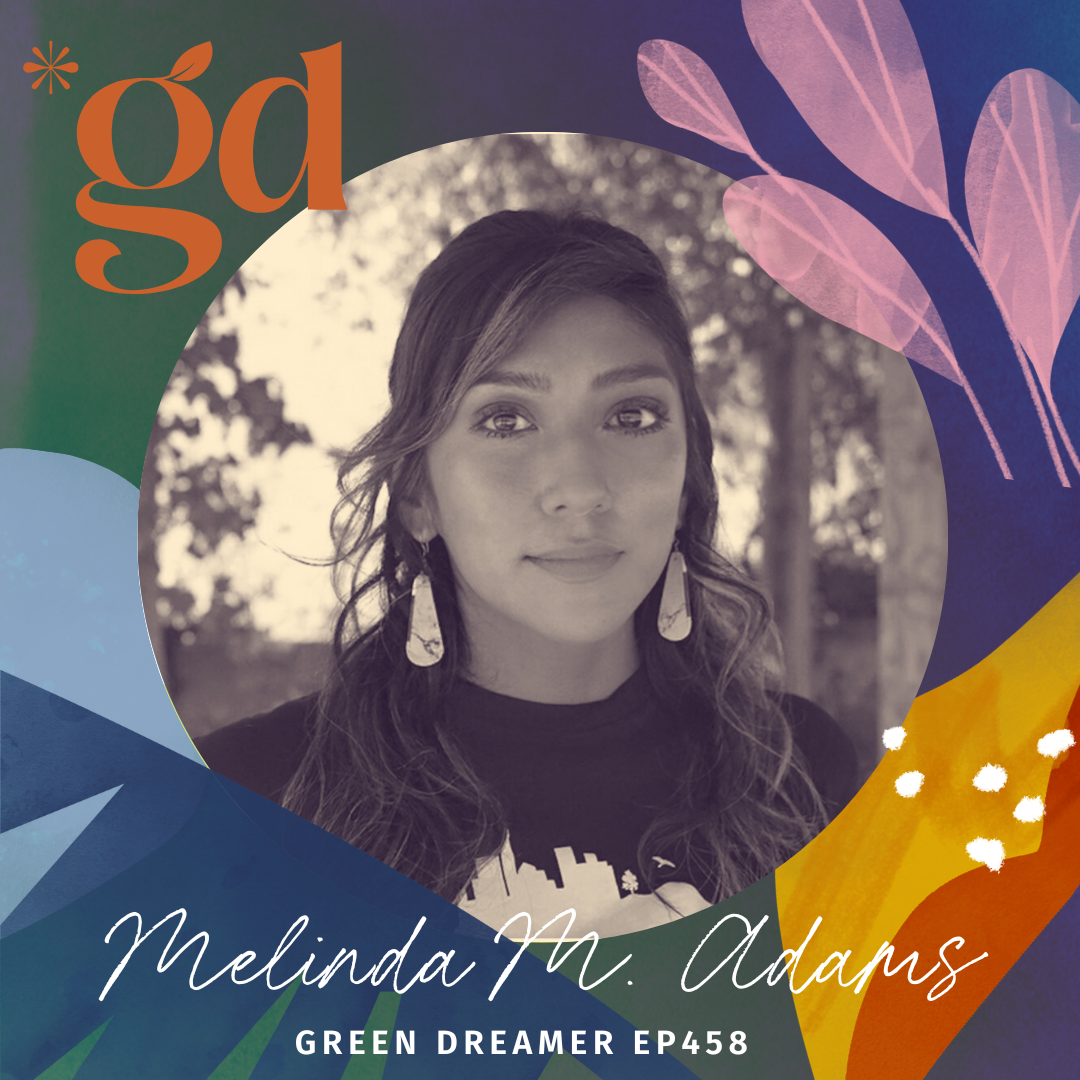
About our guest:
Melinda M. Adams, Ph.D. is an Indigenous fire scientist and belongs to the N'dee, San Carlos Apache Tribe. An Assistant Professor in the Department of Geography and Atmospheric Science at The University of Kansas, Dr. Adams' research lives at the intersection of ecology, environmental policy, and Indigenous Research Methodologies.
Artistic credits:
Song feature: “Moss Covered Alder Tree” by Oropendola via Spirit House Records
Episode artwork by gretchen blegen
Dive deeper:
Learn more about Matriarchal Ecological Knowledge
Read the article, “Solastalgia to Soliphilia: Cultural Fire, Climate Change, and Indigenous Healing,” co-authored by Melinda M. Adams, Erica Tom, and Ron W. Goode
Learn more about Kinsale Drake and the NDN Girls Book Club
Indigenous Critical Reflections on Traditional Ecological Knowledge, a book by Lara A. Jacobs
The Serviceberry, a book by Robin Wall Kimmer
On Indigenuity: Learning the Lessons of Mother Earth and Red Alert!: Saving the Planet with Indigenous Knowledge, books by Daniel R. Wildcat
Fresh Banana Leaves: Healing Indigenous Landscapes through Indigenous Science, a book by Jessica Hernandez
Expand your lenses:
Independent media is more important than ever! Please consider joining our Patreon or making a one-time donation today.
interview transcript
Disclaimer: Please note that Green Dreamer’s interviews are minimally edited (both audio and non-verbatim transcript) for clarity and brevity only. All statements should be understood as commentary based on publicly available information, and the views expressed in this interview are those of the guest and host only and do not necessarily reflect the views of Green Dreamer.
While we have made reasonable effort in our interview research and production process to ensure accuracy, we do not present our commentary as factual assertion and we are unable to guarantee the completeness or correctness of every piece of information shared. As such, we invite you to view our publications as references and starting points to dive more deeply into each topic and thread explored.
Kaméa Chayne: I want to start the bulk of our discussion today a little bit differently because I usually begin by diving right into questions about what is wrong, and how did we get to where we are today.
But I want to invite you to guide us to imagine first, what is possible for us when we collectively mend our relationship with fire?
Melinda M. Adams: I like that question. And I think it's a little bit hard for people to visualize what a future with fire looks like that's not destructive or that's not life-taking. And so, what I and lots of others in the fire world try to do is encourage people to steward with fire or experience it, build time for yourself out on the land or as a collective to see the benefits of post-burn effects, or even the steps leading up to it.
The added layer that I bring, and the people that I work with bring, is that we use the relations and the research as a way to unveil layers of colonialism, layers of removal, of erasure, of lack of decision-making, lack of preparedness, lack of healing that's been taken away from Indigenous peoples. So on top of trying to rebuild people's perception and relationship with fire, I'm in this space where I encourage people to think of what a decolonial fire future can look like. It's not only benefiting Indigenous communities, but it's benefiting all of our shared environments, all of our communities.
Kaméa Chayne: Yeah, thank you for offering this vision of what is possible for us. During the start of this year, 2025, there were devastating wildfires that ravaged through Los Angeles that received a lot of media coverage. So maybe that's like the more recent, highly publicized wildfire that a lot of people would have heard of. And with that, I think more people are starting to look to Traditional Ecological Knowledge for guidance, one of that being practices of cultural burning.
For people who have maybe only heard this term in passing, but never really had the opportunity to learn about it, how would you introduce cultural burning to people who are not very familiar?
Melinda M. Adams: Cultural burning, as I understand it, being a researcher, as a person who upholds these relationships, involves purposefully placing and managing responsible, lower-temperature, lower-severity fires on a myriad of landscapes led by Indigenous peoples.
So that's kind of how I conceptualize cultural burning. And then the goals often differ with cultural burning than they do from prescribed burning or agency-led types of burns, in that the goal of cultural burning is to restore those cultural materials, those plant medicines that we would use, or historically have used, that we want to see returned.
The added benefit of intentional, responsible burning led by Indigenous peoples is that, collectively, it also mitigates against the onset of some of those devastating wildfires that you just explained.
Kaméa Chayne: Yeah. And one of the discussion points that I often see surface is this acknowledgement that bioregions across California, for example, historically have evolved with wildfires and with Native communities collaborating with fire to manage and tend the landscape.
And to provide a bit more context, what do we know about the history of fire suppression among Native communities in these regions, and how that then influences the different types of fires that ignite and spread? You started touching on this a bit earlier, but how do we nuance the discussion instead of just simplistically saying that all fire is destructive and bad, or fire is necessary for renewal in these places, and people just have to kind of learn to live with that and with that risk in mind?
Melinda M. Adams: I appreciate that question. Again, the fire worldview that I have is that I have worked in places such as California, where the onset of wildfire, giga-fire, is a threat to lots of ecosystems and lots of places that people call home. What I've learned throughout that scholarly journey and being an Indigenous person that does this work is that there are many landscapes across the world that are fire-adapted, fire-dependent, and that have a long history of Indigenous peoples purposely burning for the return of our cultural materials. They call it cleaning up, like, they clean up the landscape, and so it's taking care.
Land-keeping is another term that's that parallels the good work of a fire return. For example, I started my scholarly journey actually in the Great Plains and the Midwest, learning about prescribed burning and knowing that there was this innate relationship between Indigenous peoples of the Plains and Prairie and the fire adaptiveness that that ecosystem holds. That ecosystem has since been obliterated through large-scale agriculture, large-scale mining, commercialization, and industrialization. It used to blanket all across what we consider the Great Plains, Northern Mexico, and Southern Canada. This was a shared ecosystem.
Now, less than one percent of it remains, and it's a fire-dependent, fire-adapted ecosystem. Lots of plant medicines and lots of plant and animal life relied on fire being returned to those places either through lightning strikes, natural fires, or Indigenous led, purposely placed fire. So that's the area that I call home now, the Great Plains region.
So, having that training, like Western science training and understanding the ecological benefits of fire-dependent prairie ecosystems and oak savannas, and then matriculating over to California, there's a whole other view of fire right there in the landscape of gigafire, megafires, learning again Indigenous peoples' long history of fire usage.
Some tribes refer to themselves as fire-dependent tribes because their cultural materials depend on the revitalization of fire in fire-adapted landscapes.
Then, cross-culturally, now I'm learning about Indigenous nations of what is now known as Australia and how they've always tended their land, or tended country, with fire sticks so that their landscapes were open, they could walk through these landscapes easier, engage in cultural activities and everyday life easier. And unfortunately, that's another landscape that's seeing a rise in giga-fire, mega-fire.
Lastly, making connections with First Nations in what is now known as Canada. Similar landscapes, similar ecosystems of some of the regions in California. And they too have a long history of their people purposely placing fire for plant regeneration, or for everyday activities. What the common threads are, and there are two of them that kind of have us meet in the fire space, there's a long history of removal of cultural severance from these fire histories that's been severed through waves of colonization in all of those places that I just offered. The other part is that the history of colonization continues through fire suppressive policy.
We have land management policies that prohibit lots of different types of burning, and as Indigenous peoples, the added layer, because we always have added layers and nuance, is that we either have federal recognition or federally recognized tribes, or we don't have federal recognition. And oftentimes it's a lot harder for the unrecognized tribes to even obtain access to these fiery landscapes to begin to revitalize their fire stewardship practices to mitigate a lot of the onsets of climate and wildfire change that they're experiencing. So lots of shared histories that I've learned being in this fire space. But as we sit here and converse, lots of threads of hope, too, lots of motivation for coalition building, for community and culture. There's been lots of recognition of the history of removal and colonization, but lots of sources of healing collectively.
Kaméa Chayne: Yeah, thank you for offering this historical context and very powerful to weave the common threads between Indigenous communities across vastly different places on the planet, but to find these shared histories of collaboration and intimacy with fire and similar historical patterns through colonization of the suppression and banning of these practices that have led to and contributed to a lot more destructive fires that we see today. Also, similarly, a revival of a lot of these practices as well.
I recently shared a conversation with Ferris Jabr, and he had talked about how a lot of the microbial life in the Amazon rainforest actually plays an active role in supporting the regeneration of the water cycle there. So, life isn't just a passive recipient of the water and rain patterns in the water cycle, but they're actively playing a role in that regeneration.
So it makes me think about fire as well, and how the reconfiguration of life forms through habitat loss and land conversion and so forth in these fire-dependent regions possibly have also changed the fire cycles and how fire then gets expressed from the land. And just from personal experience, like using fire-cook stoves and tending campfires at that scale, I think it's not too difficult to see and understand how, even when I just configure the logs differently, or when I add different types of wood and different types of fuel sources to the pit, the fire actually responds and expresses itself differently. So maybe we can then also think about that, but at an ecosystem-wide level as well, which is that the fire is constantly in conversation with the land.
And so what has happened to the land and what the land currently looks and feels like, then also gets expressed through fire as a medium, as a language.
Melinda M. Adams: Oh, I love that. And just to follow up with some of the observations that you’ve already eloquently shared with us…
I don’t know a cultural fire practitioner that I work with, either through collaborations or wildfire mitigation, or ecological restoration, who doesn’t relate the positive benefits of fire to the positive benefits of water. It’s always in conversation. They’re not separate — not ecologically, biologically, and certainly not culturally.
In fact, every fire practitioner that I work with forewords how lower temperature, lower severity, responsible fire is also going to rebuild, to your point, the microbial communities, the ones that are decomposing those organic materials in the soil profiles that are then going to build better porosity within the soil ecosystem, recruit and retain water.
So it's a newer field of research, one that I focus right now very little on, but throughout the years, that research will be set up. The more Indigenous fire practitioners obtain more access to lands to scale up our Indigenous use of fire in fire-deficient landscapes, the more promise the research has to stabilize our water tables. Especially in the places that are getting hit hardest with fire, they tend to be the ones that suffer the most drought effects as well.
Again, culturally, the stories between fire stewardship and water care, they're intertwined so tightly that it's actually odd and uncommon for us to not invite water into the conversation or not to think about fire placement and how it's going to best serve water stewardship as well.
Kaméa Chayne: Yeah, I really appreciate you emphasizing these connections. And I think it also invites us to look at climate change in much more expansive ways beyond this focus and fixation on, like, carbon emissions and carbon sequestration. Like this input and output types of a math equation. There's so much more entanglement with the water cycle and with the fire cycle and so forth as well.
I'd be curious about language as well. Like, for example, a lot of Native communities that live by the ocean have a lot more vocabulary to describe waves and the ocean, and water. And communities living with snow might have a lot more vocabulary to describe different forms of snow and the subtleties of snow.
So I think it'd be interesting to look to Indigenous languages in places where there were, and still have, an intimate relationship with fire, and to see and to learn from the different ways that people talk about fire and the more nuanced language that they might have. I don't know if you want to add anything to this front before I kind of shift.
Melinda M. Adams: I think language on the land research is interesting. So I'm trying to relearn my language, having lived in the diaspora for so long as a scholar and away from home. And it's not uncommon for Indigenous peoples to have that experience, especially right now, where a greater proportion of our population is younger than they are older.
To your point about languages, I'm not a linguist, but I'm learning, and I want to be learning my language. And I want to use it as much as I can, especially on the land, that land language connection. But what has been a part of, not necessarily the research but the experience and the relationships that I hold, particularly with California, Indigenous peoples of what is now known as California, is they may not know—and this is not the encapsulation of the research, but I've run into it a few times—they may not have the word for their directives or their stewardship practices, but when they go out on the land, it either comes to them or they think of what the word might be interpreted in their language. So I think that's a really beautiful addition to the time on the land together, to reclaiming those fire stewardship tools with our Elders who are the language carriers and the language bearers. They know that language is very present in our time on the land together, and the younger generation that's there can hear it. And it might be more free-flowing on the land and working with fire than it would be in a classroom or that it would be over a Zoom conversation.
That intimacy and being on the land and re-teaching ourselves, in addition to these fire stewardship practices, the language is so closely tied to our on-the-land activities. And I will say the healing, which I'm sure we'll get to, the healing that comes with relearning the words that you couldn't quite have come to you if you weren't on the land together, your ancestral homelands, the lands that your ancestors have been taking care of through different waves of colonization. It's not an uncommon experience where elders feel, I like to use the word safe, they feel more culturally safe, to exchange their languages or build their own language on the land as they're re-engaging with these stewardship practices that were taken from them a long time ago.
// musical intermission //
Kaméa Chayne: I think no matter people's political orientation, there is a universal acknowledgement that it is never a good thing when innocent lives and beings are lost to wildfires or when families lose their entire homes and livelihoods to fire. So rightfully so, there's always more heightened awareness and talk in the aftermath of wildfires about policies or initiatives to fund or defund to support this increasing risk that a lot of communities are facing with fire.
And I've written more generally about disaster politics as it pertains to floods and how, oftentimes, natural disasters are kind of used as opportunities to push through aid and policies that actually accelerate injustice and economic disparities because they disproportionately go to benefit those at the top. But when you look at the dominant immediate responses to fire crises and the longer-term policies as well, what usually stands out to you, and what do you feel like is not being talked about enough?
Melinda M. Adams: What I feel like is not being talked enough about is, although I'm a trained environmental scientist and ecologist, and that means I spend a lot of time on the land and wanting to protect these lands and waters, and working with other people that are like-minded. So if you take my class or listen to a podcast that I'm on, it's because you probably, too, care about the Earth and environment and what the future of our Earth and environment looks like. So in my classes, I already have people that are like-minded. We see the same futures, but maybe they haven't learned enough about Indigenous peoples, or maybe there's still room for them to grow and learn about Indigenous peoples. But even though I'm an environmental scientist, I've learned about Clean Water Act, Clean Air Act, Endangered Species Act. And I believe in those policies and the positive effects that they can have.
Being in the fire space, it’s oftentimes those policies that are for environmental good and written by environmental activists to protect our Earth and environment that often hold us back from being able to place responsible, lower-temperature, lower-severity fires.
I'm learning that it's likely because those policies were written in a time when we were in fire-suppressive policies. And we still are. So when the Forest Service started, it was built on the idea that all fires are bad fires. All fires need to be put out.
So, coinciding with Clean Air Act, Clean Water Act, there are certain policies that we need to mitigate when we write burn plans. So when there's optimal weather to burn, it takes a while to apply for those permits to open up accessibility for us to be able to burn responsibly. Couple that with the issues that I brought up earlier, being from a federally recognized tribe or an unrecognized tribe, complicates these already complicated policy barriers that you're either given the green light to burn or you're not. An added complication is that when you work with fire, you see firsthand the effects of climate change, and an increase in temperature, a decrease in precipitation, because we're chasing those burn windows now. Those burn windows are closing. They're narrowing.
So it's very complicated being on board with Clean Air Act, Clean Water Act, these policies that otherwise seek to protect our shared environment. But trying to write a burn plan when those are oftentimes some of the barriers that can't be removed or can't be shifted to get the seal of approval to hold a successful burn. And again, that third layer of the environment is changing, but our policies aren't changing quickly enough to match how much change we're seeing.
Kaméa Chayne: Yeah. So, maybe it does make it more difficult because weather does change very fast. So maybe without a lot of these layers of rules in place, if a community feels like, today feels like the right day to do this, you can't just go out there and do it, even though your body senses that this is the perfect condition to do a burn today. Cause you have to go through these layers of approval that take time. So by the time that you're approved, the conditions have already changed.
Melinda M. Adams: Right, and they're built in fire suppression. They're ideal if you're trying to put fire out. They weren't written for fire stewardship or fire placement. So we need those policies to adapt with these changes in fire behavior.
But I will say on the positive note, there has been some shift in fire suppressive policy to now, the agencies are also trying to balance fire suppression activity with fire placement. So in addition to agency structure, there's also prescribed burn associations, which are community-led organizations that get together and share resources, put in for a burn plan, and then burn successfully together.
And the idea is to protect their homes and protect their communities, kind of self-empowering the community with that added layer of protection. And that was a model that was structured from the Great Plains area where I live now. And you're seeing more and more prescribed burn associations in the West. They hadn't always been there, but that's kind of a community-powered organizational trend right now, which is good.
On top of that, there has been recent legislation, most recently in 2022, that actually recognizes Indigenous cultural burning and, in a way, mitigates some of those policy barriers that I just named and opens up some access for Indigenous peoples to be able to burn. Is it perfect? No. But is it a step in the right direction? Yes.
And I feel as a scholar that studies this and was on the ground and got to lead a successful burn under this new policy, under this new legislation, it strives to undo some of what colonization has done.
Kaméa Chayne: So there definitely is movement, lots more needed, and it seems like there is an increasing recognition of the role of cultural burning in helping to care for these fire-prone and fire-dependent lands. And at the same time, I think a lot of mainstream discussions on cultural burning tend to kind of just see it as something that can materially and ecologically help to manage these landscapes, while not really honoring that it is much deeper than the physical and the environmental, but also an invitation to move into the cultural and the spiritual.
So I welcome you to draw on your work on solastalgia and soliphilia and introduce these concepts here, but what would you like to elaborate on on this front?
Melinda M. Adams: The part that I'd like to elaborate on is that this work, the paper that you're referring to, the solastalgia and soliphilia paper, it was based in California, and it's a firsthand narrative of one of my co-authors, Dr. Erica Tom. She opens up the paper with her lived experience running from a wildfire, which is quite profound, but quite resonant for people that live in California.
What I would like to elaborate on is that this could be adaptable to lots of different places. It's mirrored in lots of people's lived reality, fiery future. For example, we just had wildfires come through parts of Oklahoma. So we are coming off the most recent wildfires that ravaged Lahaina. So wildfires are happening in places where we otherwise wouldn't have thought there would be such an onset of this rolling out of wildfire.
So I do want to make that point that before 2020, if I'm remembering media correctly, the August 2020 complex fires, lots of pictures coming out during the pandemic of the San Francisco skyline, those orange sky apocalyptic-looking wildfire photographs that circulated throughout the media.
And if you stepped outside in June or July of 2020, 21, 22, you saw an orange, hazy sky. I'm over here a thousand miles away, and I saw the same orange sky in 2022 as I did in 2020. And what that tells me is that wildfires are not a place-specific problem. If we're seeing the effects of particulate matter, if we're seeing the effects of air pollution, of wildfire pollution, those are environmental problems that are going to affect everyone, all of our shared environment. In fact, the statistic was that the air pollution from California wildfires even stretched into the eastern part of Europe. So no one's immune to this issue of the rise in gigafire, wildfire.
And the same thing with Canada, those wildfires that happened there, us in the United States and other parts of the world feel the effects of that, particularly those with underlying health conditions, and our young children, and our elderly. So from the paper, I hope that it speaks to people outside of California's lived experience, too.
Like, there's room for us all to have the story resonate with us. So the terms that were used in that paper were solastalgia. And what that is, is environmental grief that people are feeling because of the effects of a changed environment, of seeing large-scale climactic events or firsthand experience of landscapes, the places that we love and care about. So that's environmental anxiety, climate anxiety, climate grief. And it was coined by a scholar named Albrecht. He’s an Australian philosopher. So he conceptualized this idea of environmental and climactic grief.
As a college professor, I strongly see the presence of solastalgia being felt and expressed by our younger generations.
And you see that in how they're responding to these news cycles of lots of climactic events that affect their mental health, that affect their everyday being. And you see that in the decisions that they have for their futures, maybe not wanting to start a family, or maybe not taking up the family farming business because they need to go away to school.
So you see these effects of solastalgia quite prevalently in younger generations. And of course, additionally, as Indigenous peoples, seeing homelands and seeing the places that hold our cultural histories, our cultural stories, our futurity being washed away or being consumed by large-scale wildfire, you're seeing this loss and this grief that they carry.
Having observed that, as a person living in California at the time, the timeline is interesting. I was there from 2016 to 2023. And during those periods, it was the largest and deadliest cycle of wildfire that I observed. Now, I wasn't evacuated, and I wasn't impacted, but seeing it around me, you know, it gives you that worldview of what the destruction of wildfire brings.
Kaméa Chayne: So maybe solastalgia is not just grief for people, but it's also grief from the land, grief from the more-than-human community. And I love this part in the paper where it reads, according to Chairman Goode, the land is hungry for the return of traditions and traditional ways — hungry for, quote unquote, proper fire back on the land, hungry for the spirituality. The land, the spirits of the land have been waiting for decades, for centuries for this ceremonial fire.
So I just love this invitation to think about grief and longings of the land as well, and not from just the human perspective of what we're losing. But also, the land wants people and the right relations back as well.
Melinda M. Adams: I agree with that, too. And I definitely think Chairman articulates that so beautifully as a fire practitioner. He's a storyteller, he's a ceremonial man. So, being able to write this piece with him and observing that people, and maybe from his perspective, the landscape is experiencing this solastalgia, is quite powerful.
And then the other term that he introduces, that we as a collective introduced on this paper, is how cultural fire, Indigenous led prescribed fire, and the allies that are with us, it's a salve or it's a healing experience for solastalgia. So that term is soliphilia. It's where you feel empowered to take care of the places that are experiencing this environmental grief, and yourself as a person. So that autonomy in being able to participate in cultural fire, learn about Indigenous peoples and cultural fire, is a step towards healing, or soliphilia.
Kaméa Chayne: Yeah, thank you. There's a lot more here, and I appreciate you bringing us into looking at the spiritual, cultural, and political. And also on the political front, I'm curious what it has meant for you to see a revival and revitalization of these practices and recognition of these practices at the same time that other Indigenous worldviews and ways of governance aren't really allowed to enter the discourse.
Maybe you want to draw on your work on Matriarchal Ecological Knowledge here. But on governance, for example, I'm thinking about how wildfires don't respect the boundaries of private property and the borders of governance. So like, what does it mean when certain corporations and they're allowed to make decisions on their own without accountability for how that can affect broader water cycles, and fire cycles, and carbon cycles beyond what is neatly in their kind of border, because everything is entangled.
So yeah, like what it means that these practices are kind of extracted and valued and acknowledged, but without also honoring the worldviews and ways of governance that these practices emerged from.
Melinda M. Adams: Sure, so I'll start with the term, Matriarchal Ecological Knowledge. And I will say that that actually came from one of the elder women that I worked with in these fire revitalization movements in California. So she's a Patwin Southern Wintun elder, and we were just shooting the breeze. And I was talking to her about research and how important I think the cultural fire work that she was doing was.
And after a while, she started to read all the news, and she started to immerse herself in the media that was coming out about this cultural fire revitalization effort in California. We were on Zoom like this because it was during the pandemic, and she's like, you know what I'm noticing, Melinda? A lot of the media just wants to interview the men. Like, where are the women that are taking up this space? Because on a lot of the burns that I did with her, and actually a lot of the burns that I've led with Chairman, it's the Indigenous women that are leading everything, making the decisions.
They may not be the one that has the center spotlight, but certainly…
It’s the Indigenous women who are making the decisions of where to place fire, which cultural materials need the fire return interval.
So it's an interesting dynamic. So she turned to me and she's like, I want you to write something [laughs]. A huge responsibility to place on it from a person that's, you know, making it through school and elsewhere from my tribe. You know, I'm not on my tribal homeland, so it's a huge responsibility.
But what she wanted to do was talk about the work that she's doing because it is enmeshed with the things that we went over earlier. It involves younger people, it involves language revitalization, it involves basket weaving. So, making materials out of the plants that you burn doesn't just stop at the burning. So it's very detailed and multifaceted. So I wanted to honor her in this, and so I conceptualize this as a scholar because that's what we do, and it's sort of the currency that we have as academics.
So, working with her and learning how she wanted to shape this, I landed on uplifting other Indigenous women scholars. So you'll see that in how I talk about relationality, reciprocity, and futurity. And I like the futurity part of that because when we say future, that might be one place, one time. It's not dynamic, and it's not actionable. So the futurity lens was birthed from this conversation with this Indigenous matriarch. So that's kind of conceptually what it is. It's Indigenous women-led land practices for the ecological, social, and cultural benefit of our people. So that's the short note of it.
Secondary to that, and this is kind of where I'll offer to you, observing a lot of environmental justice movements. So if we kind of reel it back to the Dakota Access Pipeline, the Keystone XL Pipeline, Line 3 Pipeline, a lot of those grassroots efforts were led and counseled by our Indigenous women, and they have been for decades. Certainly, our men are also balanced with us when we do this work, but what the article and the term try to do is return to and kind of readjust how…
With waves of colonialism came waves of patriarchal behavior. Men at the top, men as decision makers. In a lot of our Indigenous communities, not all of them, but in a lot of them, we are matriarchal societies.
So the decisions and governance were led by Indigenous women. So there are three threads to that. The scholarship part of it, the environmental justice observation, and Indigenous women's decision-making in that role. And the fact that before colonization, many of our societies were led by and governed by Indigenous women. So I hope that's helpful in kind of unpacking that.
And as a person that's in the wildfire space, the wildfire space is the way that it looks, it's white male-dominated. So being able to introduce a women's perspective, which is something that they as a discipline or they as an agency have recognized a lack or underrepresentation of women, underrepresentation of people of color. So it's ongoing that they recognize that they need that invitation for multiple approaches to fire problem-solving. So I hope the article does a couple of things in introducing those terms and where they are rooted in, where they come from.
Kaméa Chayne: Yeah, and there's a lot more than we're able to cover in this short, brief discussion. So I encourage our listeners to check out the full article for deeper inspiration and learning.
And as we start to wind down our main discussion, I want to bring these big picture questions back to more of the personal and invite you to share maybe some of your biggest lessons you've worked on from nurturing your intimacy with fire, and any calls to action or deeper inquiry you'd like to share with our listeners.
Melinda M. Adams: So, a personal reflection that I wanted to share was that this work is by and for Indigenous peoples' fire return for the betterment of all of us, but that some of the most profound and resonant experiences that I've been witness to come from our allies. They come from a place of generally wanting to know and do better, and haven't heard about Indigenous histories of removal or cultural severance with fire as a material and cultural tool.
So I want to give gratitude to those that are willing to learn by and with us, that are by our side and take on the role of allies, and that then introduce this knowledge into their circle, their professional or personal circle.
It's been helpful on this journey so far because a lot of the work that I dotrying to undo some of these colonial barriers to placing Indigenous led good fire, it's from a public perception because they are constituents that vote on these things and sign off on these policies.
Being able to form fire coalitions with other Indigenous peoples and communities across the world and our allies that stand with and by us has been so helpful.
So the visceral experiences with fire have been felt most by those that are our allies. So just gratitude and appreciation for the support and the amplification of the work that I and other Indigenous scholars do.
Some calls to action. I have a few of them that I thought through. So, for calls to action, just a call for your listeners and viewers, people that follow and support Kaméa, to support our global Indigenous environmental movements. I suspect many communities have welcomed opportunities to learn from and with Indigenous people.
So just a call to support global Indigenous environmental movements. And if you can, more locally, learn about your local Indigenous communities and some of the issues that they advocate for, whether it's environmental justice, federal recognition, there’s plenty of opportunity for our allies in being able to support the work that we and they are doing.
Spend time reading Indigenous scholarship. The framework Indigenous Matriarchal Ecologies is one of the frameworks that I use, but I purposely, as a person in the academy, as a professor, I privilege, which means I put first, Indigenous scholarship. So often, a lot of scholarship is written about us, but not by us. And so, as a rising Indigenous scholar, a pre-tenured faculty, I call on that. If you want to support, that's a great way to support.
Spend time reading about Indigenous scholarship and literature. And then last, share these lessons or share the podcast or share lots of other guests that have been on the show with your professional and personal circles, because the stories here are not necessarily the ones that are in the academy or that people are learning at university.
So I would just encourage you to open up the worldview and include an Indigenous fire worldview, Indigenous peoples’ history, and Indigenous peoples’ culture within that learning journey.
// musical intermission //
Kaméa Chayne: What has been one of the most impactful books you've read lately or publications you follow?
Melinda M. Adams: I love this question. It's so timely. And this is not for me. This is not soft-launching anything for me. This is literally trying to uplift the scholarship of Indigenous scholars that are just like me. They are in their first, or second, or third year of being professors.
So a friend of mine and a colleague, Dr. Lara Jacobs, she's Muscogee. She just released a book this month. She's been working on it for years. It's from Oregon State University Press. It's called Indigenous Critical Reflections on Traditional Ecological Knowledge. It's a wonderful collection of over 50 Indigenous scientists and scholars that talk about their work that they're doing and talk about our responsibilities that we have to the community while doing it.
The chapter that I co-authored is written by the fantastic Dr. Jessica Hernandez, who's Maya Ch'orti'. Your listeners might have read her book, Fresh Banana Leaves. She's a friend and a scholar as well. Hopefully, it's something for your listeners there. A couple others, Dr. Robin Wall Kimmer, of course, I'm sure you're your listeners, and you know who she is. She had her new book come out, The Serviceberry, which I think is a very generous read.
And because I've loaded this with women, I also wanted to amplify the work of one of my colleagues, Dr. Daniel Wildcat. He wrote a book in 2009, Red Alert!: Saving the Planet with Indigenous Knowledge. So I work with him here at the Tribal College, and he had a new book come out as well. It's The Lessons of Mother Earth.
And lastly, our younger generation on social media, there's an NDN Girls Book Club, and one of the young women, her name is Kinsale Drake. She just had a book of poetry come out, a lot of it about climate, a lot of it about her cultural heritage, her Diné nation. So just wanted to uplift and amplify our younger generations who are gifting the world with their work as well.
Kaméa Chayne: Yeah, wow, what a stacked list of people whose work we're definitely going to check out. We had the honor of having Dr. Jessica Hernandez, your co-author, on the podcast before. So yeah, definitely going to check out this volume of books to learn more from all the other wonderful essays that I'm sure are in there.
What is a motto, mantra, or practice you engage with to stay grounded?
Melinda M. Adams: So this piece of advice was given to me by another Indigenous cultural fire practitioner, who has his PhD, works for the Forest Service, Dr. Frank Lake. And I look to Frank for a lot of things. But this piece of advice, he told me and us in the fire world, Indigenous fire world, agency fire world, let's build coalitions in abundance versus be competitors in scarcity.
And I love that because so much of the mentality that keeps us from doing the things that we want to do or engage fully in our cultural knowledge is because we have this mentality of scarcity, that there's not gonna be enough, there's not enough for everyone. When in actuality, in our cultures and our communities, Indigenous peoples live in gratitude every day as part of our lives. So, having the generous spirit of having an abundance mentality, I think, will help right relations with allies and even amongst our own Indigenous communities.
Kaméa Chayne: And what is one of your greatest sources of inspiration at the moment?
Melinda M. Adams: Right, so I mentioned this like quad vision that I'm living in right now. So the duality of being like a Western-trained scientist, but an Indigenous person steadfast in returning to our Indigenous knowledge and practices and expertise. So there's a duality that I live in. There's also the not-quite-young, not an elder type of vision [laughs], that I try to carry as best as I can.
Young people, of course, inspire me mainly because of the good work that they’re doing, but also because of their unapologetic Indigenousness.
They are on social media and they're very proud to be learning their languages and share their culture in ways that, you know, even my previous generation weren't quite where they are right now in terms of how proud they are of being Indigenous.
I also want to just uplift the elders that I work with and the healing journey that I'm fortunate to see when we're on the land, returning fire to lots of places, the languages that we talked about earlier. So in addition to Western sciences learning from Indigenous knowledge, we're coming to the realization that, and we've always known, Indigenous knowledge doesn't need to be validated by Western knowledge.
And in fact, it's Western knowledge is catching up to Indigenous people's science. Honoring our youth, honoring our elders, and I will say it's these collective experiences that are inspiration, but they're also motivation to continue doing this work with all the community members that I'm fortunate to have worked with.
Kaméa Chayne: Well, Dr. Adams, thank you so much for this shared time together. It's been an incredible honor to share this dialogue and conversation with you. As we wrap up here, where can people go to further support your work, and what closing words of wisdom do you have for us as Green Dreamers?
Melinda M. Adams: So, words of wisdom, you know, just the quote I shared earlier, let's start to live in a mindset that's pointed towards abundance rather than scarcity. There is enough, you are enough, the work is enough.
So you can find me, actually, my grad students put together a website for us, and it's scholarmelinda.com. And so my social media is the same, X and Facebook, if you’re still on Facebook. But that's where people can reach me, and I would love for people to share comments or ways to connect. But with that, we say, A'shoog in my language, and that means all good things. Thank you.