
Stacy Alaimo: Sinking into our entanglement with the deep seas (Ep459)
“All of the ocean conservation questions, including the deep sea, are also definitely questions of Indigenous sovereignty and social justice.”
How have the deep seas already been altered by industrial human activity? What is the relationship between art and science within the world of ocean conservation? And how do our culturally shaped senses of aesthetics influence our ethics of land care?
In this episode, Green Dreamer’s kaméa speaks with Stacy Alaimo, whose latest book is The Abyss Stares Back: Encounters with Deep-Sea Life.
Join us as we explore the entanglement of all life as waterly bodies of the Earth, what it means to care for and practice love for places and beings with whom we have no direct relationship, and more.
We invite you to…
tune in and subscribe to Green Dreamer via any podcast app;
subscribe to kaméa’s newsletters here;
and support our show through a one-time donation or through joining our paid subscriptions on Patreon or Substack.
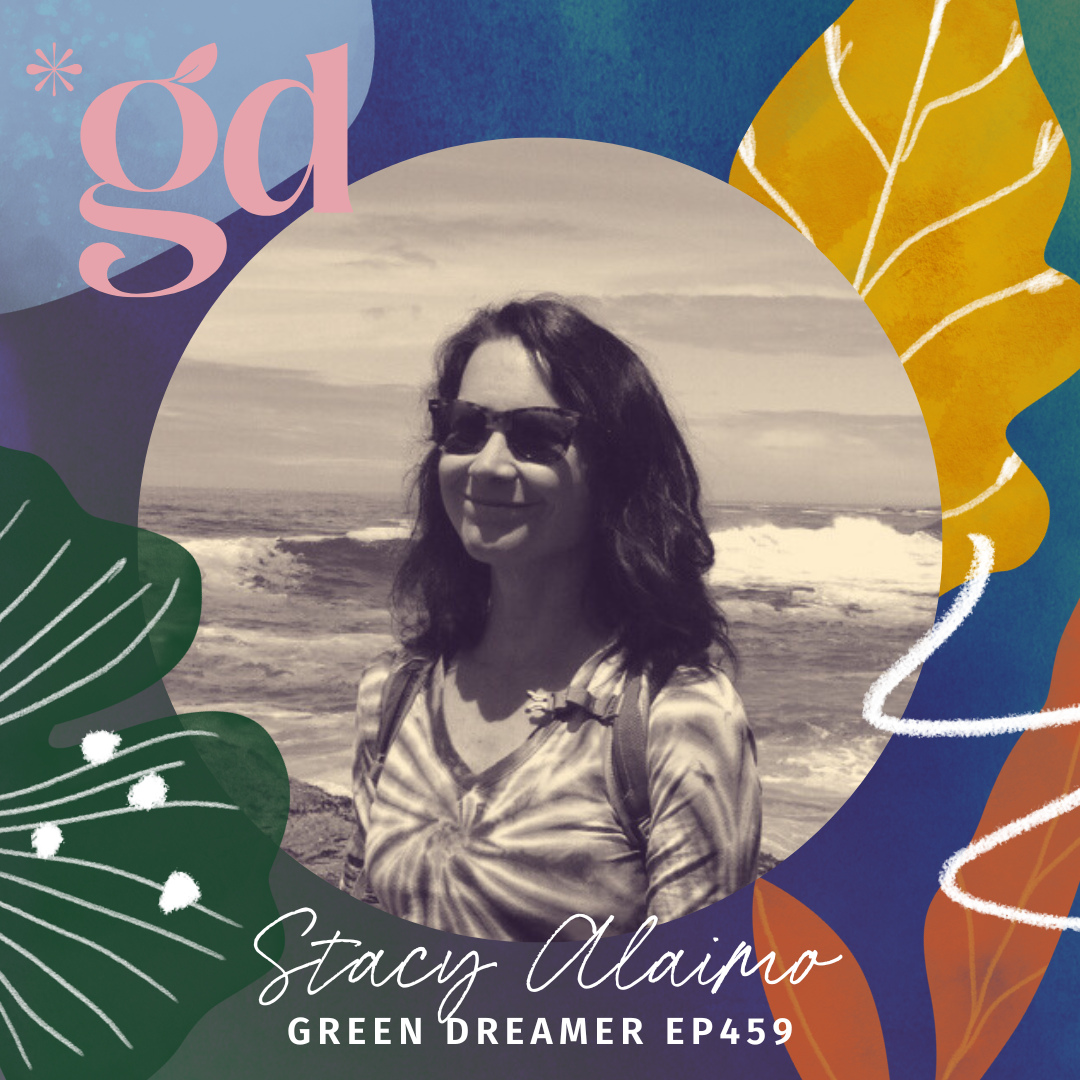
About our guest:
Stacy Alaimo is a Professor of English and Environmental Studies at the University of Oregon. She has written four books, two edited collections and many articles. Her work has been widely translated and reprinted. Her recent work focuses on the ocean, including her new book, The Abyss Stares Back: Encounters with Deep-Sea Life.
Artistic credits:
Song feature: “Lobotomy” by Oropendola (via Spirit House Records)
Episode artwork by gretchen blegen
Dive deeper:
The Abyss Stares Back: Encounters with Deep-Sea Life, a book by Stacy Alaimo
Watch the video “Blue Peril: a visual investigation of deep-sea mining in the Pacific” and learn more about the activist organization Blue Peril
Learn more about the works of Jacques Cousteau, Else Bostelmann, and William Beebe
Check out the Census of Marine Life
Learn more about the life of environmental scientist and activist Sylvia Earle
The Deep, a book by Claire Nouvian
Read this article: “Microplastics hinder plant photosynthesis, study finds, threatening millions with starvation”
How Far the Light Reaches: A Life in Ten Sea Creatures, a book by Sabrina Imbler
Expand your lenses:
Independent media is more important than ever! Please consider joining our Patreon or making a one-time donation today.
interview transcript
Disclaimer: Please note that Green Dreamer’s interviews are minimally edited (both audio and non-verbatim transcript) for clarity and brevity only. All statements should be understood as commentary based on publicly available information, and the views expressed in this interview are those of the guest and host only and do not necessarily reflect the views of Green Dreamer.
While we have made reasonable effort in our interview research and production process to ensure accuracy, we do not present our commentary as factual assertion and we are unable to guarantee the completeness or correctness of every piece of information shared. As such, we invite you to view our publications as references and starting points to dive more deeply into each topic and thread explored.
Kaméa Chayne: I think a lot of us go about our day-to-day lives without really thinking about deep seas and deep-sea life. But deep-sea life hasn't been able to escape the changes driven by industrial civilization, Western consumers, cultures. So, to start painting the picture here, what do we know about how deep-sea environments have already been altered by specific types of human activity, whether it's microplastics, trash, or even climate change at large?
Stacy Alaimo: Right, yeah, you put that so beautifully. There are so many different effects, and it depends on how far back you want to go. But of course, before oil was the main energy source, so before the substance that is causing climate change, whales were used for all sorts of things. Their bones were used for corsets and other things, but mainly their bodies were used for the production of oil.
And the whale hunting drove so many whales into extinction, but also lowered the population of the species that were left, which is weird to think about. But that profoundly must have affected it. We don't have actual science on this except for the fact that it must have happened, because there's a deep-sea ecosystem that's all organized around whale falls. So every time a whale dies and sinks to the very bottom of the sea, all of these creatures and species get to work eating the whale. And it's a whole ecosystem of food and a food web.
And when you calculate out how many, and I can't give you the exact numbers, I'm not a numbers person, but when you calculate out the immense numbers of whales that no longer exist that used to exist, you think all of those places where all of these species would have eaten the whale falls, those no longer exist. So I'm also a little bit obsessed with this idea of a kind of speculative reckoning with these harms that we may never know.
We may never know how many species various forces of capitalism, and colonialism, and everyday consumerism have pushed into extinction in the deep because there has been so little knowledge of the deep.
And yet with pollution, being radioactive pollution, plastic pollution, chemical pollution, you have all of those affecting various species. The warming of the waters, of course, is killing off coral reefs. Acidification is killing off creatures. Acidification is also known as the evil twin of climate change. And sound pollution, especially for whales, just regular shipping traffic, but also military traffic in the ocean that harms so many creatures. So there are just so many ways in which deep-sea life and other marine ecologies are being affected by just ordinary consumer practices.
Of course, I didn't even say industrialized fishing, which is the so-called bycatch, which is basically everything that's killed in order to catch just one kind of fish or a couple of kinds of fish. And just throwing away immense quantities of living creatures, killing them so that you can get this little bit over here. I mean, the harms to the ocean ecologies are just so immense that it's hard to even think it all through.
Kaméa Chayne: Yeah, and it's kind of like looking at geologic time as well, because we might think of life on land, above ground, everything settles. So people might study the layers of the Earth and be able to find out what happened or what might have happened in a particular time because of what settles and is now embedded within the living grounds of the Earth.
So it's kind of like, in the ocean, everything settles. So everything happening above water in the more shallow waters eventually, well, if they're dense enough, they will settle into the deeper parts of the ocean. So yeah, everything is entangled.
Stacy Alaimo:. Right, everything's entangled, everything has been affected by everything else. And then the immensity of the ocean and the fact that it's very expensive to do research, especially in the deep realms, means that there are so many things that we are, as humans, as industrialized humans in these capitalist networks, we’re entangled in these harms, even if we don't know it.
We're entangled in the harms, and yet we may never know exactly what those harms are. We sort of can't. They probably won't all be captured by science and scientific practices. And yet, of course, they're happening through the processes of industrialized fishing, mining, climate change, so many things. So they're ongoing, and yet we don't really see them. They’re invisible, they're unknown to us to a large degree.
Kaméa Chayne: Yeah. Well, I want to come back to art and aesthetics, because that's the core of a lot of your book, focusing on this relationship between science and the arts. And you talk about how there was a sort of separation between the arts and science in the 21st century.
And I had just never really thought about this or learned about this before. So I wonder if you can introduce a bit of a backdrop of what this references.
Stacy Alaimo: Yeah, so if you think about the 19th century and the traditions of naturalism and even Darwin, I've taught some of Darwin's works before, and students are always really surprised by how he tells stories. So when he's trying to break the news, the terrible news that humans are related to other creatures because of evolution [laughs], he gives all of these cute stories about animals adopting other animals, or animals learning things or doing funny things, all of these things to make it so that we wouldn't, or readers wouldn't, think that it was horrible to be related to other living creatures.
So there's that element in the 19th century of naturalism where art, and also stories and narratives, were not separate from real science. And then the beginning of the 20th century, when William Beebe was working, and I write mainly about his dives in the 1930s, there was a move away from those naturalist traditions, which included stories and art and other things, and a move toward what we would now think of as conventional Western science, being super objective and distancing the subject or the knower or the scientists from the object of study, and really objectifying the entity as something to study instead of something to be in a relationship with.
And of course, many Indigenous Scientific Knowledges and Traditional Ecological Knowledges and other things do not do that. But this imposition then meant that anything that pertained to the emotional or the aesthetic wasn't properly scientific. And also, gender was imposed upon that, and that was too sentimental, too female, and so you get the sort of masculinist hard science of objectivity being all about numbers and distancing and not caring about things.
What was interesting to me, in the 30s, was that William Beebe really wasn't happy with that idea of science. And there was a way in which what he was working on with the deep-sea creatures, he saw it so much as about these aesthetic and emotional encounters, and not as just a reduction of the living creature to a specimen.
Kaméa Chayne: Hmm. And before we go further with this question of how aesthetics affect conservation, I'm curious to take us to the foundations and ask, like, what does aesthetic in this context even mean? And do you feel like it's subjective and even culturally shaped in some way as well?
Stacy Alaimo: Yeah, absolutely. It's very difficult to define, and I struggled to define it. I definitely kept struggling in the book to try to define it [laughs]. And one of the readers for the book originally said something like, well, you should just say this is about the sublime.
I said, it's not about the sublime because what I'm focusing on more is what I'm just calling a creaturely aesthetic, which is basically not about the ocean as, [gasps] this vast sublime force. You're looking across the surface at wind and waves, and it's immense. And you can never capture it, and you're overwhelmed. That's more like the idea of the sublime. To me...
What I was interested in was the way in which particular creatures are portrayed as if they are encountering you, as if there’s a sense of here it is, it’s encountering you. And it’s a call to really reckon with that creature as a being in and of itself, rather than a sort of vast oceanic expanse.
Kaméa Chayne: Yeah, thank you for clarifying that. And I guess this is a little bit different, but I currently live in a biome that is historically a mesic forest. But due to colonial plantations taking over and cattle ranching and other things that have happened, the whole region today has pockets that look very different and have different configurations of life forms.
But when people come and visit, they might say like, this more, quote unquote, wild and forested area looks really messy. Or, this other person's house, it looks so nice because it has this neatly manicured lawn.
So I think about the aesthetic of the lawn and how our sense of aesthetics and taste for what we're drawn to can kind of be shaped by our knowledge, our culture, etc. So, you know, I might see big grasslands in a place where I know it's been deforested, and I see aesthetics of grief and dreams of what could be if things were reforested, whereas other people might see aesthetics of luxury, or development, or advancement.
And I know for a creaturely aesthetic, it's very different, but I do wonder, because you talk about these sorts of hierarchies, or even like we've talked about charismatic creatures before. And yeah, I don't know what the answer is, but I'm just curious, how do we know what's considered charismatic to us to begin with, and what's cuter or less cute, because that's so subjective as well?
Stacy Alaimo: Right, yeah, I agree. I agree that it's completely subjective. And yet, I also, in the research, found patterns of different kinds of ways of portraying the creatures. So some are adorable, or just beautiful, or wondrous, or marvelous, and provoke a sense of awe.
But then there's also this strand about the alien and seeing them as alien creatures in an alien zone, and we could talk about that too. But I do have to say, I completely agree with you about the lawn and the aesthetic of the lawn. To me, when I see the aesthetic of the lawn, I think, death. I just think there's nothing there. The so-called clean yard means that there are no sticks for birds or other creatures to pick up to make their nests or their homes with. There's hardly any insects, and baby birds have to have insects to survive. There's just nothing there. There's no nectar for them. There's nothing there for them, for birds, for butterflies, for bees, for any living creatures. And that's why I transformed my two empty, dead lawns that I had when I bought the house into this native plant paradise for all of the creatures.
But getting people to think differently about that aesthetic is really hard. When my mother was visiting, she was so horrified that I had a pile of sticks in my yard [laughs]. And she keeps asking, she still asks me about it eight months later, have you gotten rid of those sticks yet? And I keep saying, mom, they're hidden in those trees, and they're there because the animals need them. They need the sticks for shelter and for building their nests. This is what you do when you try to make your yard into more of a habitat for creatures. You have little piles of stones or piles of sticks for them, and she just wants it all to be empty and looking clean and orderly.
But I think, actually, even though this seems like a tangent, it actually connects to the ideas of modern science and also the domination of nature. This sense that we are supposed to externalize something called nature over there, and we're supposed to dominate it, and it's an inert resource. It's there to be molded, dominated, flattened.
If the Anthropocene is anything, it’s that human forces have basically made everything flat, boring, homogenous, the same looking, and have literally erased or destroyed so much biodiversity by just paving everything, building over everything, cutting down all the trees. And you just think, what will be left?
We don't see deep-sea corals that are in such deep water, and the trawlers go out and try to catch the fish that are on these deep-sea corals. And the deep-sea corals live for hundreds and hundreds, if not thousands, of years, and they just get decimated, and then they're gone, and then the life has no habitat.
So I think the lawn is very much like that. But it's also just part of this mindset of instead interacting with other living creatures and part of relationalities in which other beings have their own agencies, and they're doing things in ecosystems and relationships, the whole world is sort of just waiting for humans to just do whatever we want to do to it, use it in whatever way. I think it's all related.
Kaméa Chayne: Yeah. Thank you for connecting the dots. Cause yeah, like we said, everything is entangled, and the lawn very much is, like, a very relatable representation, I guess, of cultures and systems that have created the ripple effects that now are affecting, and have affected the deep seas. And I hear about, like, the thousand-year-old corals that you just mentioned.
And I'm just thinking, like, people worship ancient trees. You know, they're massive and majestic and so beautiful. And there have been stories of people. I forgot the name of the activists who lived on top of a thousand-year-old tree for hundreds of days to prevent logging companies from cutting the tree down. So there are stories like that.
And here we are just bottom trawling, you know, on a day-to-day basis, digging up and killing these thousand-year-old corals that people haven't even really known existed or haven't really reckoned with. So I think that just speaks to the contrast that you talk about a lot in terms of that distance and strangeness of creatures that are much farther away and that we might not ever fully understand and come to know, but they're there. And there is a sort of reckoning that we need to do.
Is there anything else you want to add to this before I bring in more parts of your book that I am curious about?
Stacy Alaimo: Yeah, absolutely. And there are some things that we can do insofar as, say, not buying fish from industrialized fishing. I don't know, it's hard to figure that out. But this massive scale of industrialized fishing, whether it's from trawling or the long lines, is incredibly destructive. So, yeah, I know it's kind of boring, but really consumer practices, because there are so many people on the planet that, I think, they really can have an effect when individuals change their practices as far as consumerism and what they buy, and being mindful of that.
Kaméa Chayne: Yeah, because everything's connected. There's a part of the book where you talk about the beauty pageant in ecology. And there's this website about deep-sea creatures where every animal is, quote, “objectified, coded, described, framed, and removed from its ocean background and replaced with a black one.” End quote.
I think there's a lot to say in terms of how this form of trying to study another species reflects broader scientific approaches to kind of reduce, isolate, and separate. And at the same time, at least for people, you know, sometimes people do environmental portraits of themselves or their pets in like environmental settings where they live or that they love. And then for the other contexts or purposes, they might take portraits of just the person or just their dog sitting in front of a colored backdrop because they want to focus on the individual in that way.
And so I can see some people saying, this is just a matter of creative choice and preference, and there's no need to overanalyze the meaning behind the form. But what would you say to this in regard to conservation art and photography?
And how would you elaborate on this quote, also, that “images are a product of Western science. Such universalized images don't align with Indigenous knowledge?” End quote.
Stacy Alaimo: Yeah, so the universalized images, I'm thinking there about how something like the Census for Marine Life is putting the images out in a way that anybody, meaning, of course, an assumption that it's a kind of universalized perspective and a global environmental vision, that that's what they're being framed for. Whereas different Indigenous or Oceanic peoples would have different relationships to those creatures, perhaps.
So the contrast here would be something like the Blue Peril video, which is an activist video against deep-sea mining. And that has an explicit Indigenous framing, which is really interesting because the people who are talking are voicing their perspectives as oceanic peoples and what the mining would do to them, but also to life and living creatures.
And there's no sort of removal of or distancing from that because that is the kinship network and the kind of cosmological vision of that place. Then, interestingly, in that video, they also have these scientific visualizations and data captures of the fact that there are so many creatures on the seafloor because, of course, the mining companies are saying that there's no life there, and there's this idea of no life there.
So that's a really different framing because whenever you have something like kinship, obviously, or interconnection, then it's not an objectification, or a distancing, or a putting aside. I worry about this with clickbait images, a kind of momentary, that's cool, or with deep-sea creatures as weird. Like, that one's really cool, that one's really beautiful. But after you're done clicking through them for 30 seconds, they're gone, and you never think about them again. You have no sense of connection or responsibility, or anything else.
But with the census framings, I'm ambivalent about those because on the one hand, I do think that they are created for a kind of universal spectator. In terms of colonialism, I think it's really important to think about the kind of universal position as being, default white, Western, and all of that, and colonial. And yet, I also think what they're trying to do with those framings, which take the creatures out of their environments and make this consistent black background and have this very highly stylized image, I think what they're trying to do there is have the frame be a recognition of the value of the creature.
Really, there's a kind of caring or seeing the creature as precious, as worthy of being valued and put up and held, maybe within the frame. So instead of being captured in the frame, maybe held more lovingly or caringly within those frames. The book that does this the best, I think, is Claire Nouvian’s book, The Deep.
And look, it's gigantic. But all of the creatures, the way that she positions them on the page, she's very, very careful about her positioning and the way in which, oftentimes, it looks like the creatures are looking right at you, or moving toward you, and really trying to have a kind of relationship with the creatures.
The aesthetic black background, which she made consistent, and that was an artistic choice she made consistently through that book, I think, makes it very dramatic. I also think even though there's an intimacy, a weird intimacy with having that creature literally like in your hands as a person sitting in your own living room, you have this deep-sea creature that is just mind-blowingly, bizarre looking and gorgeous, and adorable, and all of these things right here with you.
I also think that there's a sense in which, as these creatures float in their black background, there’s this one without an explicit framing, this one is more just floating in a black background, and you get this sense of how lucky we are to even have a glimpse of it. Because if you imagine the expanse of the dark seas and how far their volumetric immensity extends, how far they expand vertically, but also horizontally. And then somehow they managed to capture a photograph of one of these creatures as they went by. The lack of framing in that book, also, because it's so carefully designed, can make it another sort of loving, appreciative gesture meant to provoke relationality and awe.
Kaméa Chayne: Yeah, I'm so inspired and impressed because I feel like these are such subtle differences, and maybe not so subtle. I think, yeah, for a lot of people, when we look through these images, we're not really consciously thinking about how this is presented. Like, how are they portraying this subject that we're being invited to look at, and how is that affecting my perception of what I'm looking at?
And yeah, very important for you to be pointing out the subjective lens through which these images essentially are captured and then portrayed and displayed. Because yeah, I think a lot of this, as you mentioned, is about context, and even attempts at trying to objectify the subject are themselves subjective as well. Like the ways that they try to make this an objective display itself is subjective because that's not how other people would kind of relate to that being.
I know that you got to see Monterey Bay Aquarium’s 2022 exhibit called “Into the Deep,” but you had a kind of jarring experience when you were denied being able to even ask questions of the exhibit designers while you saw others, maybe big donors, receiving special tours.
So it leads me to this bigger question of, what do we know about how money interests are tied to the science, and research, and displays of deep-sea life?
Stacy Alaimo: Yeah, that's a good question. And I wish I knew more. One of the things that was mysterious about that exhibit was the question of how they captured these creatures, because they had a lot of living deep-sea life in aquariums at the exhibit. Because deep-sea animals live so far down, they can't ordinarily be pulled up and captured because they just kind of disintegrate, or something terrible happens to them. I mean, they're not going to survive that shift in pressure.
And they said in the film that some of them were caught as they did their diurnal vertical migration from the bottom to the surface waters. But it was still a little bit vague. And I don't know if the reason why they seemed so threatened by the fact that I was writing about the exhibit, if that had to do with worries about something being disclosed about the way the animals were treated. I really don't know. I mean, I have no idea what was going on there. I found it very, very strange, especially in terms of the way in which people usually make hierarchies of animals that deserve protection. People don't usually worry about hurting jellyfish or something. It was all very strange.
And I felt, I mean, it was very moving to see some of these creatures in real life and like right there. But in another way, I actually ended up thinking that I enjoy the photographic representations and the videos so much more, partly because I don't like animal capture and zoos, and the idea of containing animals in that way.
But also, there's something to me that's, and this is something I talk about a lot in the book, I think that some of the photographic representations or the paintings of Else Bostelmann put the responsibility on the viewer to then speculate about the creature, and then speculate about what the whole biome of the deep sea is like. So you're pulled into this aesthetic relationship with this creature, and then there's a mediated intimacy.
So, very highly mediated, but still a sense of intimacy, even though the creature is not real. And then you speculate about the being of that creature and the way in which it lives and what the biome is like. And I think there's something about being in an exhibit where a lot of jellyfish or other beings from the deep are just in a tank and they're right there in front of you. And it's noisy, it's bright, and you're so far away from the world in which these animals live, that I felt very bad for them being in the cages, or the aquariums, sort of like cages. I felt very bad for them, and it just wasn't as inspiring to me as the photographs are.
//musical intermission//
Kaméa Chayne: That was actually one of my personal curiosities is whether these tanks are pressurized in some way to allow the deep-sea creatures to be able to live in these displays?
Stacy Alaimo: Yeah, I'm curious about it too, and I just couldn't find very much information.
Kaméa Chayne: Well, hopefully, we will slowly get to learn more information on this. In the beginning, I asked questions about how deep-sea life has already been transformed by certain types of human activity because everything is entangled.
And I want to circle back to also ask the reverse, which is that despite many people not knowing much about deep-sea life and finding it distant and strange, what are the ways that our land biomes are known to be impacted by the deep seas?
Or is even asking this question in a way kind of human-centred in that, like, do we need to know how they impact us to garner interest and care?
Stacy Alaimo: Yeah, that's a great question. I'm only going to be able to give you the most abstract answer, which is that all of the ocean ecologies are interconnected. When people are talking about what could happen with deep sea mining, because deep-sea mining, the scale of it is so enormous that most people think that it will be catastrophic to deep-sea ecologies.
Deep-sea ecologies are interconnected with the entire ocean ecologies. And so the ocean ecologies are already experiencing so many different forms of harm. And the most dramatic effect that we would have on land is a lack of oxygen. So a lot of the environmental scientists who are also activists, people like Sylvia Earle, for example, who's really well known, she'll talk about how every third breath that we take is oxygen from ocean life. And so if all ocean life is interconnected, and then…
If the ocean ecosystems are decimated to the point where we just have a massive die-off of plankton and other things, it’s going to be very difficult to have oxygen on land because the air is global and the oceans are global, and it’s all interconnected.
So that's pretty terrifying. Another kind of weird interconnection would be something like, they found that microplastics are in the deepest areas of the ocean, inside the guts of creatures. So, deep-sea animals at the very bottom of the sea are already ingesting microplastics.
And then I saw something the other day about how microplastics are affecting the photosynthesis of plants. And so then you think, oh wow, if we mess up photosynthesis, that is not good. The photo that they had in the Guardian article was like a big industrial farm. So yes, farms, but then also trees, every plant, if you think of photosynthesis not working because of microplastics. Yeah, so oxygen, microplastics, photosynthesis.
It's so hard to teach environmental classes right now because I think so many of the issues we're looking at are so dire, and it's hard to even have people understand the interconnectivity of these issues, but then also just not be in despair because it's extreme.
Kaméa Chayne: Yeah. Dire and entangled and immense. With our last conversation about transcorporeality, it's like you have to think through everything all at once. And it's hard to just pixelate and decontextualize this one issue and just look at this alone.
But I guess one analogy that I might think of when you talk about deep-sea mining and destroying the bottom of the ocean is maybe thinking about soils. So there's so much life in rich and healthy soils, but people might not think about it. But if you were to move through it with something like a tilling machine or something, and dig everything up, maybe, you know, most people see trees and things above ground, but like whatever is happening at the foundations of that affects everything above it.
Because it's so hard for a lot of us to conceptualize what this could mean. Maybe that's one way to start to look at it in a more relatable way. Like this would be a giant tilling machine in the deep oceans, and disturbing the foundations of the ocean itself would have massive implications and ripple effects that it would have for everything else above it and further below it. So yeah.
Stacy Alaimo: Mmhmm. Absolutely. Yeah, I love that analogy. And that takes us back to the issue of lawns, too, because people think they can just dump whatever chemicals they want in their yard, and everything will just be fine to make it look all clean and perfect. But those chemicals stay there, they kill things, and then it's, yeah, it destroys the whole ecosystem and all of the things we've been learning about. And trees communicating, and the microrhizomes, and all the fungi, and the importance of soil as all sorts of just interrelated beings and systems, and yeah.
Kaméa Chayne: Yeah, as we start to wind down our conversation, I think I'm interested in exploring caring for the unknown a little more. So, I recently spoke with Waorani leader, Nemonte Nenquimo, and her husband and partner, Mitch Anderson, who are both speaking up for the Indigenous sovereignty of communities in the Amazon, including communities that are still intact parts of the forest without roads, without access to the internet.
So I presume a lot of them might not know much about the deep seas, what they look like, or the latest findings about their threats to extinction. I think one could say that because they don't know, they don't have personal care or direct care for these deep-sea creatures. But I feel like the ways that they're living, and loving, and in good relation with their own forest communities, means that even without their knowing, they're also loving and caring for the deep seas.
So I guess it makes me think about this paradox of knowing versus not knowing, where sometimes it's framed as people destroying what they don't understand or know. And then other philosophers might frame it as people destroy things in their attempts to know. So with all of this, I'm just like, first of all, who does “people” refer to? And then also maybe it's not really about whether we know or not. And maybe loving isn't necessarily tied to knowing, but just like, we are in good and intimate relation with our own webs of life, human and more-than-human, given that everything is entangled.
And, you know, the love and care that we have for our own lands and waters ripple off, not in like a water cycle or carbon cycle, but maybe like a care cycle or a love cycle. So, yeah, curious what bubbles up for you here.
Stacy Alaimo: That's really beautiful. I love that. I think the first thing that comes to mind is Western systems of knowledge. I mean, I'm a professor, so the ways in which knowledge, or the practice of knowing, is so disconnected from love or care or any kind of relationality or ethics that knowing becomes instrumental, or a means of capitalist production, or a means of surviving within capitalism, that knowledge is completely disconnected from ethics almost entirely.
You have, of course, with various Indigenous cultures, just such a better way of thinking about knowing and relationality, and reciprocity and care, and love and interconnection.
And then, when you think about the standard Western models of knowledge with which feminists and post-humanists and other people have also critiqued, not from Indigenous perspectives but from other perspectives, say feminist science studies or other fields, it's almost very difficult to encourage people to think about how you could change your epistemology. In new materialism, we talk about an onto-epistemology, how being and knowing are entangled and deeply intertwined.
What does it mean to try to move? If you've been trained in this sense of what is objective knowledge, what is acceptable, what is the way that we are supposed to know things, if you're trained in that, what does it mean to try to shift into a sense of onto-epistemology, meaning the very way that you know is entangled with how you are, your being? And how do you do that?
How do you disconnect from these dominant, and dominating, and mastering, and objectifying modes of knowledge? It's hard, even in environmental studies or other areas where you think it wouldn't be hard, it is. And then everything that seems like it's the sort of normal of industrialized culture is all oriented toward knowledge as a mode of domination, predominantly, I think.
Kaméa Chayne: Hmm. Well, we are coming towards a close here, but I know one of your fundamental questions is, what would it take for us to care about the deep sea? So I'm curious where you landed on with this question, and also want to invite you to share anything else that I didn't get to ask you about.
Stacy Alaimo: So, it's funny at this moment, given the political situation in the United States, I feel like my book is coming out at this moment when, of course, there are so, so many things that everybody needs to care about, and fight for, and change, and confront, and survive. And then it would be easy to say, well, since there are all these more important things, we shouldn't care about the deep sea. I guess I want to stick with a radical sense that everything matters and all beings matter and all ecosystems matter and all life worlds matter.
And that at this moment, when we do have so many things to confront that are deeply disturbing, that we should take the leap and envision boldly and bravely, and really try to think about the fact that because we're already entangled and causing so many harms, and the “we” there would be people who are settler colonialists, and colonizers, and middle-class consumers, and the people doing the most damage. They are not a universal “we.” Then there's a responsibility to care about everything that that group is affecting.
Kaméa Chayne: I guess one of my follow up questions there is, I wonder if sometimes it's not, for example, that a lot of people don't care per se, but a lot of people are being exploited, and extracted from, and being overworked by the same capitalist, corporatist, colonialist, imperialist interests as the ones that are affecting the deep sea.
So maybe there's no clean way to subtract deep-sea mining or things affecting the deep seas without cancelling extractive forces and exploitative forces altogether. Because it is very immense to think about, like we mentioned.
Stacy Alaimo: Right. Yeah, absolutely. And human labor, and class, and desperation, and colonialism, the ravages of colonialism. But also, I think that on some of these huge industrialized fishing boats and things, I think there are actually enslaved people and enslaved laborers that are doing some of this work. So I'm really glad that you pointed that out, these interconnections there.
And the massive industrialized fishing which really harms the deep sea, but also other marine environments, has a terrible impact on local people, island peoples, because they could have been fishing the same way for millennia, but now everything is wiped out, and the trawlers and industrialized fishers have to go further and further and deeper and deeper, but local people with their small boats and their communities, there's nothing left for them to eat. There's nothing left to fish because it's been destroyed.
I would say that all of the ocean conservation questions, including the deep sea, are also definitely social justice questions and questions of Indigenous sovereignty and social justice.
Even though I'm looking mainly at a lot of the more mainstream and scientific perspectives on this ocean life, there's also a huge dimension of this that it really is about social justice and Indigenous sovereignty.
// musical intermission //
Kaméa Chayne: What has been one of the most impactful books you've read lately or publications you follow?
Stacy Alaimo: I'm teaching this book right now by Sabrina Imbler, How Far the Light Reaches: A Life in Ten Sea Creatures. And Imbler is a non-binary and mixed-race person who is thinking through so many intimate things about their life, but via this knowledge about different sea creatures. So it's a really interesting juxtaposition of information about a sea creature, say cuttlefish, and how cuttlefish live, and then about the whole experience of transitioning in terms of gender.
And then another one is about the hybridity of race and whether or not they can relate that to a sea creature, or whether they shouldn't be doing that. I think it's so interesting to think about this kind of intimate reflection on one's own being and identity in terms of these species that are not pets. It's not a domesticated animal. It's not a dog, but they only really know the creatures for the most part through scientific information. And yet it's a very personal book. My students, I think, are really enjoying it.
Kaméa Chayne: Thank you for the recommendation. What is a motto, mantra, or practice you engage with to stay grounded?
Stacy Alaimo: The practice would be gardening, habitat gardening for sure. It immediately makes me feel better to be outside and to know that I'm planting for the birds and the butterflies and the bees and doing something really tangible because my work is a lot of scholarship and reading, and just to be having my hands in the dirt and then see the birds come after I plant the flowers for them is just immensely satisfying. I need to do something tangible because I spend way too much time thinking about these disturbing environmental issues [laughs].
Kaméa Chayne: Yeah. And finally, what is one of your greatest sources of inspiration at the moment?
Stacy Alaimo: I am inspired by everybody who doesn't turn away from difficult things, but tries to confront them, do activism, do something that will make things better in whatever way they can. So this would include all sorts of people.
Kaméa Chayne: Well, Stacy, it's been an honor to share this time and second conversation with you for the podcast. And as we close off here, where can people go to support your work, get your book, and what closing words of wisdom do you want to leave us with as Green Dreamers?
Stacy Alaimo: Well, my book is published by the University of Minnesota Press, so you can order it directly from the University of Minnesota Press site or from any other place that sells books.
Oh, what is my wisdom! I found the COVID era, of course, the pandemic lockdown was so difficult. And I'm turning back now to a lot of things I was thinking then, of how do you get through times that are very difficult, because I am finding this time to be very difficult and concerning. Obviously, protests, or support whatever causes you are passionate about in whatever way you can.
But then also, I think it's important to give yourself some peace and have some kind of practice that promotes peace and calm and tranquillity, and to know that if you're practicing calm and tranquillity, you can actually reset yourself a little bit to be more grounded and more tranquil.
One of the things that helps me is definitely to give myself a little time every day to contemplate something really beautiful.
And that might feel really flimsy or not up to the task of the immense challenges we're facing. But I do think that allowing yourself to look at a bird, or a flower, or the sky, even though that sounds really cheesy, actually has a real effect and connects us beyond our screens, and connects us to the world in ways that are deeply nourishing and sustaining.
And we need to take care of ourselves, to try to take care of the world.