
Sophia Kai: Finding belonging within a fractured world (Ep473)
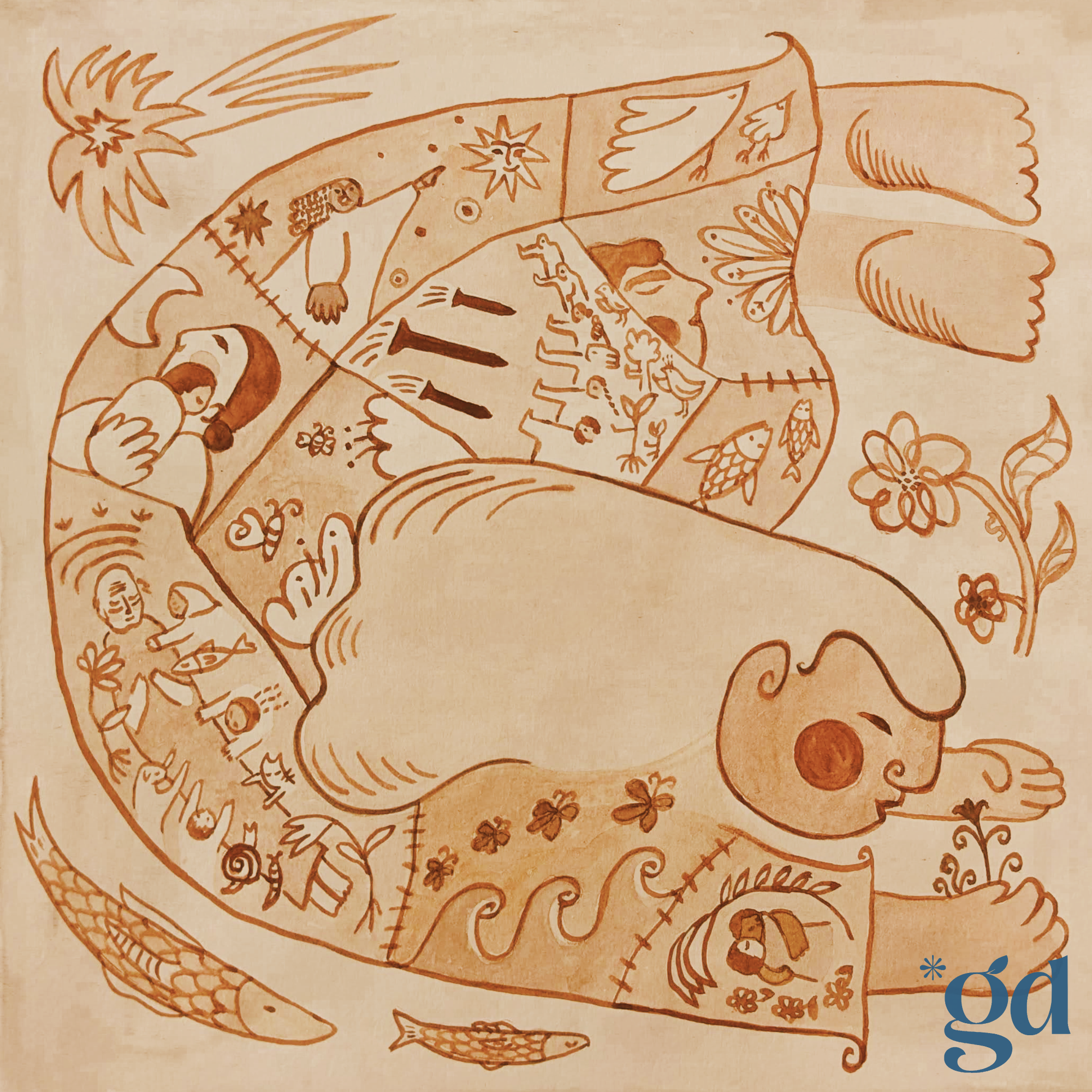
“Belonging, essentially, to me, comes from the ability to truly belong anywhere, whether or not we’re accepted, to be ourselves, whether or not that is validated by an external perspective.”
What does belonging mean within a fractured world? How do we liberate ourselves from systems that attempt to turn us into mere cogs in a machine? What can sitting with the paradoxes of being human teach us?
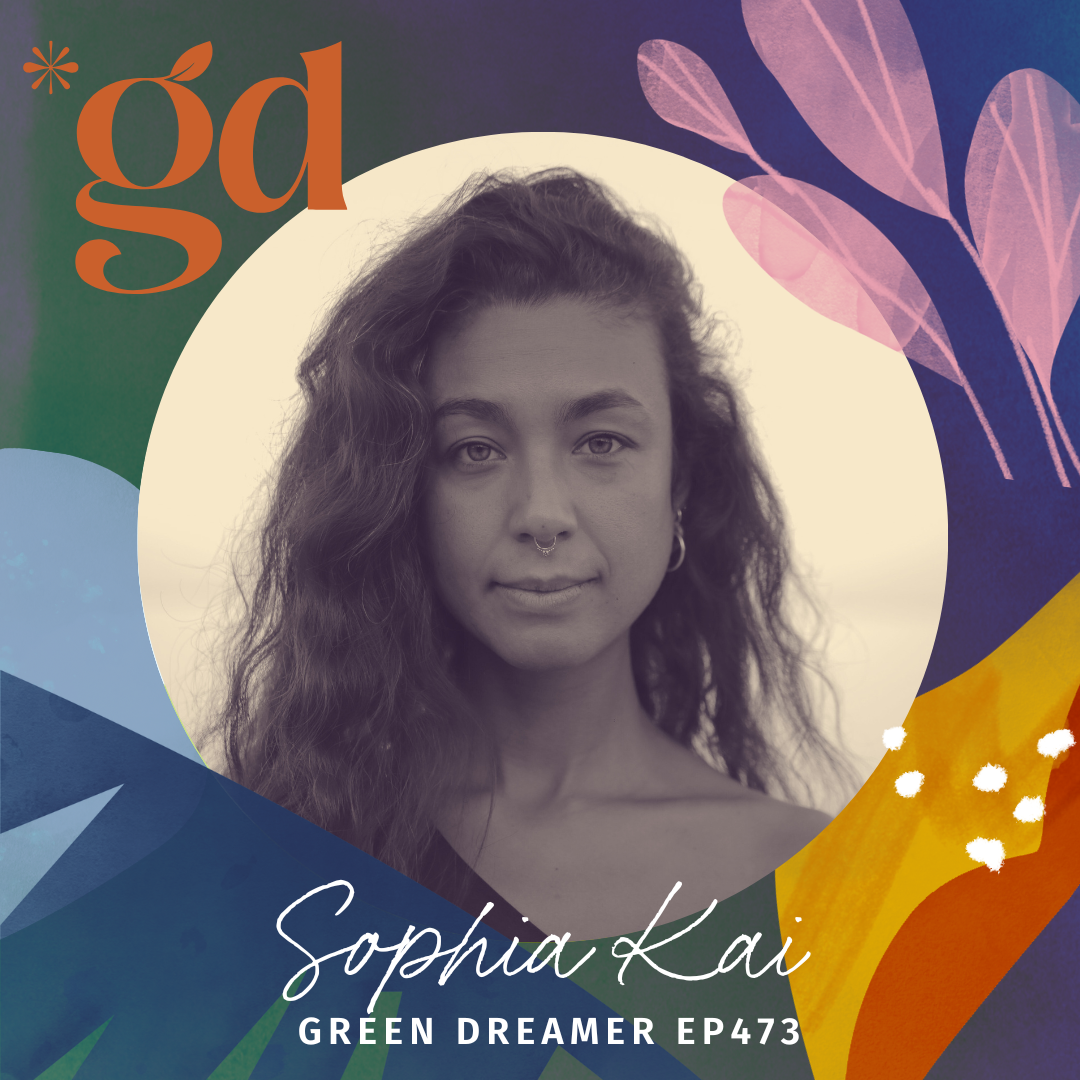
In this episode, Green Dreamer’s Kaméa Chayne speaks with Sophia Kai of Journey of the Soul, whose work lives at the crossroads of world, folk, and medicine music — blending languages, poetry and healing into musical journeys that transcend borders and open the heart of humanity.
Join us as we unravel the messiness of being human in these troubled times, and contemplate where journeying toward a collective remembrance may lead us.
We invite you to…
tune in and subscribe to Green Dreamer via any podcast app;
tap into our bonus extended and video version of this conversation on Patreon here;
and read highlights from these conversations via Kaméa’s newsletter here.
About our guest:
Sophia Kai is a poet and musician born to a Sri Lankan–East African mother and a Greek father, raised across continents in a home alive with many languages, cultures and contradictions. She discovered music young through her older brother Sebastian, later teaching herself to sing and play guitar. What began as expression became a way of prayer, grief and transformation; her voice became a bridge across borders, carrying her own journey into songs that heal and reflect our collective heart.
Still a nomad at heart, she has journeyed through convents, city streets, temples, firelit circles and countless border crossings to learn and to share. Her concerts are as intimate and immersive as her art: part ritual, part performance, part medicinal journey.
Sophia’s work lives at the crossroads of world, folk, and medicine music, blending languages, poetry and healing into musical journeys that transcend borders and open the heart of humanity.
Artistic credits:
Episode artwork: Haruka Aoki
Song features: “Touchée” (Live in Corfu) and “Ultima Luz” by Sophia Kai
Dive deeper:
Support Sophia’s music and poetry, and stay up to date with her upcoming concerts and live performances (Instagram: @journalofthesoul)
Journal of the Soul: Records of the Returning Psyche, a poetry book by Sophia Kai
Brave New World, a book by Aldous Huxley
Expand your lenses:
Independent media is more important than ever! Please consider joining our Patreon or making a one-time donation today.
interview transcript
Disclaimer: Please note that Green Dreamer’s interviews are minimally edited (both audio and non-verbatim transcript) for clarity and brevity only. All statements should be understood as commentary based on publicly available information, and the views expressed in this interview are those of the guest and host only and do not necessarily reflect the views of Green Dreamer.
While we have made reasonable effort in our interview research and production process to ensure accuracy, we do not present our commentary as factual assertion and we are unable to guarantee the completeness or correctness of every piece of information shared. As such, we invite you to view our publications as references and starting points to dive more deeply into each topic and thread explored. Thank you for adventuring with us.
Kaméa Chayne: When you talk about this culturally textured background that you grew up in, you write, quote, "It was within this mixture that she first encountered both belonging and fracture, love and prejudice, light and shadow," end quote. And I'm particularly interested in the both and of belonging and fracture that you name.
And I'm wondering how you'd like to elaborate on, like, how you've navigated questions of belonging as someone whose lineages are so tributary and spread out coming from different sources. And at the same time that you personally feel like a nomad at heart?
Sophia Kai: Yeah, well, it's really such a topic that carries so much. I remember struggling to squeeze all that information into one paragraph, and everything that I carried with it emotionally. And actually, growing up, I carried so much shame. And that is what I was referring to with fracture. And I really felt like fracture was the word that summed it up the best because there was so much inherited, internalized shame for issues that I didn't even believe were issues when it came down to it.
I remember something as simple as my elders, mother, grandmother, aunties, really with the best intentions at heart, rushing us out of the sun. And anyone of mixed background understands this, I believe, to a certain degree. It's something deep. It's something very deep that runs inside of us. And it isn't ours. Because I look around today and I get very dark in summer right now I'm at my palest point of the year. Actually, it gets even more pale than this, it's almost yellow in winter. And when I get very, very dark in summer, that was a huge fear of mine, because even though I deeply within found that beautiful, if I really tap into how I saw myself as a child back then, how I saw my aunties and mother, I thought they were beautiful.
But because of the way I saw people changing with me between May and August, in the village, particularly in Greece. I saw their eyes changing and gradually deteriorating. Their gaze was becoming more and more disrespectful and more and more impatient, more and more derogatory. And so because of this, I started to see myself through their lens, which is inevitable as a child. We're really absorbing what everyone, what the world projects upon us. And then we start to project that upon the world and upon ourselves, isn't it? So at least that's how I see it.
And so it was really a battle in and of itself, just this one thing alone. I remember as well, just the little other things that came with our cultural background. For example, the smells of our food, or the way our family members related among themselves, the expressions, the hand gestures, the head gestures, everything like this. When I perceived and observed how it was perceived from the outside in, yeah, it takes a really strong spirit to not allow that to affect your own vision of your own family and lineage. And that's where I think the trauma gets recycled, is that we start to project what a skewed vision of the world is projecting upon something that we came from. It's kind of like we're severing ourselves from our roots by adopting this skewed vision that others have projected upon us, just because they didn't know any better.
Now I've seen as social media expanded over the years, and it grew from becoming family networks, like Facebook was back then, where you're just relating to your families and neighbors, started becoming global network where people had access to first news channels and media channels. And then they started having access to celebrities and influencers and this grew and grew and grew. And people were exposed to all different cultures and then I saw the trends changing, and that was very interesting to perceive.
So to bring it back to what you asked initially about belonging and fracture, belonging, essentially, to me, comes from the ability to truly belong anywhere, whether or not we're accepted, to be ourselves, whether or not that is validated by an external perspective. That is what I had to learn and what any person who is subject to that level of fracture or fragmentation from their own lineage has to eventually learn is, where do I belong and what actually is belonging?
Belonging is being, to me, it's being myself. It's being authentic to my values at any given moment and being true in my expression, as honest as I can be in my expression and trying not to allow those projections to influence the way I express myself in the world.
Kaméa Chayne: Given all of the fractures that you had to navigate early on, I mean a lot of us are still on this journey to rewire the ways that we've been shaped when we were little, but I'm curious what was it that invited you to really reflect on this and to become more comfortable with embracing your full authentic self?
Sophia Kai: I think it was a series of things. If I go back, I could give so many different examples that just kept reinforcing this. And ultimately, I think it comes down to life just continuously presenting us with lessons, hardships, and celebrations. And then these kind of just mix together and we start to really simmer and become ourselves in that process. I think it really just is the years of life and the formative years. And I don't mean education in the conventional sense of the word. I mean, formative in terms of going through the challenges and weatherings of life and coming out on the other side intact, but changed, but intact.
So with each difficulty comes a new opportunity. For me at least it's been this way with each deep deep grief, loss, heartache, change, redirectioning, has come a deeper sense of belonging because each time at the end of the day we're here alone with our consciousness. And if I'm to give a few more concrete examples whether it was picking up all of our things and leaving very abruptly and suddenly from the States when I was eight years old moving to a completely different climate, different place, different languages, rerouting, again not belonging, to the slow deterioration of the family nucleus and each member of the family dispersing in a different direction, to a very very tragic, tragic events happening in our own family, and in the world. When I sit with each of those periods of time if my brain is to go back to one specific moment, which it just did so I'm just going to go with that one.
I'm sitting on my friend's couch in London where I was working at that time, and this was in 2017 with my good friend Lily. She asked me, Sophia, how do you still try to stay kind and still try to keep walking forward? Something along these lines, she phrased it, when life has been so hard on you. And I remember just thinking in that moment, because what's the point otherwise? Really? What is the point otherwise if not to find deeper meaning in every single challenge, every single fracture, every single time we're split from ourselves to come back and merge with ourselves even deeper? I don't see another point or another purpose.
And then the other memory that comes is, you know, in the States, in very dense consumerist environments, they always have wishing wells, kind of like the Vatican and other places. There's a lot of places for people to throw their money. There's wishing wells for little children to go and make wishes. Most of the time, I think that this might be a little strategy because I don't see wishing wells in the park. I see wishing wells in the malls. And I think this was a lot of the time a strategy to encourage children to wish for this toy or that toy, and then the parents want to make the child happy and they do it. So I used to sit, well, stand on the edge of those wishing well and throw my nickel into the wishing well. And I just had one wish in my heart. And it was truly just to be an instrument of whatever is good and whatever is peaceful. And I felt that so deeply. I just wanted to do good.
And I'm not saying I've always managed. I've certainly made my mistakes and allowed the fracture to influence my way of seeing the world and allowed my own traumas to affect my actions and my choices at times in life. But I think fundamentally, if that's our intention is to really contribute to a better world in some small or large way, then our difficulties will only ever translate into some form of strength or some form of wisdom. It's inevitable. It's like this just generator that we place in ourselves as soon as we have this intention that I want my heart to always stay pure and I truly want to always do good in this world, and to just be of service in whatever way I can. If that's an intention that we have set in our heart, there is no way that anything life throws won't be transformed into energy. That's how I feel about it anyway.
Kaméa Chayne: Well I'm having like chills up and down my arms as I hear you speak, and I guess I would ask you, if you could go back to speak with your younger self at a moment when Sophia, little Sophia, was feeling the most fractured and the most defeated by these, yeah, external fractures that were around you what would you tell her?
Sophia Kai: This is all part of the story keep going it'll be worth it.
Kaméa Chayne: You posted this graphic on the definition of humanity which in part names humanity as human beings collectively, and then also just the quality of being humane, benevolence, with synonyms such as compassion, kindness, goodness, tenderness, mercy, generosity, charity.
So there seems to be all of these positive connotations and traits associated with definitions of what it means to be human, which then becomes interesting when we think about how given all of the multi-layered crises of today, especially in like the environmental movement, human impact is kind of by default treated as something that is harmful and negative. And there are also these perspectives that, you know, humans are invasive species and are destructive by nature.
And you have a poem speaking to the many paradoxes of who we are as a species. And I want to just read a few lines here to offer a glimpse into this piece. But you write, quote, "We are the species that writes lullabies and builds bombs. We cross oceans for love and cross them again for war. We've thrown our bodies into riot lines, stood unarmed before tanks, and run into burning buildings for strangers. We've also scrolled past war with dinner on our laps and called it news. We are a paradox indeed, but not beyond redemption." End quote.
I think I want to name this sort of resistance, I feel, against like this broad stroke of a we because it's often not the same people who are causing the greatest destruction versus those that are putting their bodies on the line to protect their lands. And at the same time, I also recognize that hurt people hurt people. And we seem to have built systems that incentivize and reward extractive harmful behaviors and reactions so that rather than having like societal compost piles for those real traumas and tantrums of dissociation to break down and transmute, the system props them up and rewards them instead in many different ways.
So then it's like as much as we may resist being grouped together in such a broad way with people that we may feel like so different from or so opposed to, maybe continuing to like see our shared humanity is at least one of the ways that might offer like pathways towards how we can remember and return to each other. So I'm curious what this all stirs up for you and where this has all landed you in terms of how you view what it means to be human in these fractured times.
Sophia Kai: I see everything as fundamentally interconnected on a metaphorical and sort of more poetic level, but also on a very practical level in the sense that I am the system. And the system is me in many ways. Even if I am living up on a mountaintop off-grid, at some point I will need to drive somewhere and I will need to fill up the gas and I will pay. Perhaps I will go do some groceries, use my phone, like tonight, to connect. And in order to have that SIM card, I'll be paying a certain telephone company and I have a lithium battery in here, you know. In that sense, everyone has blood on our hands and we also have hands capable of making change.
That's how I see it. If I was to bring it into a nutshell, is that at any given point, I am both. I am both carrying forth a stream or a thread of what some would refer to evil or injustice or darkness, ignorance, and I'm also carrying forward a thread of change, wisdom, justice, sovereignty, and I think that that's what I mean by paradox. That's what I mean by paradox, is that it's not me who stood in that demonstration and them who made the laws. It is me who, if I was given the wrong circumstances, or if I had just, because, you know, otherwise then we have to go into a more existential, metaphysical discussion of does a soul choose where it's born? And if I had been born in one of those families that then educated their children and their children grew up to have very conservative views or certain elitist perceptions of the world, if I'd grown up under those circumstances, would I be any better, would I be doing any better? And then if I had grown up in the exact opposite what would I be doing today?
But with with the circumstances I am in currently, what can I do? But that's what I believe, that as a human, at any given point, I can be both. And that is why integrity is such a fundamental part of life. And that's where I think there is a window of grace. There is a grace to that, in that no matter how far down the hole we go all together, we can rise up just by you and I and this person and that person making different choices.
And to me, those choices begin with, first of all, feeling something. Just as I say in the poem, is we are the species that writes lullabies and builds bombs. That phrase alone is what touched so many people and continues to touch me as deeply as if it's the first time I'm hearing it, because it's just so true. That is the truth in a nutshell.
How do we use our hands the right way? To me, that begins with we have to just unblock certain things first. We have to unblock certain pathways first that we've developed unconsciously. And that brings us back to what we were talking about earlier with what we've inherited and internalized from those fractures and from those early, early ideologies that were not even ours as children.
How much of that is internalized? And are we willing to actually go deep enough into our own ideologies and dogmas and absolute ways of thinking in order to just simply start questioning? And then I believe once we start questioning, we open the pathway to begin feeling a little bit more and becoming more sensitive to certain things going on around. And that's when maybe our choices start to become more conscious as consumers and as creators.
Kaméa Chayne: Yeah. On the invitation to feel more, you continue in the poem and you write quote, "I know we live in a world designed to numb us. And I see how it praises productivity while burying empathy. Silence is rewarded. Individualism dresses as spirituality and dissociation is turned into a trend," end quote.
I really appreciate your framing of this as a world designed to numb us because I think it also honors the fact that a lot of people who may be living in constant crisis mode have had to dissociate and numb as a means of survival on top of how we're constantly being shaped by the world around us, our upbringing, and so on. So yeah, I appreciate that acknowledgement.
And I think I would also be curious to lean more deeply into navigating this tension between who we may yearn to be more deeply for the world, but then also all these like external messages that society is constantly telling people and that a lot of us have internalized and never had the proper mirror to really be able to like do the work to unravel a lot of these deeper questions.
So what we want and desire in life and what we orient towards, so much of that is dependent on our worldviews and our values. And those deeper worldviews and values can also be shaped. And for a lot of us, they were shaped in particular ways. But then we've chosen to do the work of asking deeper questions.
But a lot of people also don't get the chance to ask those questions. So like, them listening to their hearts might not equate truly with listening to like what would feel even more aligned with their souls at the end of the day.
So I'd just be curious to hear you talk more about the ways that modernity often wants to be this cookie cutter for a lot of people to reject a lot of what makes us human, our feelings our emotions our complexities, and that also just often wants to value us as these like machines and means of production for the system. So yeah, continuing to navigate our paradoxes, but also acknowledge that the system will try to suppress certain parts of us and discourage certain parts of us. And it takes a level of commitment and self-awareness to be able to unbury a lot of the things that we've been told to suppress all our lives.
Sophia Kai: I think some people are definitely luckier than others in the sense that, you know, it's really hard to grow up in a household, for example, with parents that are blasting the television all day, and really believe what they're hearing in the news, and really building it into the children and inking it into them. And that is different from a child who, for example, will grow up playing outside in the town square with their friends, falling in the mud, climbing up a tree, and then running home for dinner.
So there's also that to take into account in order to be fair, is to say a lot of it has to do with our foundational years and what kind of environment we grew up in. So how flexible our mind is to begin with. Where were we educated? Which country did we live in? What system was that country running on? What kind of neighborhood were we living in? Which social class did we belong to? These things they play a role this is the societal reality of our then what follows as our spiritual well-being or our ability to actually philosophize and understand deeper notions is a luxury. It is a luxury that not everyone has because some people are busy surviving and don't have the space to intellectualize and contemplate and ponder on deeper issues in life. So that's also something to consider, I would say, is luck, is one aspect.
And then there's choice. And then there's choice because, yeah, we've got the luck buffer until a certain point. But because we all have the same fundamental framework and faculties, I believe there's an ability in everyone to at least have an interest perked. Life is constantly the way I see it knocking at our door with different questions. We meet someone interesting here outside of the ordinary or hear something, a different type of music over there, or watch a random advert on the television for a country far away. There's so many different things that come into our field of awareness at all times that do give us the invitation to then follow one of those streams of thought and take that notion deeper and then ask deeper questions. So I do think that there's the choice afterwards to want to seek more than what our environment growing up offered us.
That's one thing I wanted to say before going into the cookie cutter aspect of things, which to me a great part of the way this system that we currently live in works is by creating pockets of beliefs. And within those pockets of beliefs we create needs and then products to fulfill those needs. So this is why you know you hear so often find your niche, no, I will not find my niche I do not want to find a niche. I want to break the concept of niches altogether. Because the concept of finding a niche or having a category or belonging to a certain part, I'm an artist, I'm a scientist, I'm an intellectual, I'm a psychologist, I'm a doctor, I'm a this, I'm a that. This is all part of being another cog in the wheel of a system we're trying to break.
So in order to truly break that, I think we have to really look deeper into, are we really meant to only be exploring one aspect of ourselves for the rest of our lives? Because for me personally, if I had done that, we wouldn't even be speaking today. Maybe we would have bumped into each other somewhere, but I wouldn't have the platform that I have today.
And, you know, I do want to acknowledge the devotion and gratitude for the individuals in our worlds who stay devoted, committed, and focused for entire lifetimes, sometimes devoting themselves to research and to the betterment of humanity, to the improvement of our health, to education. They are pillars of our world. And having said that I then want to come to the other end of things and address the individuals who don feel that same desire or even familiarity with focusing on one area of themselves, focusing on one particular approach to understanding life. There are so many aspects of ourselves that I believe remain dormant when we don't fully explore all of it. And this is in part really not our fault, it's what I'm talking about that you referred to earlier about this system being designed to keep us numb.
You know, if anyone's ever read Brave New World, for example, they'll know that we're talking about a post-apocalyptic, dystopian world where humans are sort of engineered and manufactured to only fit into one role in society. And as absurd and sci-fi as that sounds, because it's taken to an extreme of being formed and born in labs, that is exactly what is happening in our world. We're being groomed from a very young age to believe this is supposed to be our role, this is how we should look, act, talk. And then once we start talking and walking and learning and understanding the world then we have to choose how we want to stand in it for the rest of our life.
It's like, you know, you're just walking around and then suddenly someone says, pause, and you're just in the middle of your stride and you have to just stay like this for the rest of time. It's impossible. It's very uncomfortable. I'm just uncomfortable at the thought of it. There are so many more movements that even my physical body wants to make. Or asking a river to do the same thing, or a tree, or any natural phenomenon doesn't stop evolution in its course in order to assume only one particular form or shape. So I believe we're the same.
And that even if we do pick one vocation, it's important to also tend to the different parts of our psyche and continue questioning and learning. And actually the people who do choose one vocation and simultaneously continue questioning and learning are the ones that actually pave paths in those disciplines, usually. Because they're the ones that bring in a fresh breath of air into an otherwise stagnant discipline that has become an industry a lot of the time.
So, yeah, the breath of fresh air, and I think that the change that we all crave as a humankind comes from this ability to break the confines of those cookie cutters and really start to understand what do I like, where am I, what am I doing, and who am I doing it for? Because at this point, we can actually start to explore what we like to do, where our talents lie and our gifts and our interests lie, and that unique place is where we can actually offer something unique, truly unique to the world.
Something that is different because you know I don't think wisdom or knowledge is ever new I think it's recycled again and again and again in different words, but we can offer a unique voice to those words and we can offer really a unique approach and perspective to the same wisdom that might be needed at different points in time as we progress through our journey as a humankind, as a collective.
I've looked into your podcast and I'm talking to someone today who's already open-minded. But for many people, including some of the people that are dearest to me, it is really deeply ingrained, even if they know it to be wrong, because most people know this to be unnatural, but it's deeply ingrained and accepted, which is really the key word here, it's accepted by the majority, to have one career path or vocation and then a hobby and a skill that for a great majority of their life goes either undiscovered or undeveloped, a talent.
So it's kind of like put the career first, the job first, and then with spare time have a hobby, which most people because the body is so deprived, because most of the time the career is a sitting down desk job, the body's so deprived that the hobby naturally evolves into a fitness based hobby. So it's like racquetball or something. And I'm pretty sure a lot of people's secret, unique gift in the world isn't racquetball, you know, like for some people it is, but the great majority doesn't, their gift in the world isn't the gym, you know. It's something much deeper that we aren't given the time to explore because a series of systems have been put in place to make sure the mind and our most precious energy, which is our focus and attention, goes into futile things, really futile things when it comes down to it.
And most people are aware of this. And that's sort of the irony and also tragedy, and also really empowering beauty of it, which I'll explain why, is that most people are very aware of being deceived. And so the irony and sort of what makes my heart sink at times is, you know, we're willfully doing a lot of these things. And then on the other side, it's, everyone's aware. So all it takes is just that little extra step that I've had enough. I've had enough. I do not want to reach the end of this beautiful life and look back at unaccomplished dreams, desires, thoughts, ideas.
I don't want that. Because I really do believe we're all born with this seed, this unique seed to be planted in this soil and to give something back to the world, big or small. To make some form of impact through our actions, even through being a good mother. That's, I say even as if it's a mundane task, especially through being a good mother.
It's like we talk about being born with a seed to give to the world. I'm not talking about discovering the next rocket science research thing. I'm not talking about discovering the next renewable energy and applying it within the next 10 years before everything goes awry in society. I'm talking about just being a good mother, being a kind neighbor, picking up a hitchhiker here and there, giving back to a homeless person. Or at least actively choosing not to see them as dirty but instead to see them as victims of a system that we're also a part of that we could be there as well. Just changing our perspective in a certain way, even repositioning the way we see things on daily ordinary things is already planting such deep seeds in our world.
And so that's what I believe. We're born with this ability to plant deep seeds, either through our actions or through our perspectives, through our art, through our expression, through our way of relating to each other. You know, everyone will find their way and their groove of being of service to a better world, but that's what I believe it's really all about. And yeah, in order to do that, we really do have to reshape those cookie cutters and play around with the shapes.
KaméaChayne: I think one way of questioning the cookie cutter leads some people towards what you name as individualism dressing as spirituality. So I want to just touch on this briefly, but you posted in your stories quite recently, quote, "A red flag: seeking God in a cup in the Amazon while ignoring the nearest villages struggle for clean water. A red flag: falling to your knees in temples abroad while the hands that built them still go hungry. You can't love the ancestors and ignore their descendants." End quote.
This reminds me of our past conversations with people like Alnoor Ladha and Kazu Haga on the need to tether spirituality with larger systemic contexts and the need to connect like the inner and the outer work. But i'm curious what your experience or observations have been like in the spiritual space that led you to share and express these sentiments?
Sophia Kai: I'll start by saying I've been the one holding those cups and I've been the one on my knees in those temples. So I'm as much in the front of the audience listening to my own words as I say them. And that's the only way I know to say and share these things is because they're touching on my own experience.
Yeah, the spiritual community, it's a strange one. I believe it can be a true pillar and a source of great relief and hope in difficult times to find these communities of people that embrace everyone and just are smiley to be around and trying to connect with wiser ways of living and trying to be a little bit more conscious.
Where I think it gets a little bit dangerous, if not very dangerous, is when those become well-dressed systems that are imitating the exact same thing we're trying to break out of. And what I mean by this is that, you're wearing linen, you're wearing linen right? I'm wearing natural recycled materials too because I also prefer that for my own body, but i'm also trying to live my life in a way that is as much as I can be consciously consuming for everyone not just for my own skin.
Where it becomes a fine line, I'll give an example. You might see someone who's going to connect with the Mayan temples in Mexico. And then they'll do a whole ceremony in the temple and then go and stay at a five-star resort, which is built on the seafront, blocking access to the sea. It's block buildings, one hotel after the other. Block, block, block. There is no more public passageway to the majority of those beaches. The local communities, the Mayan people, cannot actually access the beaches that are of their own land because the tourists that are worshipping their ancestors are sleeping there.
I find this to be incoherent, is the only word I have for that. It's incoherent. And then snapping at the server, you forgot the ice in my coke. So that's what I meant by we can't love the ancestors and ignore their descendants. We can't. We simply can't. It's incoherent. It's incoherent as well in the spiritual community to be wishing and praying for peace while we're ignoring the very, very urgent issues of our world today. This is a form of bypassing which is dressed as we're focusing on what good we can do in the world.
Let me ask you something, to the person watching who might also hold this belief. If you want to do good in the world, how can you know how to do good in the world if you don't know what's wrong with the world? Who are you doing the good for, is my question. And this is the incoherent thing. It's kind of, we've just found a convenient way of bringing consumerism, inherited colonialism, bringing individualism, bringing greed and everything we don't like about the system, bringing it into a format that can help us sleep better at nighttime. Because even our desire to escape from that system was fundamentally individualistic.
And this is where I go a little bit more existential on the topic, is that when we're trying to liberate ourselves from the ego, what are we really even doing it for? Our own liberation most of the time. So even that is, that's a whole other thing. But if we really trying to make a change, we can not look at the world. Because otherwise we're saying we're all one, we're all one. In the spiritual community, you'll hear this a lot, we're all one. Except for the people of this country, of that country, the ones suffering there, the bad news on TV there.
Because as soon as we talk about those, I've been called divisive many times. And I've come to accept this term. Because if it's divisive to want the whole neighborhood to do well and not just my own little house and family, then what's unifying then? Only wanting my own good? And wanting to feel ethical and feel that I'm doing good things in the world for profit, of course, is that what's unifying?
Because these opinions sound harsh but I'm really we do need to remember this because the spiritual community is supposed to be the one bringing the consciousness and awareness. Otherwise what are we doing, we're just doing yoga poses? What's going on exactly here? I'm not saying this to sound judgmental, I'm truly speaking into my own experience and my own areas of ignorance in in the same in the same field.
Kaméa Chayne: Yeah, more of an invitation to stretch this deepening of awareness. And on the flip side as well as other people have critiqued are also social movements that sort of lack the spiritual grounding as well. So it's just these different spaces need to be in deeper conversation with each other.
We are starting to wind down here. And I want to mention that I got a glimpse into the structure of your poetry book. And I know that it moves through five themes from invocation, disillusion, embodiment, initiation, and remembrance.
So I'm curious a bit about the flow. And also just, what do you think can be possible for our humanity when each of us chooses to move with deeper intention on our own soul journeys towards remembrance in that like deepest, most full, complex, raw and holistic way?
And I'm also curious, like, can the extremes of the paradoxes of the world not be so extreme? Because I'm thinking about how people often say, if there's good, there's also evil. If there's a lot of love and beauty, then there's also going to be hatred and violence. But I don't know, I wonder if it's possible for us to move beyond these things as opposites and binaries that depend on each other, and instead wonder about worlds where love and reverence become constants that don't need to have a counterweight in order to exist.
Sophia Kai: That's a beautiful question. And before I dive into the structure of the book, I just want to address that in itself, which is my belief on that topic, is really that we come from that and we go back to that, whatever that is. And in the process, we play this game of two. And I believe in really coming here to experience the grit of that two-ness. And being able to perceive ourselves as we are in this human experience involves seeing society, seeing the world, seeing the Earth, seeing ourselves, seeing our biology, our lineage, our children, our systems.
I really believe that everything that manifests in this life, all of the polarities of our human life as a collective and as a world are teaching us something deeper about coming back to that love you speak of and coming back to that place. And unless we look at it all fully, we won't be able to be one with all of it fully. And so I really, really, really do believe in, it's just this sense, and I've said this many times before, and I'll probably say it for the rest of my life, is go deep enough into the dark and you'll find light. And go deep enough into the light and you'll find dark.
I really feel this on a visceral level that even if you take it into religious concepts or practices, you go deep enough into something, you'll get to that other aspect of it. It will bring you the opposite. Even going deep, like if we take something to something ordinary and a bit more mundane into a health practice, if you go too deep into that health practice, it will have repercussions, a lot of the time. You eat too much of one good food, or you do too much of one practice. You can tire yourself in different ways. You constrain yourself, for example. This is a basic example of that that I'm trying to get to.
But I really do think just as, you know, if I go deep enough into any given material, a plank of wood, I go deep enough, I'll come out on the other side. And so I really just have this sense that when we dive fully into the polarity and the duality of this world that's when we can understand its unity. And if we're really looking at things from a place of unity, of effortless unity, then duality shouldn't be a problem in that sense. Does that make sense? That if really I'm looking at it from inclusivity and from oneness then why should looking at the grit of that divisiveness be a problem? If I'm in a state of oneness, why not look at the dark as well?
And then on the flip side of that coin, if I truly go into that divisiveness and look at it through the lens of love and through the lens of trying to understand, I will eventually, no matter how long it takes, find a sense of unity because I will be introducing new perspectives into my awareness and through these new perspectives, I will be becoming more accepting and more global in myself.
So it's kind of, they bring each other and they incite each other. And I think that polarity and unity are in this constant dance. And we're just in our awareness, sort of anchored in one aspect of ourselves in this moment in time. But it's all really part of itself and everything leads to everything in the end, the way I see it.
And then when it comes to the book structure, which I have right here, and I based this structure off of what I believe to be the soul's pathway. The Journal of the Soul is really an ode and a testimony to the voyage we take as a soul. And to what you describe as this unity, this oneness and this love, the invocation is really the first poems are speaking to that place of universal love from which we're extracting the words, from which we're calling forth the wisdom. That's why it's called invocation. And those poems are addressing the essence, what we're trying to pierce through, through the vessel of words. So we have in the invocation, we have, for example, shape of the unseen, incarnate, ritual, offering, becoming, words. And in words, that's the one I want to give an example from.
"Did you believe words could not touch you. Words, my love, are not merely signs on a page. They are vessels carrying the texture of experience across the worlds between us. Did you think words were not flesh? Words, my darling, can carve themselves into the heart and whisper into parts of us that no hand will ever reach. A word can fall heavier than stone and tend a wound with more softness than any touch could sustain, for it speaks into that which is before and beyond touch. When language is true, it does not simply describe reality, it inscribes it upon the unseen patterns of our seeing. Each phrase is a bridge we cross, suspended between our private worlds and carrying us over the uncharted valleys where our souls meet. This is how the unseen leaves its trace and lets memory travel on without a body. This is how emotion translates into wisdom long after its waters have evaporated. Although words are not of skin and bone they rearrange what lives inside us. And if these words leave a mark upon your heart it is only because they touched what was already there."
And then just before we enter the first part which is just an introduction into what dissolution means and what the next chapter will talk about essentially, it says "Language becomes medicine when it carries resonance rather than performance. Then words are no longer tools of communication but vessels of communion."
And this is what I want to bring emphasis to when relating it to the point you just made. Words are no longer tools of communication but vessels of communion. And there's so much in there to me that brings us to how we can come back to oneness and love is that words, which is something that is by its nature dualistic, we wouldn't need words if we weren't outside of each other needing to communicate, for example. But when we can use those words as the very thing, the very tool that allows us to transcend them, then we're hitting on something that's a key here.
We're using something that is by its nature dualistic in order to transcend duality and to come back to our essence. And that's kind of like a glitch in the whole game. It touches on every topic. It's not just words and language. But we can use the very dynamics of this system and the very dynamics of this dualistic framework, the way I see it, and even our own individualism, to truly come back to a place of communion and solidarity and oneness. But we have to be willing to go deep into those things.
And that's what this poem is talking into. It's really going into the essence of the words, looking beyond what they mean in terms of practical use and going deeper into what they're saying and what they're carrying from within. And speaking from that place of communion, rather than just rational communication. I think that when we see everything that way, then we're inching our way closer to coming into love globally and coming back into true acceptance globally with one another.
Kaméa Chayne: Wow, what a beautiful reframe and invitation. I'm aware that we're well over our intended hour for this conversation. And I mean, there's so many additional topics that I'm curious to, you know, chat through with you. But yeah, maybe we'll get to share another conversation another time. But it's truly been an honor to share this time with you and be in the presence of your wealth of wisdoms and your creative expressions. And yeah, I just want to thank you so much, Sophia.
And as we close off here I want to invite you to share where people can go to find your book, find your music, find your work and support you. Any upcoming projects that you want to share out as well and then of course your closing words of wisdom for our green dreamers.
Sophia Kai: I would love to speak again. Yes, it does feel like we have a lot more things to cover together.
Where can people find me? Yes you can find me on Instagram, journalofthesoul. Sophia Kai is my music name, my artist name. You can also find the book and more about me at journalofthesoul.com.
I'm traveling around quite a lot doing different live performances and concerts here and there. So I do hope to meet some of you watching in concerts or gatherings or poetry readings somewhere around the world.
Kaméa Chayne: Beautiful. And your closing words of wisdom for Green Dreamers?
Sophia Kai: Stay alive inside, especially when it gets difficult. That is the most worthwhile service the way I see it that we can offer.