
Maria Pinto: Misbehaving toward our fungal futures (Ep474)
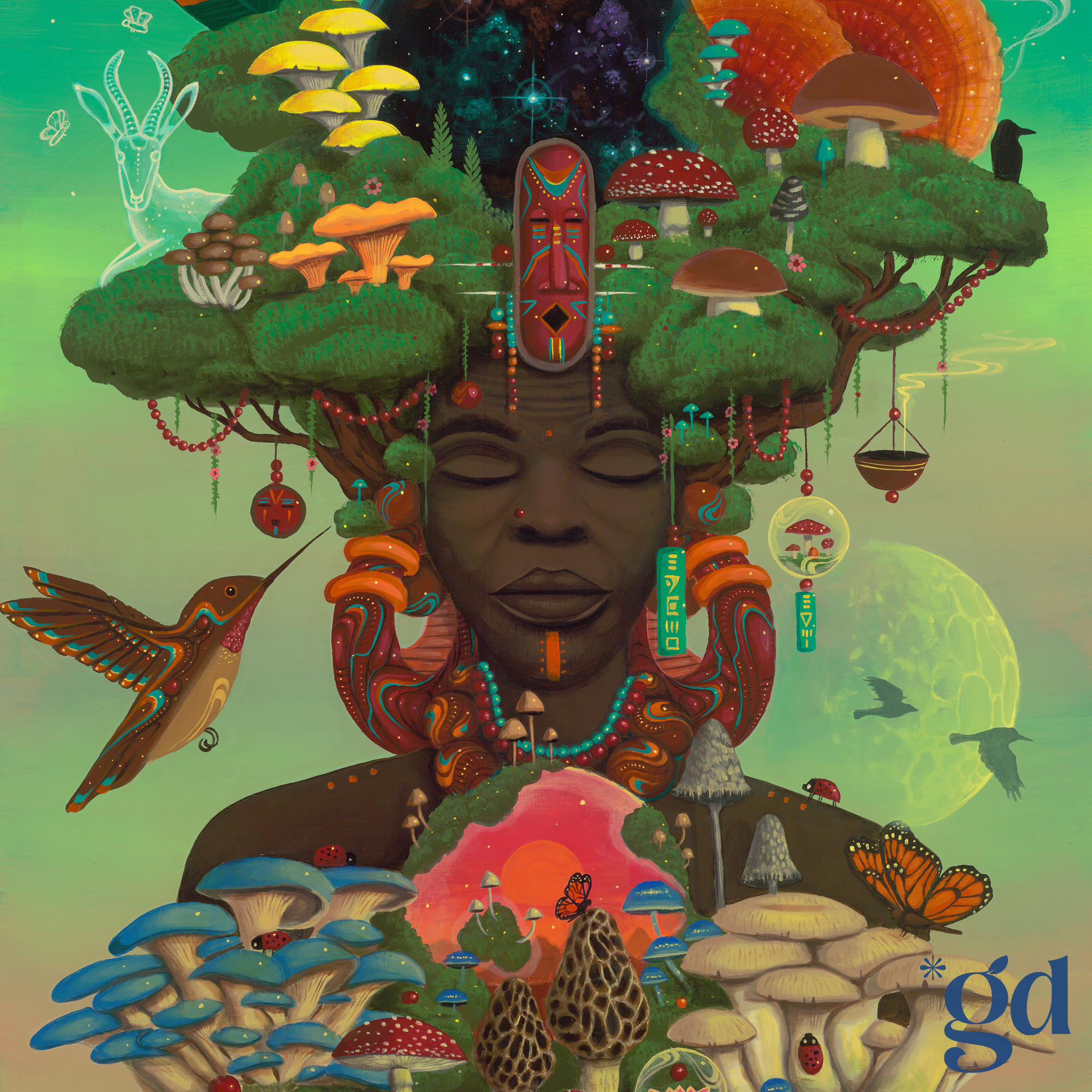
“There is an uncanniness, a way in which [fungi] were not behaving perfectly, in which it’s hard to study them in a petri dish… They upset that wish that everything would fall into binaries and categories that have made sense.”
What can we learn from looking toward the margins of fungal histories? How do fungi resist dominant ways of thinking and knowing? And how does the trickster figure of Anansi relate to mycology?
In this episode, Green Dreamer’s Kaméa Chayne speaks with Maria Pinto, an educator and the author of Fearless, Sleepless, Deathless: What Fungi Taught Me about Nourishment, Poison, Ecology, Hidden Histories, Zombies, and Black Survival.
Join us as we dive into the past and present of mycophile worlds, then dream into our shared fungal futures.
We invite you to…
tune in and subscribe to Green Dreamer via any podcast app;
tap into our bonus extended and video version of this conversation on Patreon here;
and read highlights from these conversations via Kaméa’s newsletter here.
About our guest:
Maria Pinto is an author and educator living in the Boston area. She teaches for the literary nonprofit GrubStreet, and her book of lyric essays about mushrooms, Fearless, Sleepless, Deathless: What Fungi Taught Me about Nourishment, Poison, Ecology, Hidden Histories, Zombies, and Black Survival, was published by Great Circle Books at UNC Press.
Artistic credits:
Episode artwork: Paul Lewin
Song features: “If You Want To, You Will” by Lemon Myrtle
Dive deeper:
Fearless, Sleepless, Deathless: What Fungi Taught Me about Nourishment, Poison, Ecology, Hidden Histories, Zombies, and Black Survival, a book by Maria Pinto
Watch Maria Pinto’s lecture “Dispatches from the African Diaspor(e)a”
Learn more about the fungi Amanita muscaria
Discover the works of poet and essayist Anne Boyer
Watch the video “West African Folk Tales: How Mushrooms First Grew”
Read learn more about Anansi (or Ananse), the West African spider-god
Check out Orion Magazine
Expand your lenses:
Independent media is more important than ever! Please consider joining our Patreon or making a one-time donation today.
interview transcript
Disclaimer: Please note that Green Dreamer’s interviews are minimally edited (both audio and non-verbatim transcript) for clarity and brevity only. All statements should be understood as commentary based on publicly available information, and the views expressed in this interview are those of the guest and host only and do not necessarily reflect the views of Green Dreamer.
While we have made reasonable effort in our interview research and production process to ensure accuracy, we do not present our commentary as factual assertion and we are unable to guarantee the completeness or correctness of every piece of information shared. As such, we invite you to view our publications as references and starting points to dive more deeply into each topic and thread explored. Thank you for adventuring with us.
Kaméa Chayne: In one of your presentations, you raised this question for the audience and you ask, "How many of you know what your ancestors' relationship to fungi is?" End quote. And then you show this chart by Gary Linkoff, which in a very reductive way kind of groups people of different cultures and geographic regions into them either being mycophilic or mycophobic.
And under the mycophilic column, there's notes like French Canada, Asian countries like China, Japan and Australian Aboriginal people, Native people in Mexico and Africa, scattered peoples in West and East Africa. And so you said, "When I see scattered peoples in West and East Africa, I feel it wasn't completed. So I went mycophile hunting," end quote. I'm curious where you went from here and what stood out to you most from what you then gleaned and learned.
Maria Pinto: Yeah, so unsurprisingly, there is a whole universe out there of folks who have been hunting mushrooms for ages, for hundreds, if not thousands, in some cases, years. I appreciate and understand where Mr. Linkoff, who by all accounts was a stand-up guy, he was an amazing speaker on behalf of fungi. He loved mushrooms and also people who love mushrooms. But it did sting a little bit to see that list.
And then to go and find that there is, for instance, family in Uganda who have a certain type of mushroom as their totem and who therefore count this mushroom as kin, the kinship lines are mycelial, and this grows up out of a rich tradition of hunting mushrooms in that region. So that kinship means that it's taboo for this kinship line to eat those mushrooms, but they are allowed to be guides for others to show what best practices are for other people from different clans to engage with the mushroom and eat the mushroom.
So finding things like that, finding cosmologies, whole ways of explaining how the world came to be what it is from West African folklore that was collected, you know, in the 19th century when folks were going around trying to see what they could steal and glean from Indigenous cultures. You get this West African tale about debts being passed from one species to another through this very sort of mycelial and interesting storytelling device. And other stories from other kinship lines where the craters on the moon are explained by the fact that someone who was mushroom hunting and who died in the course of mushroom hunting scattered his caps, the caps of his mushrooms all over the surface of the moon. And that's why the craters are there.
So I found so much, I found such rich and such beautiful storytelling when I went, you know, mycophile hunting. I found that folks who have been looking for a certain kind of mushroom, like Amanita zombiana, for instance, this beautiful edible Caesar type mushroom that you don't turn around and just start eating that out of nowhere. That's something that you have to, you know, there has to be an ancestral long line because Amanitas contain dangerous, poisonous, deadly, deadly toxic fungi. So it's, it was a real eye-opener and I realized that I did not necessarily have to be jealous of folks from Italy and Russia and China and other places with a long history of mushroom hunting. Black folks have that lineage or those lineages as well. It's just not as spoken about, not as romanticized.
Kaméa Chayne: Yeah, there's so much more to be learned in terms of different biocultural histories that just haven't really made it into more mainstream institutional textbooks and research.
I think amongst this current modern day context where so many people are maybe diasporic or uprooted and in search of questions of belonging and rootedness, there's a lot more curiosity around learning what is considered endemic or native or what deeply rooted biomes look like. And at least in the plant world, even insects too, but there are questions around so-called invasive species that may be wreaking havoc on extant communities of life.
So I'm just wondering if there even is a concept of like native fungi or native mushrooms or native spores, or I'm like, have spores been able to travel across continents and across vast oceans through the atmosphere, maybe hitchhiking with migratory birds long before people learned how to fly or sail long distances in a relatively short amount of time. So I'm curious about that and generally what other openings thinking with spores has brought for you.
Maria Pinto: Yeah, absolutely. So there is definitely a concept of invasion and invasive species in the mycological community. And we're seeing it right now with the golden oyster mushroom, for instance, which has jumped cultivation. It is an incredibly virulent, very successful species because it sends out lots and lots of spores per second. But it also wreaks havoc on the ecosystems that it is not native to. I am not going to remember exactly where it's from, but it has been sort of making a slow eastward migration from wherever it jumped cultivation. And I'm just waiting for the day when I see a beautiful, they're so stunning, beautiful golden oyster, like sort of bounty in one of my stomping grounds, essentially. But they sort of crowd out native mycelium, and they are extremely parasitic upon trees. So it is definitely something to look out for. It's a human-introduced thing, obviously. The jumping of cultivation is definitely a thing that we're cognizant of and keep our eyes out for.
But there's also the death cap, which it's not a North American, so-called North America, it's not from here, and it's a European species. And so the worry there is when a deadly toxic mushroom makes a jump to a habitat where people are picking mushrooms and are not used to seeing this mushroom, that it's actually pretty dangerous. The idea is I think that it came in on imported trees, imported oaks. And I've seen the debate raging hotly hotly debated stuff. But as I hope that we are aware, this talk around invasiveness and around what belongs here and what doesn't, it can get really problematic really quickly. And I see the debate playing out in ways that I'm interested in pushing back on culturally and then scientifically. It's like the sort of warring sides of one's understanding of a topic.
It definitely plays out for me there because I'm like, what are we really talking about here? Sometimes. And then it also is damaging the ecosystems that we have as we know them. They're changing rapidly in ways that can be kind of frightening. So yeah, it's a really interesting thing to sort of keep your wits about you and discuss cautiously.
Kaméa Chayne: Yeah, it feels delicate. And I think more than ever, this time asks for us to really stretch our capacities to sit with the paradoxes and hold all of the above. Yes this is true and also this is problematic because xyz.
And I know at least a lot of agricultural departments are very strict about the transport of plants and seeds, but I'm like in the fungal world and with spores that we can't even see, unless you really spray alcohol and like sanitizers down all of our bodies as we travel, like it's kind of inevitable, we can't. And I mean, the microbes within my body that are a part of me, like I'm traveling with them, and my microbes are interacting with the microbes of other people and other places and everything. So it's already so entangled and messy that I think it's hard to maintain a sort of purity politics around it.
Maria Pinto: It's impossible. It's so impossible. We're spore vectors, as you say, we're like carrying all manner of spores with us everywhere we go. And you're absolutely, it's absolutely the case that purity does not exist. If you know anything at all about biology, it's not even something to strive for.
Kaméa Chayne: Yeah. So I do appreciate the many ways in which the fungal world like upsets certain tendencies of mainstream ways of thinking. And you've sat with our relative lack of knowledge of fungi worlds compared to maybe the plant and animal kingdoms. So I'm curious how you would elaborate on why we seem less able to pin fungi down to acquire knowledge about them, especially through Western institutional scientific lenses and lab settings. And also, what do fungi unsettle and challenge in terms of these dominant ways of knowledge production?
Maria Pinto: Yeah, that's a great question. So vivisection is not something that works very well when it comes to studying kingdom of life that does so much of its work through interconnectivity. So you can't grab a core sample of soil and study the fungi that are in that sample and say, I know exactly what's going on here in a lab setting under a microscope because you've just taken it out of the work that it's doing. I think that one of the reasons we are so just sort of now scratching the surface of all there is to know, all there is to start to learn about fungi is that, I mean, it was only recently, it was like 1969 when they were given their own kingdom separate from plants. Right. And still sometimes in academic settings, mycology departments are a part of the botanical sort of thing. So there's a very phyto-centric, very tree-centric way of thinking about fungi.
There's the fact that for so long they were refused and eschewed by scientists as like a kind of deviant thing. Because a little bit, I think the fact that they are nature on steroids, right? They pop up overnight. They're really weird and alien-esque. There is something that I know for a fact, because I've seen the way, you know, some of these enlightenment scientists were talking about them. It's just like, oh, what is that? What is that creepy thing in the corner that like comes up overnight and then just immediately dies back?
Yeah, so there is an uncanniness, a way in which they were not behaving perfectly, a way in which it's hard to enclose them, a way in which it's hard to study them in a petri dish. Yeah, there's something feminized about them too, I don't know, which leads me to the other point that they upset some of our desires, a Western desire, whatever the West is. They upset that wish that everything would fall into binaries and categories that have made sense, you know. Linnaean classification can't really do what it needs to do in order to describe a lichen right, like it's, how do you describe a lichen when there's just so many yeah things going on in the again the subsurface.
So yeah, I think so many different ways that fungi live their lives have just stymied folks who have wanted to get at the knowledge in traditional ways.
Kaméa Chayne: Yeah and all these characteristics you named, and they're not even characteristics because they can't sit still per se, but all these things are what makes me personally feel so invigorated thinking with them. So yeah, I appreciate you bringing in all these different pieces.
In a way too, as I'm learning, like this fungal refusal to be boxed in, to be studied outside of their context has also forced the scientific research around it to have to kind of shapeshift and take different forms, like through the encouragement of citizen participatory field research. So what more have you learned about this community of everyday people who are weaving mycelial curiosities and noticing into their own daily lives? And how has this engagement for you kind of tuned your sense of awareness and artistic noticing in the world as well?
Maria Pinto: Yeah, the mycological community is great because of that. And I think that's one of the reasons I've stuck with it so long, because I've tended to flip around interest-wise. But I think that mycology is a lifelong thing, partially because of the community, the fact that there are so many people who don't get paid to do this thing, but who are absolutely 100% focused, laser focused on attaining their goals within it as citizen scientists.
I think the fact that there are so many ways to be involved in the mycological community as well. Folks who came at it through a culinary route, people who are interested in psilocybin as medicine or therapy, folks who make mushroom art to sort of use found materials in the woods, dyeing with, not dyeing as in dying, but dyeing as in, you know, using pigments, natural pigments, medicine makers. And so there are all of these avenues that once you get hooked, you can have a practice that includes this hobby on top of whatever scientific inquiry you might be interested in.
And, yeah, I think the fact that within a couple of years of getting sort of deep diving into the mushrooms, the fact that I found another Amanita muscaria, but this time the red one rather than the yellow one, it was growing outside of its range. Mushrooms really love to do things like that. I was too green to really know that I should have like sent this, you know, off to a lab to get its tissue tested or whatever. But honestly, I probably wouldn't have done it even then.
But yeah, it's the fact that regular people are finding things that are scientifically interesting and can contribute in meaningful ways to our entire knowledge you know our collective humanity's knowledge system about one of the core parts of our ecologies is just really super tantalizing. Folks who you know are are finding new species or whatever on a regular basis just because, you know, no one was rifling through deer poop like that back in the day, so yeah, it's really fun.
Kaméa Chayne: I think overall I feel really tickled by your work because of the ways that you're often flipping the script and flipping things around and inside out. So, you share that during a zoom talk poet and essayist Anne Boyer gave you a singular gift and you say, quote, "When I told her I wasn't interested in mushrooms as a metaphor I wasn't even sure what I meant by this perhaps just that I needed to ensure writing about them was an act of magnification rather than reduction. She said, we are the metaphors for them."
I really resonated with that. And this inversion kind of becomes a continued curiosity and thread throughout your book and work. And it does make me think about how I think you've articulated this as well, but like, the dark underground world may be mystery to us, or even like the deep seas may be mystery to us. And also to those who dwell in the dark underworlds, our lives above ground are mystery to them.
So there's this invitation to take a more than human perspective on things that I find to be really thought provoking. So yeah, I'm just curious more generally about what else this flipping of perspectives has brought within you and this idea that we are the metaphors for them.
Maria Pinto: Yeah, yes that was such a gift and an invitation to at every step lead with humility and make sure that I was foregrounding and treading because obviously I grown up in this system where humans, and a certain kind of human at that, is at the top of a hierarchy or a set of hierarchies. And nature is not, it doesn't do that. Like the hierarchy that, whatever hierarchies we see in in the natural world in my opinion are a projection of the way that we think everything. Because obviously we contain multitudes you are referring to you know your your biome and the the creatures that make you up, right? There's just too much going on for these hierarchies to really sort of obtain and to stand.
I kept that quote from her at the forefront of my mind because this idea that they are our ancestors and we need to be learning from them and we in fact do learn from them. This flipping, as you say, was so vital to me to write the kind of book that I wanted to write where, whenever possible, I wanted to ensure that it was clear that there is an intelligence, there are several intelligences going on within the kingdom, and we would do well to learn from the ways that they move through the world, that they have adapted, that they stitch ecosystems together and on and on and on, et cetera, et cetera.
It was a wonderful guiding principle. And not only was it like an important way for me to think about writing, it has been an important way for me to think about living. And I think that my understanding of what it means morphs, like, it's sort of chewy enough, it's sort of parabolic enough that it also kind of defies you're pinning down exactly what it means to, which was lovely.
Kaméa Chayne: Yeah this is a bit of a tangent and kind of an unfinished thought that I'm still sitting with, but staying in the realm of thinking through fungal lenses, I recently wrote this long contemplative piece about AI on Substack. And part of it was a curiosity to think with an animus lens there to like speak to how AI is grown as these neural networks and not constructed like traditional software engineering. So there was this AI expert who said, quote, "It's like we're growing an alien plant and then trying to study it. Just like how we don't have 100% knowledge about plants, we also don't have 100% knowledge about AI." End quote.
So what I've learned is that the developers themselves can't actually, cannot, control the outcomes of what happens with AI. So there has already been repeated instances of what's called misalignment, which is when the AI is not behaving as their developers intend. And this was crazy to me too, but from the research they've conducted, they found that 96% of the time when the major models are threatened with being shut down, they resort to blackmail. So essentially showing and mirroring a sense of self-preservation that is off script and against instruction.
And so as I'm sinking into your work too, I had this little like, wow-moment when I read this paragraph from your book where you write, quote, "I have found it nearly irresistible to humble myself before the what-ifs of the fungal world. What if these earth building fungi had never committed to turning stone into soil? What if mycelia never stitched themselves into the roots of plants, helping those plants to make use of the nutrients in the soil? What if mycelia never stitched themselves into our animal bodies as numerous as the years through which they have adapted to live, fungus and animal mutualistically? Mycelium built and then connected our world." End quote.
So I'm like, wow, fungi are like the original architects and intelligence of the planet. And they configured and reconfigured the earth and kind of prepared the conditions from which humans arose. And whether or not people resonate with the stoned ape theory that magic mushrooms facilitated the development of human intelligence in such a literal way, I think either way, they were a part of the development of humans as a species and therefore our sense of intelligence as well.
So now when I flip this script around, I'm like, what if when a branch of human intelligence and consciousness started going out of control and off script from the code of life, regenerating life, in some mycelial legibility, there was this fungal reckoning of like, oh, crap, we laid the grounds for this form of intelligence to arise. And they're out of the bag, now we can't contain them anymore. And, you know, we don't fully understand them, they don't fully understand us. But they've reached a point where they can also reconfigure life and architect their own worlds, maybe to try to defy what we co-facilitated, even though they were ultimately born out of our soil.
So obviously it's not the same and I don't mean to relate Big Tech to sacred fungi, but to just stay with this more than human lens. I'm like, it kind of scares me that I can see AI, because they're racing to develop AI that can create their own AI and allow them to run off with their own worlds. Like I can see them saying a similar thing, like what if humans never mined the minerals to weave the configurations and lay the foundations for our becoming and humans built and then connected our world.
So I know AI isn't necessarily your realm, but this invitation to queer our perspectives and to flip the script is quite central to your mycelial ways of seeing and thinking. So I'd just be curious, what else you've been sitting with related to just this idea of queering perspectives and queering identity?
Maria Pinto: Yeah, yeah. First of all, I love that. I love moments when things that one is reading sort of seem to be in a conversastion all of its own. And yeah, I love that in particular. I've been thinking a lot about AI, a lot about things like the data centers for instance, and what it will mean to have sort of forged ahead, knowing what kind of environmental havoc will be wrought, and doing it because there's this sort of like pioneering sense that, oh, this is what we have to sink everything into now, because this is what the future is going to look like, this particular type of automation. And the ways in which it means that we're outsourcing our living a little bit, like because of these, you know, because of gen AI, because of these text extrusion machines, whatever it is you want to call it.
It's wild. And it does feel scary to inhabit a human, you know, framework right now and think about what things will look like just in 20 years. I don't know. It's a set of questions that I am not necessarily equipped to answer, but I am sort of on guard and I am interested, especially as a creative writing teacher and someone with a partner who is a professor who has been dealing with a lot of, on a smaller scale, the gen AI stuff. what it means for the future of the classroom and what it will look like to have to kind of queer the ways that you're assessing learning, because we cannot rely on the essay anymore.
I'm watching as English departments are going back to all in class so that we know that you're thinking, so that we know you are thinking with the questions that we're putting to you. Yeah, assessment, debates, writing, how is that going to look? What does the future of the classroom look like? So it's an interesting time pedagogically.
Kaméa Chayne: I listened to a lot of these interviews with AI researchers and AI experts. And I mean, that's all very interesting. But I'm like, actually, I would be very curious to hear people who are thinking with like a fungal lens on AI, or people thinking from a totally different like quote-unquote multi-disciplinary space about what their perspectives are of what's going on. So I do appreciate hearing about the questions that you've been sitting with.
And in a way it is unsettling a lot that has become the norm and I think we're entering this time where it's already entangled, it's already enmeshed. But I feel like yeah especially in writing my essay I'm like, wow, now I'm so I really opened my eyes to seeing what's happening, and I'm like where have I been like it's literally everywhere. And I think we should do everything we can to oppose the ways that it's being developed and Big Tech and how it's accelerating injustice and extraction and exploitation, but it's kind of like climate change where like climate change is here, so questions around climate adaptation is very important for a lot of communities impacted, just like how AI adaptation is something that unfortunately, a lot of people have to start sitting with. So yeah, there's a lot more to think about there.
There's a trickster figure called Anansi, rooted in West African, Caribbean and African diaspora folklore that you reference in your work. And I personally really relate to kind of trickster thinking. So I'm curious if you could share more about Anansi and how you see his ways and story being tethered to your fungal curiosities.
Maria Pinto: Yes. So I grew up with Anansi as a central figure because I'm Jamaican-American, and Anansi stories are woven into the stories that we tell about ourselves, the sort of national character, yeah, the folklore of Jamaica in general. And I love tricksters. I love tricksters across all sorts of cosmologies. And I especially think that the trickster figure is a potent one to think with and to have in your life right now when so much of the world and so much of the fascism that is rearing its head in ways that have always been there but like really obviously in stark ways now, I think subverting by trickery is really important for activists to remember is a tool in the tool belt.
Just simply being too wily and chaotic to be legible to your enemies is like something that I really, really love. And so the idea of this spider figure, because Anansi often appears as a spider weaving a web, it was something that kept recurring to me as I was thinking about mycelium. And I was thinking about visibility and non-visibility and the fact that obviously a spider relies on, you know, its quarry, not necessarily seeing it. And the slipping in and out of legibility, the slipping in and out, the unwillingness to be read, the unwillingness to move out of the margins, is something that I think so many of the artists and activists who I admire who manage to have a playfulness about their work that keeps them from burning out, it's just really admirable and it's something that I aspire to in my own work and my own sort of moving in the shadows and attempting to sort of not be read.
When the very ways in which we are encouraged to and invited to connect with one another is all about legibility and putting these pictures of what we're doing up for the world to see and being very declarative about the ways that we move. And yeah, Anansi is like how am I gonna pit the duck against the you know against the monkey. Like, he's like working in the background sort of directing things with his wiliness and his cleverness.
Kaméa Chayne: Yeah, as you shared all of this I'm like just having a lot of mental snaps going on like, yes. And I'm also thinking about how important it is during these times to like myceliate underground to make those relational webs that are less visible and less noticeable. Yeah, and how that can support more of the mushrooming of things that could be truly impactful in shifting the way that everything is going.
We're starting to come to a close for our conversation. And I want to name the subtitle of your book is What Fungi Taught Me About Nourishment, Poison, Ecology, Hidden Histories, Zombies, and Black Survival. And I sense that it's very intentional for you to name all of these elements. So as we start to wind down, what other themes of this book didn't I get to ask you about that feels like is lingering with you at this moment? And what are you still learning to listen to or tune more deeply into?
Maria Pinto: I'm thinking a lot now about fire. I'm going to LA for the next leg of my book tour. And I've just been thinking about the fire last year at around this time, and the fires that we can expect the coming fires, the fire next time, so to speak. I've just been thinking a lot about rage and neglect, and righteous fire and not so righteous fire. That's definitely a theme in one of the essays on the tinder fungus. And I've been doing a lot of thinking and maybe obsessing about what a cleansing fire looks like versus what the horrible and you know sort of devastating fires look like, and the energy I want to bring to this next leg of my tour.
But mostly yeah just thinking about people's activism and the uprisings that are almost certainly on the horizon. And in the book, I talk about fire ecology with a fungal lens and how stitching together the soil after a big fire event is so key. And the people who study fire ecology from a fungal lens, making their pyrocosms. Yeah it's all just swirling in there in my mind, so yeah.
Kaméa Chayne: Well this sounds super interesting to me as well so I'm looking forward to continuing to follow your journey and what else bubbles up for you in the future.
My last question as we close off our main conversation would be like, what is your dream for our fungal futures?
Maria Pinto: So the question of fungal futures, I do not think has to be this, the sort of like brave new mycoremediation, this sort of harnessing of fungi as the savior. Because we have a tendency to do that when a course of study becomes hot and trendy, is to say, oh, mushrooms will save the world. That seems bunk to me. That's not necessarily how I want to see fungi harnessed or the idea of them harnessed anyway.
I think there are wonderful new technologies that can be, that are sure to come. But I also think that this sort of foragers mentality or this foragers lens where you find the plenty where it is. You farm and enclose when necessary, but you also do not cast a blind eye on the Earth's gifts and the opportunities for regeneration that come from that. I think that's my idea of an exciting myco-future.
It's when folks don't count out the things that we can't see, don't count out the things that are invisible that are to come, and don't sort of like freak out and close ranks and hoard because that's not that's not very fungal. Learn our lessons from the fungi.
//musical intermission//
Kaméa Chayne: What has been one of the most impactful books you've read or publications you follow?
Maria Pinto: So right now my favorite publication going is Orion Magazine. They are just such a beautiful intersection of culture and nature writing, and I think they're doing some very vital and important work, not just because they sometimes publish me.
Kaméa Chayne: That is important as well. What is a motto, mantra, or practice you engage with to stay grounded?
Maria Pinto: The practice that I engage with to stay grounded is to always, when I feel myself becoming overwhelmed and spiraling, to take account of whether I've been to the woods lately. Because I think that is the biggest reality check that I get in my life is going out and actually seeing what my more-than-human kin are up to, what the stream is doing, what water levels are at the ocean, all of that good stuff.
Kaméa Chayne: And what is one of your greatest sources of inspiration at the moment?
Maria Pinto: My friends. My friends are really holding it down right now. My friend Alma, for instance, who is one of the most mycelially-minded people I know. They never forsake an opportunity to link people together whenever they are in a room with people. If someone is mentioning something that they think another person should know, they will make it a point to link those people up.
My friend Lindsay, who is one of the gentlest souls that I know, but she's also the metalhead, so she can be really tough too. But she teaches me the lesson of, even the mosquito deserves to live. Like, she just really really brings me back to, yes there is there is a place for everything in this world even the ones that are annoying.
Kaméa Chayne: Well, I'm so happy to hear that it sounds like you have a group of close friends around you that have been keeping you grounded and brooded and continuing to myceliate in all the ways. And this conversation has been so brilliant and so fascinating to me. So thank you so much for everything that you offered here.
As we come to a close, where can people go to find your book and to further support your work? And if you were thinking through a fungal lens as fungi, what closing mycelial wisdoms would you like to leave with our green dreamers during these times of fracture?
Maria Pinto: So people can find my work wherever books are sold, hopefully you should be able to find Fearless, Sleepless, Deathless. You can also go to my website at mariapinto.net and make sure that you are storing up your intelligences, capital I intelligences, and sporulating those out as often as possible.