
Darcia Narvaez: Cultivating nestedness for children and future generations (Ep462)
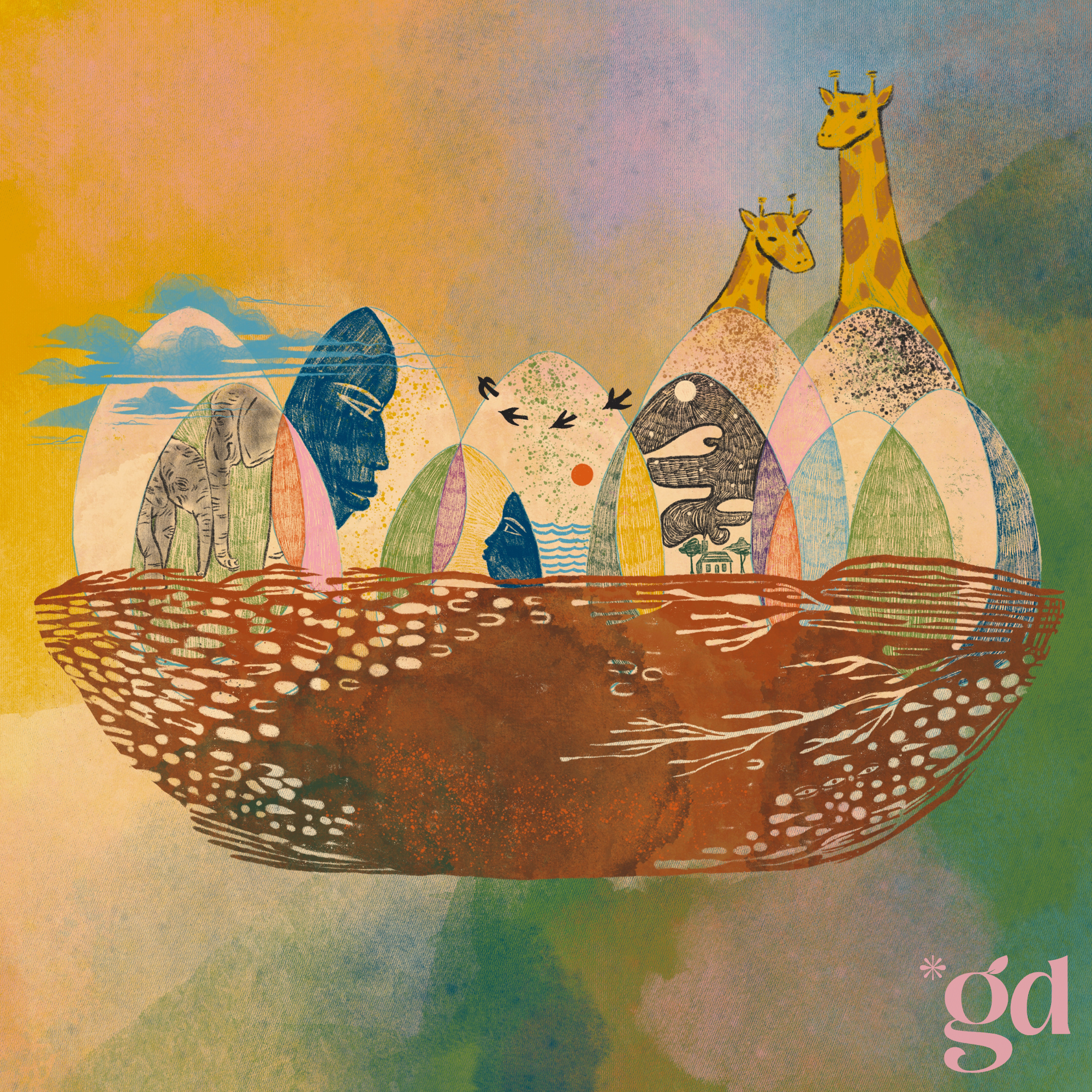
“Nestedness is feeling the embrace of Earth and the community around us, which includes the plants, the animals, the forests, the waterways, as well as the human beings around us, where we can unfold in our fullness, our full potential, and offer our unique gift to the world.”
What does it mean to cultivate “nestedness” for young children, infants, and future generations? What can we learn from how other species care for their offspring? And what is the importance of recognizing that our desires and cravings are often socially and culturally shaped?
In this episode, Green Dreamer’s Kaméa Chayne speaks with Darcia Narvaez, whose recent books include Restoring the Kinship Worldview and The Evolved Nest.
Tap in as we explore the re-integration of care into community life, how we move beyond theories of change towards embodied practices of change, and more.
We invite you to:
tune in and subscribe to Green Dreamer via any podcast app;
tap into our bonus extended and video version of this conversation on Patreon here;
and read highlights from these conversations via Kaméa’s newsletter here.

About our guest:
Darcia Narvaez is Professor Emerita of Psychology at the University of Notre Dame. She uses an interdisciplinary approach to studying child development and human flourishing. Her recent books include Restoring the Kinship Worldview and The Evolved Nest. She hosts the webpage EvolvedNest.org and serves as president of KindredWorld.org.
Artistic credits:
Episode artwork: Shyama Kuver
Song features:
“Novo Amanhecer (Emilio Dias Cover)” by Nessi Gomes (Check out Nessi’s voice work here)
“We Belong to Life” by Ayla Schafer and Maneesh de Moor
Dive deeper:
The Evolved Nest: Nature's Way of Raising Children and Creating Connected Communities, a book by Darcia Narvaez
Restoring the Kinship Worldview, a book by Darcia Narvaez
Learn more about Darcia’s work with The Evolved Nest
Check out author and ecologist Gay Bradshaw and The Kerulos Center
Dive into the trilogy of films featuring the science of the evolved nest, narrated by Darcia Narvaez: Breaking the Cycle, The Evolved Nest: Nature's Way of Raising Children, and Reimagining Humanity.
Learn more about Iain McGilchrist and his book The Master and His Emissary
Discover the Nested World Live Lectures on Substack, with Darcia Narvaez
Of Water and the Spirit, a book by Malidoma Somé
Expand your lenses:
Independent media is more important than ever! Please consider joining our Patreon or making a one-time donation today.

episode transcript
Disclaimer: Please note that Green Dreamer’s interviews are minimally edited (both audio and non-verbatim transcript) for clarity and brevity only. All statements should be understood as commentary based on publicly available information, and the views expressed in this interview are those of the guest and host only and do not necessarily reflect the views of Green Dreamer.
While we have made reasonable effort in our interview research and production process to ensure accuracy, we do not present our commentary as factual assertion and we are unable to guarantee the completeness or correctness of every piece of information shared. As such, we invite you to view our publications as references and starting points to dive more deeply into each topic and thread explored. Thank you for adventuring with us.
Kaméa Chayne: You’re listening to Green Dreamer, and I’m your host, Kaméa Chayne. Today we’re honored to welcome Darcia Narvaez, who is a Professor Emerita of Psychology at the University of Notre Dame, and who also co-founded the Evolved Nest Initiative.
Darcia is the author, co-author, and co-editor of many books, including Restoring the Kinship Worldview and The Evolved Nest: Nature's Way of Raising Children and Creating Connected Communities, which are the two that we’ll be mostly focusing on today.
I want to briefly mention that I know parenting, caretaking for, and raising children is a delicate and very personal subject, also with cultural sensitivities. And I also want to acknowledge that in spite of the systemic critiques that we go over in this conversation, I do think that most people are doing their best and have made the best decisions they could make at certain points in time, based on what they had access to, based on societal pressures, or based on the prevailing viewpoints or information that they were told or taught.
So, I invite you to listen with this gentle acknowledgement in mind, and yeah, also just want to share that I personally appreciated how much this discussion made me reflect on these different layers of my life, of course without laying blame on my parents for not being perfect in how they raised me because I can also understand the contexts that led them to make certain choices. But i think it’s a helpful conversation also to invite me to contemplate how we might want to parent or caretake for our future generations with greater intentionality, if we want to really rewire the potential pathways of our futures.
There’s so much enveloped in this insightful conversation, which, by the way, was made possible through the direct financial support from our community, including on Patreon and on Substack. So, if you feel inspired by our people-powered show, we do really need you. And I hope that me repeating this across episodes doesn’t water down this message because this is such an important time to support independent media, and it would help us out so much to have your direct support in ways that you can find at greendreamer.com/support.
As we now ease into this discussion, I’d love to invite you to take some deep breaths to come into presence with us here. Trusting that you are right where you need to be.
Thank you for joining us today, and I hope you enjoy this episode!
Darcia Narvaez: Nestedness is feeling the embrace of Earth and the community around us, which includes the plants, the animals, the forests, the waterways, as well as the human beings around us, where we can unfold in our fullness, our full potential, and offer our unique gift to the world.
Nestedness requires, then, a worldview of nurture where you honor the infant, the fetus first, as a person who's coming into this space with gifts to share. And their unfolding requires a biology of love, of providing the nurturing, to allow that child the freedom to follow their inner compass. And when they're interfered with in various ways, which we could talk about, the inner compass gets broken, or damaged, or misdirected, and you end up with all kinds of problems we see today on the planet.
Kaméa Chayne: So, there's always this conversation about nature versus nurture and how much our genetics play a role in terms of, like, how we end up being as human beings. I'd love to invite you to share a bit more about how much of it is really our genes, how much of our, quote unquote, self-actualization is from how we're raised, and then up until what age is a lot of this being shaped.
Darcia Narvaez: Well, we vary between us, among us, very little in terms of genes. There's things they find, mutations, that in order for it to be something successful, you have to outcompete someone with a different genetic makeup in these little tiny ways, 'cause we share 99.99% of our genes with one another. You have to outcompete a rival with a different set, a slight difference, over generations.
That means your offspring have to survive, thrive, and reproduce, and your descendants of those offspring have to survive better than the rivals. So people get all confused about our inheritances. Genes are just one thing. We inherit quirks and all sorts of other things, too. It's just easy to measure. And what's easy to measure gets people's attention, and then we think that's all there is. And that happens all over the fields of science. So, we have many inheritances, not only genes, but the evolved nest is one of our inheritances, and that's by structuring the biology of love and the infant with the biology of love around it.
And that's an inheritance of ours, along with self-organization that the child does based on experiences. So most of who we become is epigenetic, turning genes on or off, which are scheduled to be coming on or off at certain periods in our development, which last ‘til almost age 30. And so it's really important to have the nurturing. All the nest components that we look at in my lab and my scholarship are important to help that person follow their uniqueness. And then their epigenetic profile is one of well-being, of flourishing, rather than illness and ill-being, which is so common today because we forgot the evolved nest. We forgot how to raise our human nature, which is common all over the world. The evolved nest is a common practice that traditional societies practice all over the world, and they have similar human natures, similar adult personalities, with cultural differences of various kinds. And we forgot all that. And so we have all these dysregulated, destructive, self-oriented, aggressive people from the dysregulation that happens when you're not providing that support needed by each system as it's developing along the way.
Kaméa Chayne: And part of what you talk about in terms of creating nestedness for young children is to, first of all, have care that is more communal, but also to be able to meet the needs of the baby and the young child when they need it. And I think there's this sort of dominant perspective, I think, in Western cultures that this might be spoiling the kids by letting them think that they can get whatever they want whenever they want. So, how would you sort of address this talking point?
Darcia Narvaez: There are a lot of damaged adults who didn't get their needs met. And so they have a lot of resentment about that. And then they see a child's needs, and they don't wanna provide it because they survived. Look, I'm here, right? So you have a lot of twisted psychology going on here. And the actual facts are, we have the evidence that if you don't provide for the basic needs of that baby, and we can talk about those specific things, the baby's actually ruined. That's how you spoil the baby. You've spoiled their unfolding, you've spoiled their health, their wellbeing for the long term potentially. So, it's really important to know what a baby needs because otherwise you're seeding mental disorders, physical disorders, all sorts of health problems later. They may not show up immediately, but in adolescence or in adulthood, they might get suicidal, anxious, depressed. And we can see the signs of anxiety and depression in babies who are not well-loved in the way that the nest provides.
Kaméa Chayne: I mean, I'm sure nestedness might look different for people of different ages. So, for example, for a young child, it might be meeting their needs as they kind of express them. But would it be different for, like, a teenager who's becoming materialistic and being like, I wanna buy this, I wanna buy that. So, that sort of meeting whatever they want is probably different, I assume.
Darcia Narvaez: That's right. So a baby is ready for conversation to be in, not verbal, but any kind of physical conversation from birth, and actually in fetalhood as well. They're expecting that they're coming into a community of supporters and conversation partners.
So they expect that. And at birth, we can see that they're ready to physically connect with others. You know, they hardly can control their bodies.So conversation, the welcoming of the baby, that includes not only talking, but holding. They need to co-regulate. They need to learn how to regulate their heart rate, their breathing from being held mostly, hopefully, skin to skin contact. Then they get the communications they need to grow all sorts of systems in a healthy manner.
Breastfeeding is part of that, and medicalized birth interferes with the success of breastfeeding. All sorts of things that are interfering with the timing of the mother and baby's body. Babies should decide their birth. They vary by 55 days, how long they wanna stay in the womb. But we allow medical professionals to tell us the due date and then pull the baby out, and then they're premature and the things aren't ready yet. All sorts of things go wrong then when we don't honor the wisdom of the baby's body and the wisdom of the mother's body, and the wisdom of the mother.
Our nested way of living is a wellness-informed pathway of our ancestors. That’s another inheritance that we have forgotten. And the wellness-informed pathway is when you provide that evolved nest to the young and throughout life, but especially important in those first four years. Then you grow a healthy psychology, sociality, neurobiology, all the way down and up, and then you become an adult who's well, not sickly, wise instead of aggressive and paranoid. And then those adults keep the cycle of what I call cooperative companionship going. Meeting the basic needs of everybody. Whatever their age, their needs are provided. And we're off that cycle. We're off the pathway, and that has led to this mess we're in.
Kaméa Chayne: I want to add a quick note here that I want to be mindful about instances when medicalized births may be necessary for high-risk pregnancies or for the health and safety of the baby or the person giving birth. And I also want to acknowledge that I think most people do their best given what they know, given what they have access to, or other societal factors. And at the same time, I think that these are still important systemic critiques, so, yeah, it’s important to be able to hold all of these truths and understandings at the same time, rather than approaching it as a sort of either/or.
And I know that at least in my own experience, not that I remember this, but I was still in my mother’s womb a week after the so-called predicted due date. And baby-me wasn’t ready to emerge yet, but, even still, my mom was prescribed drugs to push me out and to induce that mediclaized birth even though there was no health or safety concern. It was really more so for convenience for both the medical system and for my dad, who had a lot of upcoming work commitments, as a sort of societal pressure to not have the time to wait on this unknown. So I think there's a lot more of these layers to unpack further.
Before we go more into the systemic factors of unnestedness, I'm curious what else we can learn from how some of the more-than-human world approaches raising their young. So what are some examples that you've felt most fascinated by?
Darcia Narvaez: Yeah. So I wrote the book, The Evolved Nest: Nature's Way of Raising Children and Creating Connected Communities. And Gay Bradshaw, my co-author, is just an excellent writer and ecologist who has an animal rescue operation at The Kerulos Center. And, we talk about in that book, we take a nest component that we share with animals, and then take an animal and talk about how they look in that particular nest component.
So one of my favorites is elephants, because elephants have a matriarchy where the elder females, they're no longer having children, but they're the grandmothers and the aunts. They are staying around the pregnant mother, and they're walking across the Savannah, and then it'll be time for the birth. And the baby will come out, and everyone will reach out to touch the baby as a welcome. And then they keep the baby in the center of their group as a protected, kind of, external womb. So it's just so wonderful to see those images and the videos of that as well.
//musical intermission//
Kaméa Chayne: You say that disconnection is the result of colonialism. And I know this is a big topic, but how would you begin to share about how unnestedness relates to historical processes of colonization and industrialization? How do we kinda portray the more systemic structures that have been put into place?
Darcia Narvaez: So the big problem is inequality and hierarchical civilization. So when that gets established in any rigid way, the people who have more start to control and enslave in some fashion the people who have less. And they enslave animals and plants to keep having more and more. So the inequality is the root.
Now the Western colonizers have taken that to the nth degree and then moved it all over the world with their explorations, their missionizing efforts, and their desire to just collect whatever they can for the benefit of their country back in Europe. And so, we've decimated, then, so many cultures.
The biocultural diversity of the world has been undermined by all that colonization which continues through globalization. Capitalism is all about extraction and taking from others, and bearing on the poor or the non-rich. So we are there, and with hierarchical civilization in general, you aren't going to be able to be a nurturer to your children. You're not gonna be able to provide the evolved nest to the young because you have to go labor. If you are young, and if you are wealthy, you just have gotten desensitized. You're less empathic. It's just like Jesus said, it's easier for a camel to go through the eye of a needle than a rich man to get into heaven because they can't let go of their stuff, right?
And now we've made it so that people who have benefits or privileges, and capitalist countries, they have all this stuff, and they hoard and have storage units, where they keep all their stuff to themselves. And it is just, the whole culture has gotten very crazy, in part because we didn't provide what was needed, which is love in those early years. And so you never feel like you have enough, and you feel insecure, completely insecure because you didn't have the evolved nest that provides the ongoing embrace of security throughout your life.
Kaméa Chayne: So I mean, in one sense, a lot of this conversation is about raising and nurturing children, but I think in another sense it's also just about governance, like how we govern society. So, I just kind of see there's this kind of both/and of family units being really isolated and reduced into these nuclear families, and at the same time, governance taking on this form of nation states that are also, like, very, very large and beyond what, maybe traditionally, would be considered a human-scale community. So I wonder what more you have to add to the sort of different scales of, like, the private and the public that we're living within today.
Darcia Narvaez: Well, it's complicated. I could say a lot more about all of these things. So in terms of the large-scale societies, I mean, there are instances in our history that archeologists have found where small groups that spend most of their time in the hunter-gatherer civilization, which is our heritage. 99% of our history was spent as hunter-gatherers, and they're fiercely egalitarian. So I'm not talking about complex hunter-gatherers who raise animals or do horticulture. And these folks will be separated, and then we have evidence that they'll come together for a while, all as this huge group, to do feasting and perhaps find partners, or perhaps to work on some fishing or hunting together.
It varies around the world. So, in those circumstances, you have a large group. And there might be some hierarchy, there are some leaders, but then it all breaks back down the rest of the year into egalitarian small groups. And that is our expectation. Babies expect to be treated as an equal, apart from their great needs. And we all have that need, and we get sick when we are not in an equal relationship. And we have lots of evidence for that now.
So the smallness and bigness of social groups are not my area of work. But people who focus on localization of bringing the production of food and materials needed to live back to the local community is a way to get away from these crazy practices of, for example, shipping bottles of water from Australia to England. And then shipping other products back. So you make it yourself, but then you ship it across the ocean. And that happens for all sorts of products. And because the carbon effects of carbon pollution are not accounted for in the economic system that we decided is fine to use, even though it's destructive, and it doesn't pay attention to the important things in life, right? So we have gotten caught up in a narrow view of how to live.
And then when you under-care for people, their values are all messed up because you've twisted them away from their inner compass. And so they're malleable, they feel unconfident. So then they have to get some kind of ideology that you tell them in school or church or whatever, that this is the way it has to be. There's no other option, and you have to act this way. Be obedient. So, obedience is not a thing for our heritage, but that's required in this kind of hierarchical system that we live in. And so you get sick. You can't be yourself, and you have to keep suppressing it. And then, yeah, you're abused in various ways.
Kaméa Chayne: Yeah. Like you said, this conversation could go in so many different directions because this impacts everything. And I think I'm thinking about these two conflicting realities, which is that on the one hand, dominant Western societies often like to portray land-based, ancestral, Indigenous cultures as primitive, as less civilized, and less developed. And that's often used as a justification for colonization, cultural assimilation, and erasure. And then at the same time, there's this pattern of Western scientific research, again and again, so-called proving to us that, hey, these practices from our ancestors, maybe they're onto something. These practices from Indigenous cultures are actually more supportive of our well-being.
I've just seen this in so many categories, whether it's food, having children outside interacting with dirt for our microbial health, chanting collectively for mental health, walking barefoot, and even things like allowing our bodies to adjust to ambient lightness and dimness before we sleep, 'cause that supports melatonin production and supports our biological clock. So I really love the term the evolved nest 'cause I think it's almost a reclamation of what it means to be evolved, and emphasizes the so-called ways that advancement, in many ways, has been moving us away from our humanity.
So, I mean, I know you've talked about how technology and screens are making a lot of children less empathetic, but I think I'm just curious what other thoughts you have to add to these conflicting realities of certain practices and ways of being diminished as being less evolved and less developed, while scientific advancement keeps catching up to what our bodies and ancestral cultures already knew.
Darcia Narvaez: Yeah, that's such a good point. I think Iain McGilchrist has done the best job of describing how only part of our brain has, kind of, dominated the Western world for the last some hundreds of years. At least the left brain orientation, which is a different one than when the right brain is in charge.
He has thick books on the experiments when you numb one side or the other of the brain and what they're like, and things on damaged brain patients. So, what the left brain is about is technology, manipulation, and is only about ego. Me, me, and, you know, having a power. And that's what happens when you under-care for a baby. You're under-caring for the growth of the right hemisphere, which occurs in the early years. And so, the right hemisphere is the seat of our empathy, our social and emotional intelligence, our ability for higher consciousness to be transcendent of the self.
But the left brain is all about me, me, me, and what I can control and what I can put into some generalizations. So it requires the right hemisphere, the right brain, the whole brain. Well, let me just say the right hemisphere is wired to the rest of the body and takes information from the whole body and is processing all the experiences of the body and the world. And so it's gathering all that. So, it's really important for children to spend a lot of time running around and having holistic experiences, because they're gathering all that for the left brain, then to take that information and make a generalization about, and then draw conclusions.
But what's happened and when you under-care for children, which we've done for a few thousand years, is you undermine all that kind of intelligence that makes us human. And then when you send them to school, teach them to read, which is all left hemisphere driven on average, and then they don't have the collection of experiences. They just have what you tell them in a book, or now tell them on a screen. And then they have to extract some way of being from that, so they don't have personal knowledge, which is critical for being a human being. You build yourself, you transform yourself, by learning something new, and your behavior changes.
That's how we know something new. But that's all divorced from, now, how we raise kids. We send them to school, you memorize some information, take a test. Oh, you know stuff. Their behavior doesn't change. They don't really know stuff, right? But we think they do. And then they put them in charge of things, and they don't know what they're doing.
And so all this damage happens to the world from people who are essentially novices. They don't have an ethic of being concerned for others, 'cause their empathy's kinda low, and it takes ‘til almost age 30 to develop it well in nested conditions, and violent video games can undermine it. And drug use undermines the final finishing of the brain that allows us to really be fully mature.
Kaméa Chayne: There's so much here. So it's not that the right brain is more important than the left brain or vice versa, but that they need to be in deep conversation constantly with one another. And I'm wondering how much this impacts, like, what you call our kinship views versus dominant views. So is it more so that when we're more engaged with one hemisphere of the brain, we're more likely to develop certain worldviews as well?
Darcia Narvaez: Yeah, so Iain McGilchrist talks about how in each situation you can come with either a right hemisphere orientation to that situation or left. The left hemisphere is about categorizing people. So I look at you and, oh, you're taller than me, you're shorter than me, you're prettier than me, you're this kind of extraction, whatever it is.
And once you're in that mode, it's really hard to get into the other mode, which is the right hemisphere. It’s like, oh, what's beautiful here? And how do we interact in some new way today? And the flexible playfulness that is our joyful spirit comes through in that mode. So if you have been suppressed, you don't play very much, you're put in front of a screen as a baby, as a young child, as a student, you're forced into reading when you're three instead of running around and playing with your imagination. Because until age six or so, babies or children are in this hypnotic state where they're just kind of taking in the world and how it works, and they just follow the models they see.
But if you thwart them and you force them into the reading and that kind of thinking, making decisions, what do you want, a blue balloon or a red balloon? You're pushing them into the left hemisphere way of being in the world. So they get a lot of practice for that. And so then it's gonna be much easier to be in the ego consciousness, which is about me, me, me, and power, and I wanna be number one.
Kaméa Chayne: This is a little bit of a tangent, but I'm thinking about how when we eat more refined sugars, the microbes in our bodies that feed off of that then start growing in their population. So then they signal to our bodies that we want more, we want more. So then we get more sugar cravings, and then we give them more, and then it kind of goes down that direction.
So it literally changes the biochemistries of our bodies and, like, our acquired tastes and desires. And unless there's an intentional decision to break away from it, going along with it really just entrenches us more deeply into that way of operating. So I kind of see this happening at a societal level where the more that people are raised in unnested ways to see the world as us versus them as competitive, individualistic, disconnected, the more that it feeds into the system, which also rewards these kinds of behaviors and qualities.
Darcia Narvaez: When you're stressed out, which we do to children and everybody, you're gonna crave, then, those dopamine hits, the sugar. And that's gonna actually then wreck you, because a lot of the fast food now has all these glutamate-excitotoxins that actually kill brain cells. And then you don't know what you're doing, but you're in this mode of addiction to fast food or sugar. And you get stuck in a loop, and you're looping.
Kaméa Chayne: Yeah. So it's actually not a tangent. It's quite literally related as well.
Darcia Narvaez: And self-centered. You're self-centered, right? Because you're just, oh, I gotta have that, I gotta have it, I gotta have it. And you're not here, free. Your free will is lost. You have been taken over by other things because you didn't get the love that you needed, which lets you be free, and you get to do what you want when you're free. But now, no, you're not free. You gotta do what they tell you and what the system has forced you to do.
Kaméa Chayne: Yeah, so it's also, like, we're often told, listen to our bodies, listen to our bodies. But at the same time that we listen to our bodies, we also have to contextualize, like, how were my desires and cravings shaped?
Darcia Narvaez: Yep. Absolutely. Yep. Very good.
Kaméa Chayne: Yeah, deeper questions are important. So, I mean, in terms of thinking about course correcting, I think at one level I'm thinking about friends and relatives who visit farms with me that grow food, and they feel scared of dirt and of soil and bugs because maybe they didn't grow up having those sorts of connections and exposure. So they don't romanticize this sort of reconnection 'cause they never had opportunities for that sort of remembrance.
And I'm also thinking about people who see these worldviews, the kinship worldview, and the dominant worldview as just another form of religion or spirituality or personal interest that, you know, a subset of society is really interested in, in a way to kind of diminish it as just a trend or another fad that some people are into. Rather than understanding it as this desire to return to something that is more rooted and connected. Because I think we are trying to argue that there are certain ways of being and worldviews that are more grounded and nested, and other ones that are more out of touch and dissociated. So yeah, I would invite you to elaborate on any of the above.
Darcia Narvaez: So, actually, the nested way, the kinship worldview is Tao. The Dao is following nature's ways, right? And not harming the well-being of others. And if you have to kill an animal to eat, for example, you ask permission. You don't just go willy-nilly doing all these things impulsively, but you've been raised to be aware, attentive, to the manner in which you behave, to all the relationships you're in right now with this tree, with this glass of water. The water is fueling me and my well-being. And to be grateful for all these relationships all over the place that Mother Earth has provided. And to understand that you are not separate. You are not alone. You're always accompanied by all these wonderful beings, right? And there's the unmanifest too, the ancestors, the spirit, which is hard for Western scientifically educated people to take in, but we've got, you know, what millions of years of history of these things that others know better.
So the kinship worldview, the nested, the wellness pathway where you start with the evolved nest for everybody, is the way of the Tao, the Dao, that the ancient Chinese folks were pointing to, and that other philosophies and religions have terms for as well.
//musical intermission//
Kaméa Chayne: I guess I'm thinking about the context of modern Western society today and the ways that it has, at the same time, undervalued care and also commodified care. So care, in a lot of ways, is institutionalized and commodified. So I'm wondering what your thoughts are on the limitations of that compared to care that is really integrated and not quantifiable in monetary currency.
So something that actually could contribute to building relationships, as opposed to more of a transaction.
Darcia Narvaez: The orientation of the dominant culture is one of separation. Everyone's an object, and so you have to exchange or agree, make agreements for object to object, to care, or to exchange something. So it's a misunderstanding of how the world really works, which is nature's gift economy, where nature's always providing, always providing.
And your waste, our animal waste, is the food for another animal. And it's just this cycle of recycling and repurposing everything. But that's not the capitalist way, that's not the dominant culture's way. It's about extracting, making things, and then throwing them away, and they don't recycle.
So institutionalizing care is a matter of the dominant worldview's perception that everything's separated, and people feel separated because they didn't grow all that social-emotional intelligence and flexible attunement that is normal for our species. And so if they maybe don't want their family to be very close because they developed a dismissive, avoidant attachment. Stay back, because their neurobiology is not conducive to the cuddliness that you'd see all over the place in collectivist societies where they don't undermine babyhood. And so the care maybe feels better to pay for someone to come to your house and help you out as an elderly person in situations where your neurobiology has learned to be a separate self.
Now, that's not helpful for all sorts of reasons. When we feel separate, we do damage to others, and we don't even maybe care. Especially if you have the complete Western view that nature is inferior, it's a set of objects, they're inert or dumb, and they're for humans to use as they will. And that the hierarchy is really important to keep those white men in charge. 'Cause women are inferior, you know, they should have the babies, but that's it. You know, and nature, oh, control all that. And all those non-white people, oh, you know, they're primitive, and they don't know what they're doing. And we have to come in and teach them a religion and how to be educated like a real human being. If you believe all it's really hard to care, right? Because your heart is not there. You've shut down your heart. That's what you have to do to survive.
Kaméa Chayne: Yeah, so I think what your work really invites me to think about is that we can't just critique culture. We can't just critique individualism and, like, how things work, because a lot of this is how a lot of us have been wired, and our tendencies, and how we show up in the world, and our cravings, like we talked about earlier, are shaped in particular ways.
So it's like we can't just critique these things intellectually. We have to have embodied practices towards healing. So yeah, I would invite you to also elaborate on that as well.
Darcia Narvaez: Yes, we have a nesting ambassador program that we're testing this summer, and that will be launched in the fall for anybody. But it's where you learn the principles and practices of the evolved nest. And part of that is to self-assess your nestedness, right? So, did you get enough touch today? Positive touch. Did you play enough today? Did you go out in nature and feel gratitude to Earth? Did you have some healing to let go of resentments today? And various things like that. So all the components of the nest, we can practice every day. And little by little, you can find yourself moving into the kinship worldview.
At evolvednest.org we have 28 days of self-calming. 'Cause most of us don't calm very easily, we're easily triggered. Right? So you have to learn how to recognize the signals that your jaw's getting tight or your shoulders are going up. Oh, I'm getting tight, I'm gonna do something to calm down. We have 28 days of solo play to help adults learn how to play again.
So we have a lot of tools that we're trying to help people get re-nested in adulthood, adolescence, and help them nest everyone around them.
Kaméa Chayne: Yeah. And in the beginning, we talked about how a lot of the ways that we're shaped go up ‘til age 30, roughly. So, I think I'm wondering, like, for those of us who recognize that we were raised in unnested ways, are we screwed? Or will engaging with these practices still allow us to return and remember a different way of being? So, how much plasticity is there still for us?
Darcia Narvaez: You have our ancestral wisdom inside of you. It's just that you have to go through the layers of all the defenses you've placed in the way and come back. So, vagus nerve stimulation of various kinds you can do to get back into being fine with intimacy, 'cause that's part of what's required, and it also increases your compassion for others when that works well, the vagus nerve. What I did with my college students is I taught them folk song games. A hunting we will go, a hunting we will go, we'll catch a little fox and put 'em in a box and then we'll let 'em go. And we're in a circle. We're holding hands, we're singing, we're laughing, we're looking at each other. Oh, that's great for the vagus nerve. It's also great for the right hemisphere.
So the way to regrow your right hemisphere is to do something where you have to be in the moment, reacting, responding to the other. So play with a child under age seven. Because they expect you to be right there with them, you know? And that's gonna grow your empathy, it's gonna grow your ability to have social intelligence, your ability to let go of your ego.
Kaméa Chayne: So we're not hopeless, and there are always ways to rewire ourselves, and rewire society and how this whole world operates as well. The other thing I wanna highlight is obviously that nestedness is not just for people who choose to bear children, because the more ancestral understanding of nestedness sees raising children in much more expansive ways, and also extending that to our more-than-human kin.
So, given that a lot of us unfortunately live within dominant societies of severance, disconnection, individualism, or some people still under colonial occupation, or some people living in places considered post-colonial, but really still living with legacies of those histories, how can we kind of seed nestedness within the cracks of unnested societies for the system at large?
Darcia Narvaez: You kind of gave the answer away there. In the cracks, right? You gotta find those cracks. Reach out to or have a conversation with a stranger at the grocery store, or at the bus stop, or on the streets, say hello, and try to re-nest them and reconnect. Make sure that you're aware of the relationships around you at any given moment and how your behavior is affecting them.
And then be playful and be silly. We have a monthly discussion for The Nested World, and a person from London said, well, he doesn't live in London, but he went to London, and he was on the underground, the subway, and he thought, well, all these people are not looking at each other, nobody's talking, I'm gonna tell a joke. And so he just told a joke, and people around him laughed. And then they started to talk to each other. So you can have a catalyzing effect on building the nestedness that we all need.
Kaméa Chayne: That's beautiful. Thank you so much. I think as I'm thinking about our paths forward, I'm also thinking about how there are so many people who know that we can bring about something more life-affirming and wanna be a part of the pathway towards healing. And at the same time, there are certain approaches of trying to fix our societal ailments of today that are really limited, or might reinforce our structural injustices and foundations of separation, especially if they're coming from mentalities born out of unnestedness.
So I guess maybe as prompts of self-reflection for us, what are some characteristics or qualities of these types of attempts at quick fixes and solutions that are more coming out of worldviews of domination and separation that we should kind of be more mindful about?
Darcia Narvaez: Well, that's a big question. What comes to mind is how psychology, my field, tries to fix people so that they can go back to work in this crazy system, right? Take a pill to sleep for your anxiety, for your depression, instead of talking about the system as being crazy, and we have to change it. So instead of helping people find their activism, really, they suppress it. So there's a lot of that everywhere in scholarship among the university professors, unfortunately, you know, just get along. It's your problem.
So that individualism, that it's always the individual's fault. Another one is poverty. It's their fault. They didn't work hard enough, but the whole system is structured to cause poverty among all of us. We're all socially poor in the States. We're all ecologically poor now because everything's getting extracted for the bank accounts, a few more zeros in your bank account.
Kaméa Chayne: So as we talked about. A lot of people who were raised with unnestedness are more likely to perpetuate unnestedness as well. And arguably, a lot of people in positions of power were born with qualities of unnestedness. And I think there's a lot of hubris in that, in that they think this is how the world works. And they're not aware that however they see the world is just one subjective experience, influenced by how they were shaped and how they were raised.
So, given that this is very systemic in that the system rewards these sorts of unnested qualities and ways of behaving in the world, beyond the individual level of things that we can do for ourselves, I'm curious what your thoughts are on, like, what revolutionary healing looks like from a biosocially and neurologically informed perspective. So, how do we heal a traumatized collective of people of nation-states birthed through a context of abuse and neglect?
Darcia Narvaez: Well, that's another big question. That could be a dissertation. Yeah. So here's one idea. What we do, what I've done, is I've created little movies. We've gotta change people's imagination. They think this is it, and they think the past is yucky. Who wants to go there and live in a hut? Whatever it is. Because they've been propagandized by all that. So I've made these little movies, 6-minute, 8-minute, 12-minute. Breaking The Cycle. What's that mean? Breaking the cycle of competitive detachment we're in and returning to the cycle of cooperative companionship.
The second film, The Evolved Nest: Nature's Way of Raising Children. What do animal nests look like? How is ours the same? And then the 12-minute one, Reimagining Humanity, which is 12 minutes, is remembering who we can be, who we are. And trying to inflict that sudden awareness on people. So I think we have to show them what it looks like because it's not enough just to talk about the ideas and say, oh, it could be this way or that way, and maybe that's better, and don't you wanna do that?
Sure. But people don't know what to do, and so we need a lot more know-how, as well as raising consciousness about our lostness. We also have to develop the know-how to live regeneratively on Earth, to live as a partner with all our kin rather than a dominator.
//musical intermission//
Kaméa Chayne: What has been one of the most impactful books you've read lately or publications you follow?
Darcia Narvaez: I read like 20 books at a time. I think it's Malidoma Somé’s, Of Water and the Spirit. It's his initiation, his childhood, and moving into his initiation in the Dagara culture.
Kaméa Chayne: What is a motto, mantra, or practice you engage with to stay grounded?
Darcia Narvaez: Well, this is the one I used throughout my adolescence. When in doubt, don't. So if you have any doubt about something, don't do it. Right. So, yeah.
Kaméa Chayne: Thank you for that. And what is one of your greatest sources of inspiration at the moment?
Darcia Narvaez: So many. I think it's my mother. She passed away a few decades ago, but she was a beautiful spirit and had interests in the kind of things I'm doing now, but wasn't able to do them. So, I'm glad I'm living out her dream in a way.
Kaméa Chayne: Well, Darcia, it's been an honor to be in conversation with you. Thank you for everything that you shared with us today and all that you inspire with your work.
As we wrap up here, where can people go to find your books and support your work? And what closing words of wisdom do you have for us as Green Dreamers?
Darcia Narvaez: So, evolvednest.org is the place to go, or darcianarvaez.com. You can also go to my university website through Notre Dame. And we're gonna launch a website soon called Nestedworld.org. So those are good places. And the final, final comments. Well, I also get inspired by understanding that we have been here before and we aren't going anywhere else.
When I die, I'll become dust, maybe in a mushroom suit. And then I will generate all sorts of new life after me, right? And that's how we came to be. And so don't worry, we might be wrecking this world, as the Hopi call it, the fourth world, we're kind of messing this one up too. There'll be another chance, we'll be here together.
So plant the seeds of nestedness and love now, and that will move into the future.