
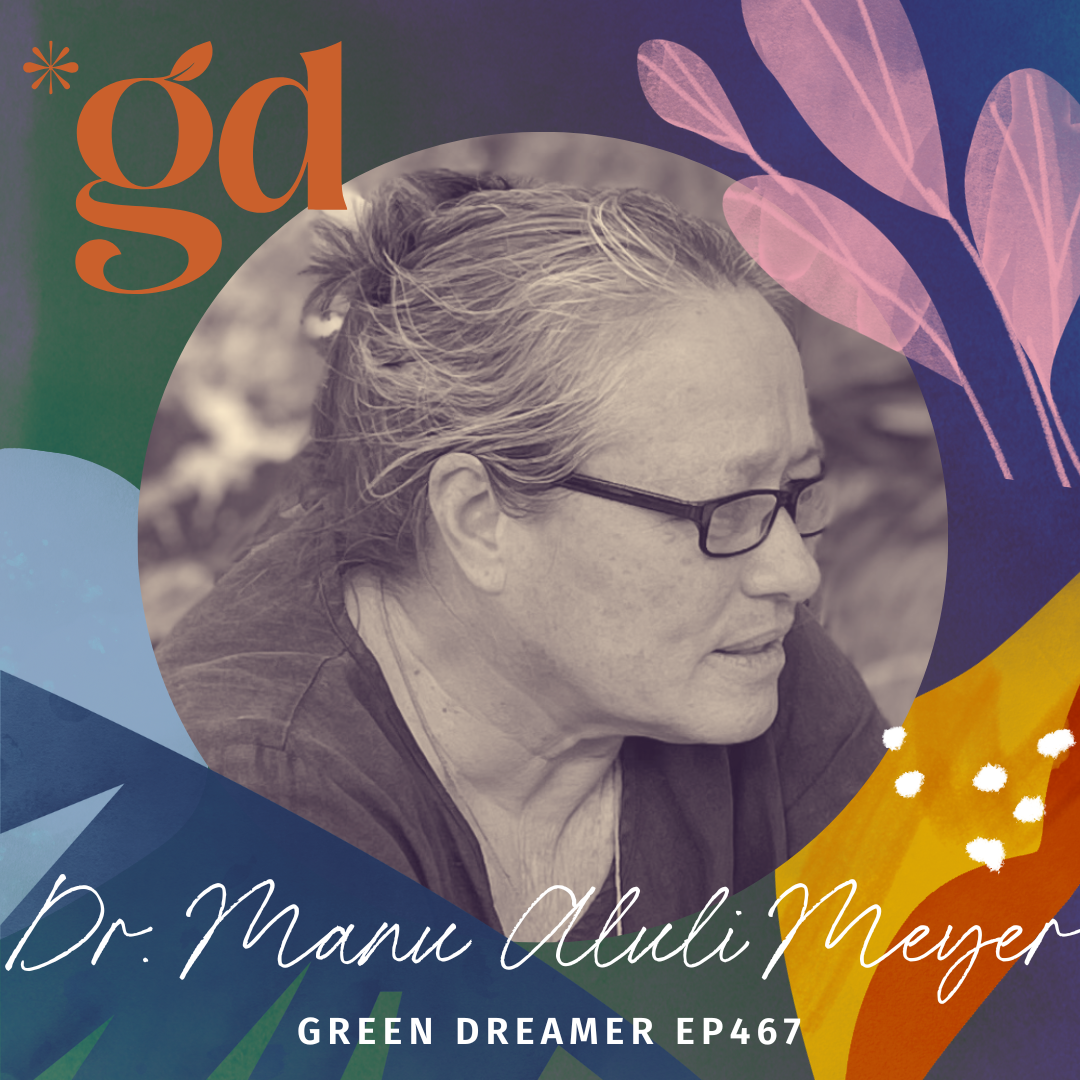
Manulani Aluli Meyer: Nurturing untaxable relationships of mutual sharing (Ep467)

“I’m a Hilo girl. Most of my work, even on Oahu, is exchanged without money. It’s not like we only do it ten percent of our day. We do it all the time. There’s a hidden billion dollar industry here that will never get taxed and that is through our sharing.”
Why have the majority of coconut trees across the Hawaiian islands not been allowed to bring coconut fruit into maturity? What does it mean to nurture communities of sharing and caring that are more relational, less transactional, and therefore less taxable? And how do Hawaiian ways of knowing — situating the intellectual and sensorial in the biocultural — fundamentally differ from Western epistemologies?
In this conversation, Green Dreamer’s kaméa chayne is joined by Dr. Manulani Aluli Meyer (Manu), the author of Hoʻopono: Mutual emergence, and co-director of NiU Now!, a community cultural agroforestry movement emerging to affirm the importance of niu (coconut) and uluniu (coconut groves).
Tune in as we explore the biocultural significance of coconut groves in Native Hawaiian culture, how the ongoing work of revitalizing uluniu supports community food sovereignty in Hawaiʻi, and more.
We invite you to…
tune in and subscribe to Green Dreamer via any podcast app;
tap into our bonus extended and video version of this conversation on Patreon here;
and read highlights from these conversations via Kaméa’s newsletter here.
About our guest:
Dr. Manulani Aluli Meyer is the fifth daughter of Emma Aluli and Harry Meyer. Her work is in Indigenous epistemology and its role in world wide-awakening.
With Indrajit Gunasekara, Dr. Aluli Meyer co-leads the Puʻuhonua Society food sovereignty initiative NiU NOW!, a community cultural agroforestry movement emerging to affirm the importance of niu, coconut and uluniu, coconut groves. At the center of the movement is the re-establishment of a loving relationship with niu and the ancient knowledge practices of Hawai‘i’s coconut heritage as a “tree of life,” a complete food system.
Artistic credits:
Episode artwork: Holly Kaʻiakapu
Song feature: “E ʻOlu” by Pohai (ft. Pulama), via Ohana Records
Dive deeper:
Hoʻopono: Mutual Emergence, a book by Manulani Aluli Meyer
Check out NiU Now!, the community cultural agroforestry movement led by Dr. Manulani Aluli Meyer and Indrajit Gunasekara
Watch an excerpt of the documentary NiU Now and learn more about the film here
Learn more about the fight to protect ulu niu coconut trees
Listen to the song, “ʻO Makalapua”
Learn more about educator and philosopher Paolo Freire
Discover the Pohaku Pelemaka organization
Learn more about the Kaulunani urban forestry movement led by Heather McMillen
Read about Jesse Mikasobe-Keali‘inohomoku and Hawai’ian food sovereignty
Irreducible: Consciousness, Life, Computers, and Human Nature, a book by Federico Faggin
Check out the bookshops Native Books and The Hawai’ian Force.
Expand your lenses:
Independent media is more important than ever! Please consider joining our Patreon or making a one-time donation today.
interview transcript
Transcript disclaimer: Please note that Green Dreamer’s interviews are minimally edited, and our transcripts do not have 100% verbatim nor spelling accuracy. All statements should be understood as commentary based on publicly available information, and the views expressed in this interview are those of the guest and host only and do not necessarily reflect the views of Green Dreamer.
While we have made reasonable effort in our interview research and production process to ensure accuracy, we do not present our commentary as factual assertion and we are unable to guarantee the completeness or correctness of every piece of information shared. As such, we invite you to view our publications as references and starting points to dive more deeply into each topic and thread explored. Thank you for adventuring with us ~
Manulani Aluli Meyer: Aloha mai kakou pau e kuu mau hoa. My name is Manulani Aluli Meyer. And my ʻohana hails from the island of Maui, the island of Moku o Keawe in Hilo ʻOne, in Hilo Pāleku, and my current ʻohana came from Mokapu and Kailua on this island of Oʻahu. And now I live in Palehua, up Mauka, in the hinterlands. And I have a twin sister. My ʻohana is a large ʻohana dedicated to ʻike Kūpuna and all sorts of practices of Hawaiʻi to help nurture and develop our cultural practices and our healing processes. So it's a joy and honor to be here.
Kaméa Chayne: Thank you so much for this introduction. So NiU Now! is one of your major focuses right now, and niu is coconut in the Hawaiian language. And something that a lot of people may not have consciously thought about or really taken time to notice is that a lot of kumu niu or coconut trees in Hawaiʻi don't have fruit on them. So can you share about how this sort of liability mindset started taking over and what its impact has been? And are there actually any legal mandates by the occupying state for people to cut down the fruit before they have a chance to mature?
Manulani Aluli Meyer: Well you know the cosmological difference between our American colonizers and Hawaiian thinking is really perfect in this discussion with coconuts. The niu started being a liability years ago because Americans don't understand coconuts. And every Hawaiian knows you don't sit under a coconut tree, as the malo’o, the brown nut, does fall, but we usually grab the nuts before it gets to that level, although you can still eat the malo'o phase of the coconut. So the difference between ornamental liability and the tree of life is the difference between Indigenous knowledge and capitalistic knowledge or love of land and fear. So it's a perfect, perfect example. So that's why we're dedicated in planting coconut groves called ulu niu around Hawai’i. And we have a good teacher from Southern Sri Lanka. His name is Indrajit Gunasekara. And you have to have a good teacher to teach us the things that we are longing to know around coconuts.
Kaméa Chayne: It's been really inspiring to learn about everything and this movement that you guys are leading. And I guess I'm curious what percentage, or do we have an idea of what proportion of coconut trees across Hawai'i could be potential food source, but have not been allowed to complete their cycles of fruition?
Dr. Manu Aluli Meyer: Almost all of them, except Molokaʻi. But we need to have a different relationship with this food source. And so we need to encourage ourselves to develop that relationship. And that takes time. And we don't want coconuts in Waikīkī. That's not what I'm into. We to have a relationship again with coconuts so that we're not fearing coconuts. And that takes time. But we're on all islands. Kauaʻi just contacted us yesterday, Haena. But we're in Puna, in Kaʻakepa, in the ulu niu of Kaʻakepa, on Molokaʻi, Maui, Kukaniloko, and we've got about 25 ulu niu, or coconut groves, we've begun with the help of many others, truly many others.
Kaméa Chayne: Really beautiful. And for me, the logic of the liability mindset is kind of like, well, trees can fall. Trees have fallen and injured, you know, a very small number of people. And therefore, because they can fall, let's cut down all the trees. Or like forest fires can happen in forests, so let's just take down all the forests. So I think, I don't know. The logic to me just does not make sense, especially given the context that food sovereignty, food security is such an important issue in the islands. And so given that they produce such wonderful sources of nutrition and food to people. It really does not make sense.
Manulani Aluli Meyer: It doesn't at all. In Sri Lanka they build places to sit, but further out of the tree so that people aren't afraid of them. So one culture, we need to have a relationship again with our niu. And that takes education. Because it's medicine, it's milk, it's vinegar, it's sugar, it's water, it's weaving, it's building material. The coconut is an amazing, there's literally hundreds of things you can do with a kumu niu coconut tree.
Kaméa Chayne: Yeah, it's a powerful remembrance to have. So in addition to kumu niu and coconut trees not being allowed to fruit into maturity I know that some of the ali'i or Royal New Groves or kupuna groves have been kind of dying back as well. So what are some of the main culprits and reasons behind their degradation?
Manulani Aluli Meyer: Well, you know, it’s old age. We just didn’t know that coconuts have a lifespan. You know what I mean? Coconuts don’t stay for hundreds of years. They’ve got about a hundred to a hundred-and-fifty-year lifespan. Then they die. So the constant rejuvenation of our ulu niu aliʻi groves is the mark of good leadership and of a beloved ali'i. When you plant a grove, an ulu niu, it’s basically that you’re dedicated to your people. You have an ʻōpualiʻi. You have a sign of good leadership, that you care for your people.
And so the planting of ulu niu, of coconut groves, was that spiritual connection with your lāhui. And so they are gone, because the last ones were really planted in the 1860s on Molokaʻi, Kapuaʻewa. And so they’re allowing us to enter, and we’ve already started. We’ve had our new nursery and put two hundred of those coconut seedlings, four varieties, into our community in different ulu niu on Molokaʻi. So we only go where we’re asked. And there are scores of coconut groves. Kaʻakepa is one of them in Puna. We’re going to the Haena grove on Kauaʻi. We only go where we’re asked. It’s kind of a Hawaiian thing. We don’t mahaʻoi around. We don’t go and just tell people what to do. No, that’s not what we do. So being asked is part of the ritual of our own becoming, when we wait for the right time. Yeah.
Kaméa Chayne: Yeah. So I guess the issue isn't necessarily that these older groves are dying back because they also have a lifespan. But maybe more so that there was a period of time due to colonization when the continued cycles of regeneration and the seed collecting and the replanting wasn't really taking place as much, right?
Manulani Aluli Meyer: That’s right. That’s right. So we’re doing it. But first, we gotta learn what makes a good rejuvenated niu, and why do we put similar trees together, because there’s so much diversity. We see, we didn’t even know there was diversity in niu. You know what I mean? There’s so much diversity. Some niu are really long, so the pulu niu, the fibers we make rope out of. So we planted those. Some niu are so small, they’re like this small. We use them as instruments that we puʻu and poke maka holders around our necks.I mean, there are hundreds of varieties of niu. We have planted over fifty different varieties in different uluniu. People are beginning to know that after five or seven years, you begin to have coconuts growing on the niu. So they are being used.
Kaméa Chayne: Yeah. Were the hundreds of varieties brought over as canoe plants since the beginning or were there waves that were later brought in to diversify?
Manulani Aluli Meyer: Good question. Both. Absolutely both. Especially when like Laeʻa started bringing all the Pacific Island people. So the coconuts came in from many different ways, including floating. Coconuts can travel like a hundred days, hundred plus days on the ocean for thousands of miles. They basically came also when the Pacific Islanders came and to live in Laeʻa. We got many different varieties then. I was told in the sixties that plenty of Samoan coconuts were brought in the planes. People would just carry them. It must have been quite a sight to have all these different kinds of coconuts. Because the coconut you can actually, when it's brown on the ground, we call that malo'o or oka'a, depending. And you can shake it. And if it's got water in it, you can still eat it. And if you can shake that coconut will have water in that niu for like a year and a year and a half. How's that? On the ground. So that's food security for everybody. So that just changed my life when I found that out.
Kaméa Chayne: Yeah. I mean, we're constantly trying to think of ways like how do we preserve harvests when there is an abundance? And it's incredible that they learn how to do it on their own.
I know one of the biggest threats to the health of the new tree right now is the coconut rhinoceros beetle. So for people who've never heard of this, like how did it get introduced, and what is the state of this threat to the tree right now?
Manulani Aluli Meyer: I think it came around twelve years ago, the military brought it in accidentally from places like Guam. What's happening is that the science of taking care of this issue is not really working. So for instance, the pheromone traps the CRB, the coconut rhinoceros beetle actually doesn't trap them. And so they're just doing data points on how many. But they're calling them out to these secluded places like we have here in Kapolei. And so take your pheromone traps down if the state tries to place them around you. So we just want the state to understand the severity of this issue. We don't want to get depressed with the severity of this issue, which we were years ago, but we had to decide on life, not death.
So we have netting, we have ways to keep our lands clean so that, go through your mulch pile every three months because It takes about six months, I believe, for the larvae to grow. So every three, five months, go in your mulch pile. A year ago we found 200 coconut rhinoceros beetle larvae. Yeah.
It's going to really help each other to keep each other's farms knowledgeable about this so that we're not fainting and not depressed over this. It's just another process of this ignorance. And not to inoculate your trees. Everyone will do it differently, but I choose not to inoculate, put poison into our trees. Because it's poison. The inferences, it kills the bees, it kills the soil. I mean like why would you want to do that? So there is just a different philosophy on what people are doing.
Kaméa Chayne: Yeah. I was gonna ask about like the most effective practices being implemented. So it sounds like a combination of just trying to plant as much as possible and also the physical barriers I saw in the documentary as well, like the netting and being mindful of mulch piles. Are people also putting chickens into the mulch piles to help?
Manulani Aluli Meyer: Yeah, chickens are a good idea, but they're big. Those people are big. You know what I mean?
Kaméa Chayne: And for people who are not so familiar, what's at stake is that the coconut rhinoceros beetle can kill the entire trees, right? So, this tree that could have produced fruit and food and resources for decades, it can kill like a mature, otherwise healthy tree.
Manulani Aluli Meyer: Yep, it can. And even if you see the cut the signs of the of the coconut rhinoceros beetle it's like the leaves get cut because they eat the center. So if the new leaves coming out of the tree look like they're ready for a lūʻau because they've got it looks cut, beautifully cut. It's really weird. They can survive if you catch them going out and you put a net. And a tree still can survive if it's being attacked by the bug.
// musical intermission //
Kaméa Chayne: I want to bring in this comment that you shared. Quote, “There's a cycle of planting and giving it away. When you do things in cycles, you're not rushing things. You're behaving like natural systems. Things of quality have no fear of time.” End quote.
I think with all of this in mind, I'm wondering what this mentality can teach us in the face of like seemingly urgent crises, like the quickly spreading beetle or other invasive plants that seem to demand a kind of urgent solution. So what does it mean to stay rooted in Indigenous knowledge and ancestral ways of being and practice for like more recently introduced problems that come with a deep sense of urgency?
Manulani Aluli Meyer: Well, we are experiencing the sixth extinction right now. And so, because Hawaii is surrounded by ocean our issue for me personally is DSM, deep sea mining. And it's all connected to the coconuts because once you objectify our natural world, it then can be extracted from, like it's nothing. And so the same thing with coconuts That people only do things if it's for money or they think their program only needs money. And NiU Now! basically does this without money. But I appreciate when people give us money because then we can fly to different islands and different things.
But the idea of cycles is an Indigenous understanding that things of quality really don't have a fear of time because it's going to come back again. It's going to return again. So what is our response? We're gonna do this regardless of the negative slant of CRB. We're gonna do this regardless of no money. We're gonna do this regardless of money. We're just gonna keep doing it. So the sense of continuity is a, I call it where the mo'o lives. It's where mo'o is our sense of succession. It's our idea of continuity. So we'll do this because we have a relationship with each other. And then with our ulu niu our coconut groves. For instance, we have our fifth year coming up at Kūkaniloko on November 1st. On November 1st, we have our annual Makahiki Mālama ʻUlu Niu at Kūkaniloko in Wahiawā, a special place. We've planted 116 niu there. No, a hundred and eight, sixteen varieties. And they're doing pretty well. They were hit with CRB a little while and we were able to replant some of them. But we're in our fifth year now, so they're ready to almost produce coconuts. And this is in Wahiawā over here on Oʻahu.
Kaméa Chayne: Yeah, really exciting. There was a really beautiful part of the documentary where Indrajit shares about the difference between coconut groves and coconut plantations. So maybe that also reflects this like continuity mindset versus something that is more linear. So I wonder if you can share more about like the difference between plantations versus groves.
Manulani Aluli Meyer: Great, great question, Kaméa. The difference between an ulu niu, which is a coconut grove, and the difference between a coconut plantation is the difference between money and freedom. You know what I mean? Nurturing and profit. So we're trying to stay steady by planting the grove idea in people's minds, because everybody sees coconuts and they just go, money, money, money, money, money. And I don't blame anybody for that because we are living in a capitalistically driven economy. And once we start to diversify that, then people will get the idea that you can actually eat your own food, drink your own wainiu. So we have to develop that in concert with the coconut grove.
So the coconut grove is an organic system of regenerative, sustainable food security, and the coconut plantation is about money. And money is about uniformity, which is an interesting phenomenon. So groves are about diversity and function, and plantations are about uniformity and money. So one kind of helps the other get clearer.
So as AI helps us understand that our work should be more meaningful. And as they tick away jobs, I say let's do more meaningful things. I'm not afraid of 60, 70% of our jobs being taken. No one's gonna kick us all out of our homes, but we do have to be more creative about our work. So yay, come on now. Who wants to learn about planting ulu niu? Coconut grows. Yeah.
Kaméa Chayne: And there's a lot that can't be replaced, like meaning and relationship and purpose and community. And I feel like that's a lot of the calling of right now is returning to those things and rerooting ourselves.
Manulani Aluli Meyer: Consciousness and meaning and purpose, computers can never have. So we are the conscious ones. And that's what I'm learning about the purpose of AI is our own evolution and our own awakening, which is kind of exciting for me. We're in an exciting time. And spiritual evolution accelerates with the engagement of contrast. That's from Christopher Bache. And we're in a time of contrast.
Kaméa Chayne: Yeah. When you talk about the groves compared to the plantations, I'm also thinking about how there's all this hype around coconut water, which, reasonably so, but most of what people find in stores, in like canned forms or in like the bottles, I'm presuming most of that comes from coconut plantations. A lot of them from like Thailand, Philippines, and so on.
So there's also just like, yes, coconut water is great, but like where is this coconut water coming from? And how was it grown?
Manulani Aluli Meyer: I have this question that which is they only say it's coconut water, but I have this question that fresh wai niu coconut water can last about two weeks in your refrigerator. So how can these cans last for months? When you taste fresh coconut milk The first time I tasted a fresh coconut milk that Indrajit made for me, put a little paʻakai, salt in it, I drank it and I just cried. It was there's no comparison with fresh coconut milk and canned coconut milk. Zero. There's no comparison.
Kaméa Chayne: Yeah. Sounds like soul food. Yeah. And spiritual food too. And I think that's also a big difference is with the grove mentality, there is this element of community. There's the element of spirituality like woven into all of that as well. But the plantation model, it's so devoid of those things because it's just treating the land like a machine.
Manulani Aluli Meyer: I don't mean to speak ill of the plantations because many lives depend on that. But here in Hawai’i, as they've asked Indrajit to join in the let's trade coconut export kind of thing, he has to say he's focusing on families and ‘uluniu coconut groves. So he's really clear. I'm really clear, but he's our practitioner. I'm the cheerleader of this. But we are dedicated to family food security and community food security. And so we're just growing coconut groves everywhere.
And coconut groves can be three, six, ten, you know, it doesn't have to be a two hundred. But some groves are hundreds and to thousands. Some groves are thousands of trees. It's really amazing.
Kaméa Chayne: You make this really powerful statement, which kind of encapsulates a lot of what we're been talking what we've been talking about, but you say that “we don't have to exchange money for food.” And I was just really deeply moved by the part of the film where you slow down and you say, quote, “I forgive myself. I forgive myself for that ignorance. I forgive my family. I forgive all those who made food a purchased item, not an item that we grow. I forgive myself.” End quote.
I had goosebumps all over, as you expressed those feelings. And I'm just wondering especially for many people who grew up just going to the grocery store or going to restaurants to buy food and that's the only relationship that they've ever known with food, it might be hard to really understand what you mean by this idea that we don't have to exchange money for food. So what would you like to elaborate on this just different way of relating to food and to community life?
Manulani Aluli Meyer: Thank you for this question, Kaméa. I forgive myself for the self-sustaining thought that money is the only thing that can be exchanged, but we lived within a subsistence and a sharing economy. So sharing, doing something for a farmer and he gives me his kalo. You know, it's not even bartering, it's sharing. So we're not even clear about how we can deconstruct capitalism so we can reconstruct a different economy. We don't even have the ABCs of how to do that. So we can start small by just giving people things.
And so I give my time for talks and people still keep paying me. It's a really amazing thing. But almost all my talks are free and it's not like I charge people every fifteen minutes like lawyers do, because they have to. That's what their job is. But just to keep the idea that we do not have to, it's not about money. We just think it is. And so I forgive myself for thinking that money was the only thing that I had to exchange. And it just takes creativity and collective effort, and then the ability to have friends and family who are dedicated to growing things, growing fish, exchanging things like time for babysitting, you name it. It's just possible we can do this differently, but we don't know how. But you know that there's a living vibrant sharing economy in Puna. I'm a Hilo girl. You know, most of my work here, even on Oʻahu, is Manuahi exchanged without money. So it's not like it's we only do it, you know, ten percent of our day. We do it all the time. There's a hidden billion dollar industry here that will never get taxed and that is through our sharing.
Kaméa Chayne: Yeah. I think that definitely is a big underlying theme and question is like how do we continue to make our lives less transactional and more relational? And I think when things become more relational our lives become less taxable too because they're not capturable in these sort of monetized and quantifiable forms.
Manulani Aluli Meyer: It's coming. It's coming. It's coming. We can even use that little plastic card. You ever you use your credit card and you just go, wow, this is such an illusion of money. Such an illusion. And so maybe we can just say this I just did twenty hours for my auntie next door, you know, taking care of her cat and so gives she me 20 hours of that. You know what I mean? We could just keep doing stuff for other people and then it's in this little card. We just have to agree to a different system. We haven't even known that that's possible. So I forgive myself for my self-sustaining ignorance in this situation.
// musical intermission //
Kaméa Chayne: And a lot of this also comes back to remembering different worldviews. So I want to weave in a little bit from your latest book, which is Ho‘opono: Mutual Emergence. Obviously we can't cover the whole book in this conversation, but I want to invite you to start by introducing what you mean by cultural empiricism as a way of knowing because I know that you've had somebody else critique your ideas of cultural empiricism as being anti-intellectual. And so yeah, I'd be curious to have you introduced this idea and what did that perspective of a critique tell you about how Hawai’ian ways of sensing and knowing just differ so deeply from more dominant Western ways of knowing.
Manulani Aluli Meyer: That's the genesis of why I became an epistemologist is I was at Harvard and this professor, philosophy professor called my ideas of teaching, she said well how how would you teach a class in oceanography? I’d teach it through Western systems of littoral currents, wave refraction and reflection. But I’d also teach it through culture. This is our word for kahakai, kai aheahe, ke poʻi kai, kai heʻe nalu, kai uliuli, kai moana. There's different names of the striations. And there's different names of the moon phases that affect the currents. Oh, there's different names of currents that tell you something. So I teach you through that. And then she said, well then you're an anti-intellectual.
So that put me on my path because, truthfully, we are anti-intellectual but because we believe that intelligence is beyond mundane empirical. Empiricism is the belief that our knowledge only comes from our five senses. And that's taste, touch smell, sight, and hearing. So does all of your knowledge come from only those five senses? Yes or no? The answers for kanakas are completely no. A lot of my stuff comes from dreams. from a different sense, sensory perception.
So my senses have been culturally shaped. So when "O Makalapua" comes on, for instance, all my kupuna start crying. It's a song about a queen. So growing up in the sixties, seeing all these eighty year old women that were alive when the queen was alive, they were sobbing because "O Makalapua" is a famous song. I mean, like so I hear I see my emotions are affected by the song. That is a cultural shaping of my hearing and seeing.
So cultural empiricism is a basic building block of knowledge. And once we get there, we're different. Oh my God. By islands, you know what I mean? Just islands. When you look out, you see blue, blue, blue, blue, blue, blue. I don't see oil rigs. I don't see high rises. I don't see pollution. So that has changed, geography shapes my knowing. So that is the basis of saying we are shaped uniquely. But so is the Iowa farmer. He's shaped very uniquely. I don't know what those green stocks are. Oh, that's corn, Manu.
So it's not like we're saying we're separate from you. It's like saying we're trying to fine-tune the qualities of how we differ so we can be stronger together. And you know that to me is basic that, yeah that we're different.
Kaméa Chayne: So it's kind of like we're only able to arrive even closer to truth when we acknowledge everyone's different lenses and how people are shaped differently. So we can calibrate them and then put them all together, and then really get to see everything more clearly.
Manulani Aluli Meyer: Exactly. Exactly.
Kaméa Chayne: Yeah. There's this beautiful quote you share: “We simply do not see or experience the ocean as lawaiʻa, as fishermen. Their senses are culturally shaped. And this is not something to intellectualize, it's something to practice. honor and recognize.” End quote. So I think that practice piece and the sensing piece really drills all of this home in terms of like we can't separate them like as these walled off institutions of education where we're like using our brains mostly, but then not learning like how this pieces together with the hands in the dirt and the bodies and the ocean and all of it.
Manulani Aluli Meyer: Nice. Well, you know, Mark Twain said it best, never let school interfere with your education. So we're just trying to talk about a wider sense of education besides walled-in school structures. And that's why the DOE schools and our schooling system has literally dumbed us down. And Derrida had said, one of the most respected philosophers in the world in the 70s, text is going to be the downfall of Western civilization. Isn't that amazing? Like wow, because you can't really discern what's truth unless you really know yourself. So that's what he was talking about. Consciousness, you can't really sense in text unless you know yourself. So this is why Hawaiian thinking, aia i loko nei, know yourself. So that when you read something or experience something, you can say, no, no, that might be true for you guys, but it's not true for me. You know?
Kaméa Chayne: Yeah. I also wonder, I think there was a portion where you critique the quote-unquote apolitical and quote-unquote a-cultural nature of education. So is this kind of what we've been talking about in terms of how we need to recognize that everything is cultural, everything is shaped and political in some way.
Manulani Aluli Meyer: Totally, totally it's only what I talk about. Yeah. Well you know, I think Western thinking confuses uniformity with universality. It starts with a U, has a N over there, but yeah, when they say universal, no, I hear uniform, uniformity. So universality, specificity leads to universality, not the other way around. So what happens is when you do ʻike kūpuna 'ike aina, the knowledge of our elders and the knowledge of land, you go deep, deep, deep, deep, deep, deep, deep. You know what happens? You bust out into universal principles. So it's not like we're so different that we can't see the essence of another and combine. We're just different because of our geography and because of our situation.
But oh my God, we all know what love feels like. We all know what wisdom accrues and what it does. So I'm not saying that we're so different that we can't relate, but we have to define those differences ourselves so we can help the world to evolve. That's what I'm…yeah.
Kaméa Chayne: And as we look ahead, these are challenging fractured times for a lot of people. I think a lot of people are struggling in terms of like how to process all the overwhelm of right now. And you say, “We don't want to blame America or capitalism, greed, uniformity. It's meant to grow us up so we can see where we can change, transform, and evolve. I believe rediscovering the coconut tree is a part of that, not fearing the tree of life, a food source.” End quote.
So as we look ahead, how would you like to elaborate on this kind of a reframe in looking at where we are, not necessarily holding this sort of blaming mindset so that we can better move forward?
Manulani Aluli Meyer: Well, you know the continuity lives in absorbing so that we evolve. And so conflict is a midwife of consciousness, one of my mentors said, Paolo Freire. And so conflict is a midwife of our own evolution of consciousness. So if we don't have conflict, we don't evolve. So instead of just having conflict, let's evolve. So that's my mindset. It's either love or fear. And so I want to live in the love category. And I really do. And aloha is the primal source. It's the e-ini of our evolution. It's the life of our evolution is when we learn how to love. And even love our perfect imperfection. That's why I love that song. You know what I mean? Because you know, there's a big line of our function and dysfunction, you know? So yeah.
Kaméa Chayne: Yeah. That calling really resonates with me as well. And I think there's also this emotional aspect. You say that seeing the state of the world today, also seeing the misunderstanding of different cultures and continuing to feel the historical and cultural trauma that Kānaka Maoli have gone through and are still going through to this day, are unbelievable. And you say that “It feels overwhelming right now. We're not fighters, we're farmers. We aloha aina practitioners.” Given everything, because I feel overwhelmed just learning about histories of different places and the ongoing trauma and suffering that different peoples and lands are still facing today. It feels like a lot. So I'm curious what your personal process has been for trying to transmute and alchemize all of these big emotions that are real and present and shared.
Manulani Aluli Meyer: You know, I have a twin, and she's very small and very papa. She's very dark. She looks like my mom. And I look like my father. He's from Belleville, Illinois So having that difference, that total conflict of difference, just wanting to pound her every single day of my childhood life, she has forgiven me. But I've had to figure out why I suffered so much. So, I'm a radical Buddhist in the non-religious sense, but in the practitioner sense, where you actually make images and, thank you calamity, for having a twin sister that is so unique because without her, I would not be who I am.
So we teach ourselves the root of my own suffering is my belief that I'm not aware. So unawareness is different besides desire. I like to translate dukkha. Dukkha is unawareness. And so my unawareness has caused my suffering. And this is 40 years of practice, these things. I am a practitioner. So give it on. Bring it on. Bring it on. You know what I mean? I really do believe I am not my body. So once you get to that frequency where you really get that we are spiritual energies having a physical experience. You just see the world differently.
Kaméa Chayne: And when you say unawareness, what is that unawareness to? Or is there even a way to put this into words?
Manulani Aluli Meyer: It's a good point. Yeah. No. We are born aware. This is why the Christ thinking is so fabulous. Because he says we're born sinners. You know, sin is an esoteric word for missing the mark. It doesn't mean it…it's just marksman's term. So we're born missing the mark of our true existence, which is like we're like light beings operating in this in this very dense world. So I am a student of light, and a student of things that are beyond culture. And so that's helped me to understand the trauma and the intergenerational heaviness, kaumaha we call it of our people. And I don't belittle any of it. I'm just saying I just have things to do.
And I say dissolve. When people say, how are you doing, but I say I'm dissolving. You know what I mean? Yeah, just dissolve. I'm just dissolving. And I used to ride motorcycles. I had three motorcycles. So if you ride motorcycles and we never wore helmets in those days. If you are riding a motorcycle, you know what I'm talking about. Because yeah, you're close to death at every single second, and you're still moving. It's a phenomenon. It really is. Yeah. So I love riding.
Kaméa Chayne: Yeah. Well, I've so appreciated hearing all your manaʻo and thoughts on everything we discussed today. And there's so many things I'd be curious to talk story with you about, but we do have to start winding down. So as we close off, I want to ask you what feels closest to heart to NiU Now!, right now. And what are the best ways that people can support, either near or afar, and to be able to learn more and to join the movement?
Manulani Aluli Meyer: Well, we certainly need people to be interested. We have monthly sessions here at UH West Oahu. But I want to give a shout out to Pōhaku Pelemaka and Leila Kealoha guys and Mikey to thank them for supporting Indrajit and the work. And Jesse and Kehau and Kekaula and all the work that they're doing in Puna at the ulu niu o kaʻakepa. And so they're developing the very first manual of how to take care of coconut groves. And so I want to thank Puna for inviting NiU Now! in and for inviting the Kaulunani urban forestry movement that Heather McMillen is leading. I just really want to thank everybody for believing that we can do this differently. And I really do, including you, Kaméa, including you.
Kaméa Chayne: What's been one of the most impactful books you've read lately or publications you follow?
Manulani Aluli Meyer: Irreducible by Federico Faggin. Get that book, everybody. He's the guy who developed the microchip and now he's really clarifying that we are conscious and AI will never be conscious. Federico Faggin, Irreducible.
Kaméa Chayne: What is a motto, mantra, or practice you engage with to stay grounded?
Manulani Aluli Meyer: ʻUloʻā e Kevelina Akeeloha. That is, loving is the practice of an awake mind.
Kaméa Chayne: And what is one of your greatest sources of inspiration at the moment?
Manu Aluli Meyer: At the moment? My greatest source of inspiration is my partner, my wife, is turning 70 on Sunday. Oh, so just aging gracefully with her has been very important, but just aging gracefully after 20 years of marriage.
Kaméa Chayne: Yeah. Well, I wish you all a beautiful celebration around that. And Aunty Manu and Dr. Meyer, it's been just a huge honor to be in conversation with you. So thank you so much. Yeah, and as we close off, where can people go to further support your work? And what closing words of wisdom do you have for us as Green Dreamers?
Manu Aluli Meyer: Green Dreamers, hahai no ka ua i ka ulu lāʻau. Plant a forest and the rains will follow, but it also means share purpose with others and transform the world. And you can find my work by just ordering the book at Native Books Hawaii. And that's called Hoʻopono. And Native Books is my sister's shop in Chinatown.
In Hilo, you can also find the book at my best friend's place, the Hawaiian Force at Luana's shop on Front Street, Hilo. Mahalo nui, Kaméa, mahalo nunui no keia ai ʻike nahenahe. Thank you for this time. And thank you for your brilliant questions. And your understanding of Hoʻopono and the things in that book. So thank you. There's much to do, and there's much more to forgive.